
At a time when children are increasingly indoors – absorbed by screens, separated from the street and distanced from the spontaneous rituals of neighborhood play – a new exhibition by the Banco de la República has launched at the Museo de Arte Miguel Urrutia (MAMU), and one that asks a deceptively simple question: what happened to playing outside with friends?
Having opened on April 23 at El Parqueadero and second floor of MAMU, Francis Alÿs, juegxs de niñxs 1999–2025 brings together 27 video works from the Belgian-born, Mexico-based artist’s celebrated long-running series documenting children’s games across the world.
Curated by Cuauhtémoc Medina and Virginia Roy, the exhibition proposes something more than nostalgia. It invites viewers to see play as a form of social architecture – a place where children create rules, resolve disputes and build entire worlds from whatever their environment offers.
Games, the curators suggest, are “social laboratories in miniature.”
For more than two decades, Francis Alÿs has traveled across cities, villages and conflict zones filming children at play. What began in 1999 evolved into an audiovisual archive spanning more than 50 short films across five continents, 27 of which are included in the Bogotá exhibition.
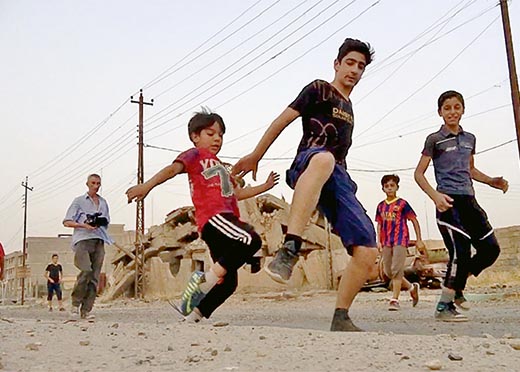
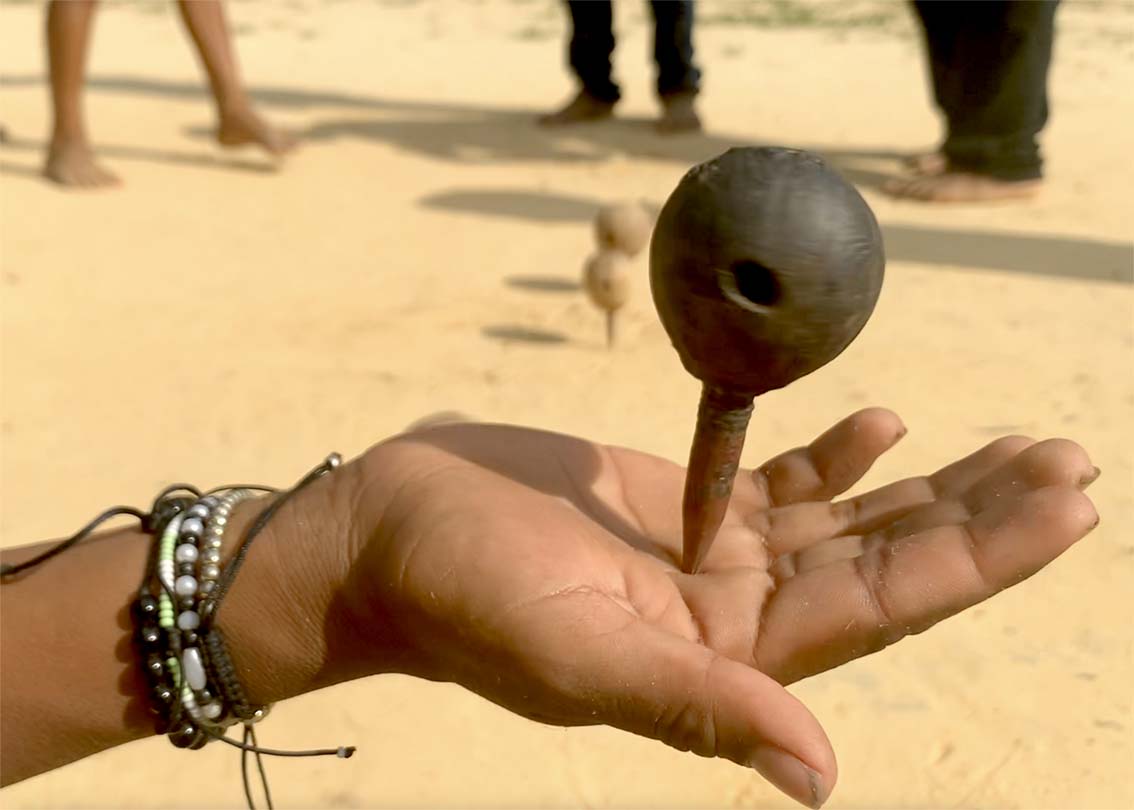
Children jump across hopscotch grids in Afghanistan, toss bones in India, spin tops in Mexico and invent rhythmic contests in narrow urban streets. One of the featured Colombian works, Trompos de semilla, Arara, Colombia, 2025, was filmed in the Amazon with support from Banco de la República’s Cultural Center in Leticia, capturing children in the Arara community playing with spinning tops made from seeds.
The games are simple, but the implications are not.
On the screen there are adults directing the action, no digital interfaces, no organized sports structures. Instead, children improvise with what is at hand – sticks, stones, crates, seeds, chalk, bottle caps – creating systems of cooperation and competition, rules and rebellion.
That act of invention lies at the center of Alÿs’s fascination.
![Francis Alÿs, Children’s Game #29: La roue [The Wheel], Lubumbashi, Democratic Republic of the Congo, 2021. Courtesy Photo: © Francis Alÿs](https://thecitypaperbogota.com/wp-content/uploads/2026/04/La_roue-2021-STILL-5-1-650x464.jpg)
Born in Belgium in 1959, Alÿs grew up with the image of Children’s Games (1560), the iconic painting by Pieter Bruegel the Elder depicting hundreds of children absorbed in play across a town square. According to the exhibition guide, the work became a lifelong reference point—an early visual map of how play reveals the structure of society itself.
Alÿs studied architecture at the Istituto Universitario di Architettura di Venezia before moving to Mexico in 1986 as part of an aid project to help install aqueducts in Oaxaca. He later settled in Mexico City’s historic center, where he developed the poetic and political language that would define his career.
His practice – spanning video, painting, installation and performance – often addresses borders, migration, urban fragility and the absurd mechanics of social order. Power dynamics, the commercialization of public space and the erosion of civic community remain central artistic preoccupations.
In Juegxs de niñxs those themes emerge quietly but powerfully.
Alÿs is not merely documenting childhood. He is observing how public life functions – and how children, often without adult mediation, rehearse the structures of society through play.
The exhibition reveals how games create temporary communities. They teach negotiation, competition, fairness and exclusion. They reflect both freedom and hierarchy. In some videos, the children play in ordinary neighborhoods filled with laughter and routine. In others, games unfold beside military checkpoints or in areas shaped by poverty, displacement and war.
Play persists, but never outside history.
The multi-screen installation at MAMU emphasizes these contrasts, showing both the universality of childhood and the inequalities that define it. Similar games appear across radically different geographies, suggesting what the curators describe as a kind of underground cosmopolitan culture of childhood – one that challenges the rigid identities of the adult world.
At the same time, the exhibition reflects on disappearance.
Traditional street games, some with roots stretching back to ancient Mesopotamia, are becoming less visible. Urban traffic has overtaken streets once used as playgrounds. Safety concerns have limited unsupervised outdoor play. Screens and digital entertainment increasingly dominate leisure time. Public space itself has become more regulated, commercialized and less available for improvisation.
Alÿs’s work does not romanticize the past, but it does capture transient moments of celebration.
What looks ordinary today – a spinning top, a hopscotch square, a game played with stones – may one day become a contemporary hieroglyph, evidence of how communities once formed themselves in public space.
As curator Cuauhtémoc Medina notes, games are not eternal. Their disappearance may signal something larger about the transformation of humanity itself.
If all the world’s a street, Alÿs has chosen not to place these collaborative works on the market, underscoring their documentary and communal nature. For the multi-medium storyteller, games, like art, are not commodities, but shared records of our collective experience.
This Bogotá presentation marks the exhibition’s fifth international stop following showings in Mexico City, Antwerp, Guadalajara and Santiago de Chile. In 2024, Alÿs also presented the project at the Barbican Art Gallery under the title Ricochets, marking the first time his work was shown in the United Kingdom.
At MAMU, the museum becomes more than a gallery – it becomes a space to reconsider childhood, the city and the fragile public spaces where both are formed.
Museo de Arte Miguel Urrutia. Calle 11 No.4-21.
Admission is Free.