
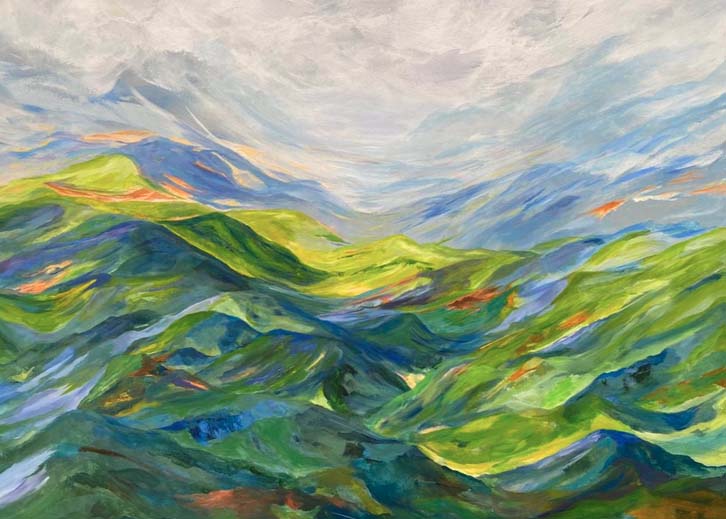
In Bogotá, the mountains are never out of sight. They rise abruptly along the city’s eastern edge, forming a green wall that shapes the capital’s light, weather and sense of place. For Colombian artist Marina Sánchez, the ridges that surround the Colombian capital’s cardinal points are also more intimate: a constant presence, a point of orientation and, increasingly, a subject of quiet urgency.
Her latest exhibition, Panorámicas de la Sabana, runs from 5 to 29 March inside the colonial Museo del Chicó, where 26 acrylic-on-canvas works reinterpret the high-altitude plateau of the Sabana through a distinctly chromatic lens. Installed in the museum’s Salón Colonial, the show brings together landscape, memory and abstraction in a series that feels both personal and outward-looking.
Sánchez has long been recognized for her expressive use of colour but this body of work marks a measured shift. While her earlier practice leaned towards abstraction, here the forms are more legible—ridgelines, shifting skies, traces of vegetation – yet never fixed. Instead, they dissolve through layered pigments and gestural brushwork that privilege sensation over strict representation.
What distinguishes Sánchez’s approach becomes clear in the work itself. The Cerros are not rendered as stable topography but as shifting, atmospheric forms. Bands of diffusec green rise and fold into one another, interrupted by flashes of cobalt, ochre and lilac, while a dense, unsettled sky presses down with quiet intensity. The composition resists stillness. It moves – closer to inclement weather than landscape.
Rather than mapping terrain, Sánchez constructs it through colour. The mountains appear to breathe, their contours dissolving at the edges as if seen through mist or memory. There is no single vantage point; the eye travels across the canvas, tracing lines that feel at once familiar and unstable.
“I want to show the relevance of these giants that often go unnoticed,” Sánchez says. For Bogotá’s residents, the hills are omnipresent yet rarely examined beyond their silhouette. In her telling, they become active participants in the city’s identity – “guardians” that accompany an urban landscape marked by rapid, and at times impersonal, expansion.
The project began during the pandemic, when isolation altered both her routine and perspective. Working from home, Sánchez found herself drawn to the view outside her window: the slow fade of light across the mountains, the subtle shifts in colour at dusk.
“Being away from people – family, friends – I was left with the sky and the light of sunsets,” she says. “I wanted to replicate something I hadn’t fully appreciated and, in doing so, feel part of nature.”
Her visual language, however, is not shaped by Bogotá alone. Sánchez has exhibited in New York City and Milan – cities where she has also lived, and whose pace and structure have informed her approach to rhythm and composition. If Bogotá provides the grounding geography, New York and Milan introduce a contrasting sensibility: verticality, movement and a heightened awareness of structure.

These contrasting narratives – from urban to rural, isolation and engagement, are visible throughout Panorámicas de la Sabana. Linear gestures – suggestive of passing headlights or urban flow – cut across certain canvases, briefly suspending the stillness of the mountains. It is a restrained intervention but an effective one, hinting at the tension between expansion and preservation.
Colour, in Sánchez’s palette, is not decorative but foundational. Greens shift from luminous to dense; blues dissolve into shadow; entire forms recede into haze. The landscape is reassembled through pigment, hovering between recognition and abstraction.
She describes her work as “chromatic poetry”, a phrase that aligns with her broader intention: to create space for reflection. “I want to offer a moment of calm beyond the difficulties that surround us,” she says, “despite the inevitable conflicts, wars and inequalities.”
In Bogotá, that impulse carries particular weight. The Eastern Hills and peaks to the West are not only a visual constant but a fragile ecological system—central to water sources and biodiversity, yet increasingly under pressure from urban growth. Sánchez’s paintings do not argue this point directly; instead, they suggest it, allowing atmosphere and colour to carry meaning.
For the artist, colour remains essential. “It would be difficult for me to imagine the world in black and white,” she says. “Colour is vitality. It gives strength and solidity. It is pure magic.”
That conviction runs through the exhibition. The hills emerge not as backdrop but as presence—shifting, watchful and quietly insistent. In Sánchez’s hands, they ask to be seen again, and more carefully this time.
Panorámicas de la Sabana runs from 5 to 29 March at the Museo del Chicó (Carrera 9 No. 93-38, Bogotá). Admission is free.