
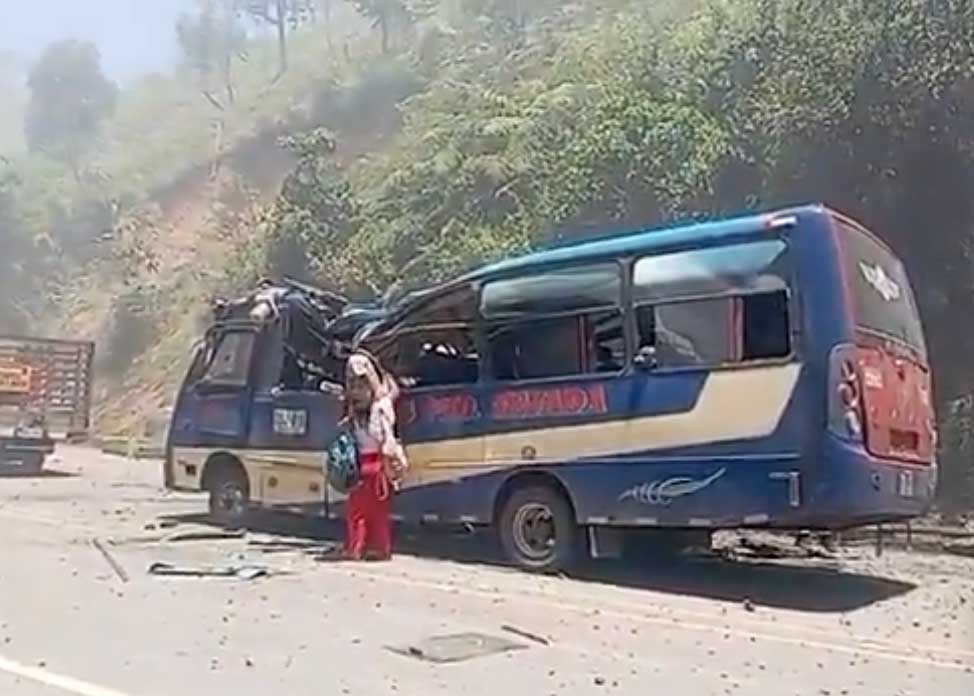
The United States has updated a “do not travel” warning for large parts of southwestern Colombia after a wave of terrorist attacks have left over 20 people dead, underscoring growing international concern over the country’s deteriorating security situation and prompting regional authorities to demand stronger support from the leftist government of President Gustavo Petro.
The U.S. Department of State maintained most of Colombia at Level 3 – “Reconsider Travel” – citing crime, terrorism, civil unrest, kidnapping and natural disasters, but reinforced its Level 4 advisory for several conflict-hit regions, including the departments of Arauca, Cauca, Valle del Cauca and Norte de Santander.
Under the latest guidance, Americans are advised not to travel to Cauca, excluding the departmental capital Popayán, and Valle del Cauca, excluding Cali, due to crime and terrorism.
Norte de Santander and Arauca remain under the same highest warning level, while travel within 10 kilometers of the Colombia-Venezuela border is also strongly discouraged because of kidnapping risks, armed conflict and the possibility of detention.
“Do not travel to these areas for any reason,” the State Department said in its advisory, adding that violent crime, armed robbery and murder remain common, while terrorist groups continue to operate in remote and rural zones.
The warning was reinforced by a U.S. Embassy security alert issued in Bogotá on April 27, following 26 separate attacks across southwestern Colombia during the weekend of April 25. The attacks targeted transportation corridors, military installations and police stations, with authorities confirming at least 20 deaths and dozens of injuries.
Police and military facilities are frequent targets of armed groups, and the State Department warned that attacks in Colombia have included car bombs, grenades, truck bombs, explosive devices placed on roads and buildings, and even drones carrying explosives.
Illegal armed groups, including dissident factions of the former Revolutionary Armed Forces of Colombia (FARC), narcotrafficking organizations and other insurgent groups, have expanded their territorial presence in recent years, particularly in remote areas where coca cultivation, illegal mining and strategic trafficking corridors overlap.
The deadliest recent attack occurred near the El Túnel sector in Cajibío, Cauca, along the Pan-American Highway, where an explosive device detonated against civilian vehicles, killing 20 civilians and injuring over 50 more. Authorities attributed the bombing to FARC dissidents under command of alias “Iván Mordisco”.
The attack shocked the country and intensified criticism of President Gustavo Petro’s “Total Peace” policy, which seeks negotiated settlements with illegal armed groups but has faced mounting scrutiny as violence worsens in several regions.
In response, the Cauca governor’s office declared three days of official mourning. Authorities described the bombing as an “atrocious and unjustifiable” act and ordered flags to be flown at half-mast across public institutions and schools as a tribute to the victims.
The government also called for national unity and a stronger institutional response to confront armed violence in one of Colombia’s most volatile departments.
In neighboring Valle del Cauca, Governor Dilian Francisca Toro said she respected the U.S. warning but urged foreign governments and the media not to define the entire region by recent attacks.
“We ask that our region not be stigmatized,” Toro said, insisting that Valle del Cauca remains open to visitors and that violence does not represent the department’s cultural, economic and social identity.
At the same time, she sharply criticized the national government’s security response after attacks in Cali and Palmira, calling for “real, sustained and effective support” through more troops, stronger intelligence operations and direct action against criminal structures operating in the region.
Following an explosion near the Agustín Codazzi Engineers Battalion in Palmira, Toro announced an investment of nearly 70 billion pesos ($17 million) to strengthen police communications infrastructure, expand surveillance camera networks and improve secure transport corridors across municipalities.
In Cali, Mayor Alejandro Eder said an attempted attack against the Pichincha Battalion involved explosive gas cylinders, one of which failed to detonate while another exploded inside a minibus.
Authorities activated a citywide security operation and Eder offered a reward of up to 50 million pesos for information leading to the capture of those responsible. “We cannot allow terrorism to regain ground in our city,” Eder said.