
At dawn in the central Colombian Andes, the evacuation-route signs that line the entrance to PNN Los Nevados National Natural Park feel less like bureaucratic requirements and more like reminders of a mountain that has shaped national memory. Winds cut across the high altitude wetland – páramo – at 4,800 meters, carrying temperatures that fall well below freezing even as sunrise paints the Central Cordillera in muted hues. Birdwatchers, hikers, and photographers gather at this altitude dressed in heavy jackets and scarves, preparing for a day in one of South America’s most dynamic volcanic landscapes; and one immortalized in the writings and sketches of Prussian explorer Alexander von Humboldt.
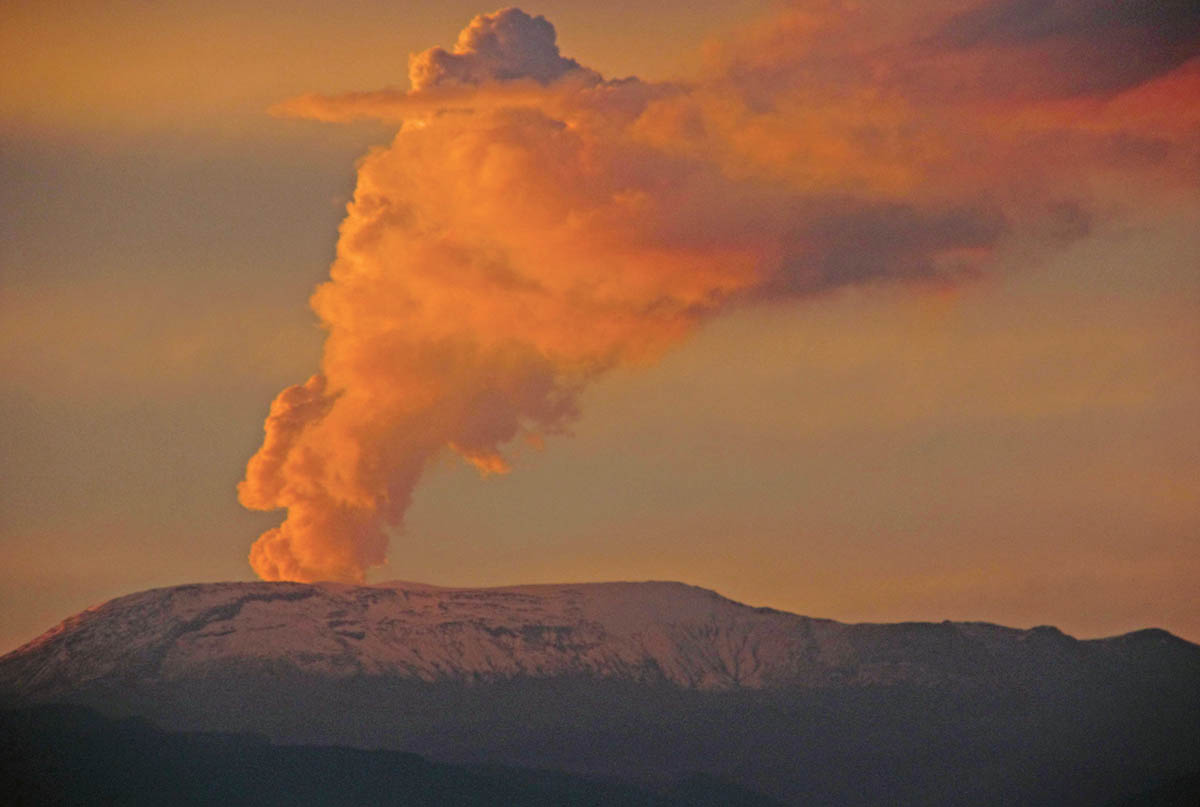
From the high ridges above Manizales, the Nevado del Ruiz dominates the horizon. Its summit – 5,320 meters above sea level – is visible from four departments on rare cloudless mornings. The volcano is part of the so-called Coffee Axis, yet its presence has long transcended geography. On November 13, 1985, a fast-moving lahar triggered by an eruption swept away the town of Armero, killing an estimated 25,000 people. It was South America’s deadliest volcanic disaster and remains one of the world’s most tragic reminders of the power stored beneath stratovolcanoes.
This year marks the 40th anniversary of that night, and as Colombia reflects on the events that reshaped entire communities, Nevado del Ruiz continues its cycle of rumbling, steaming, and releasing columns of ash. In May 2016, an eruption sent a 1,300-meter plume above the summit, forcing Manizales to halt airport operations and blanketing the city in gray dust. Today, the volcano remains under permanent surveillance by the national geological service, Ingeominas, and is currently classified at Orange Level 2, signaling heightened activity.
Yet despite the risks – or perhaps because of them – Nevado del Ruiz is increasingly part of Colombia’s growing landscape of volcano tourism, a global trend that draws travelers to active geological sites from Central America to Southeast Asia.
The motivations that draw visitors to Nevado del Ruiz mirror patterns seen worldwide. In Guatemala, adventurers ascend Acatenango to camp overnight and watch neighboring Fuego volcano send arcs of molten rock into the sky. In Indonesia, sunrise treks up Mount Bromo or the sulfur miner-carved trails of Ijen crater attract thousands each week. Iceland markets its recent Reykjanes eruptions as natural spectacles located within reach of Reykjavík, while Italy’s Stromboli has served as an open-air classroom for geologists for more than a century.
Colombia’s high-altitude volcanoes offer a different experience: a combination of equatorial glaciers, páramo ecosystems, and the lingering presence of memory and disaster. Nowhere is that blend more visible than at Las Brisas, one of the main access points to Nevado del Ruiz. Here, travelers from around the world gather with guides to begin treks through a rugged environment marked by black volcanic rock, fog, glacial melt, and steaming fumaroles.
Access to the higher altitudes is strictly regulated. A special permit from Parques Nacionales is required to approach within 200 meters of the summit. Trained guides lead visitors through zones where glacial ice turns to fast-flowing streams – waters that eventually sustain more than 40 communities downstream and provide habitat for mountain tapirs, pumas, spectacled bears, and the endemic Herveo plump toad.
The slopes are also home to over 20 specialized bird species, making the region a draw for ornithologists and eco-tourists who travel from as far as South Africa and Europe. On clear mornings, sudden breaks in the weather reveal the steaming crater. Most days, though, the summit remains hidden, enveloped by fast-moving clouds that erase its silhouette in minutes.
Many visitors descending from the high ridges stop at Termales del Ruiz, a mountainside hotel where thermal pools fed by natural springs offer a soft contrast to the austere landscape above. Surrounded by hummingbirds and feeders set among gardens, the site has become a favored rest point for hikers. The steam rising from the pools dissolves the harsh images of the volcano’s upper slopes- blistering winds, bare rock, and the ever-present reminders of seismic unrest.
Colombia sits along the Pacific Ring of Fire and is home to more than 15 notable volcanoes, several of which have shown activity in recent decades:
-
Machín, a low, grass-covered cone near Ibagué and Armenia, remains on yellow alert after new activity detected last month. Though dormant for millennia, its crater measures 2.4 kilometers wide.
-
Nevado del Huila, visible from Bogotá on rare clear days, hosts three peaks and has been steadily losing glacial mass. A significant eruption in 2008 led to evacuations and reinforced long-term monitoring protocols.
-
Cumbal, straddling the Colombia–Ecuador border, attracts “snow merchants” who still climb its slopes to harvest ancient ice. Its last major eruption in 1926 dusted Quito in ash.
-
Galeras, one of the country’s most active volcanoes, rises over Pasto. With a documented history of frequent eruptions dating back to the Spanish colonial period, it forced large-scale evacuations in 2010.
-
Sotará, near Popayán, has never erupted in recorded history but is classified as potentially active. Its irregular formation and three craters have made it a point of scientific interest.
As the anniversary of Armero approaches, guides and park officials continue to emphasize responsible visitation. Colombia’s geological services broadcast frequent bulletins, evacuation routes remain clearly marked, and local communities participate in regular preparedness drills. The past has left little room for complacency.
Around the world, similar discussions frame the ethics of volcano tourism. In Guatemala, concerns center on overcrowding on trails and limited emergency infrastructure. In Indonesia, authorities periodically close access when activity spikes, balancing safety with the economic importance of tourism for nearby villages. Iceland, meanwhile, has grappled with how to manage visitor surges during eruptions, prompting new restrictions and trail systems.
For Colombia, the challenge is to offer access to one of the Andes’ most dramatic natural environments while maintaining a collective memory of a tragedy that reshaped its social and geological consciousness.
The Nevado del Ruiz remains a symbol of Colombia’s turbulent relationship with its mountains: a source of water, biodiversity, and awe, but also a reminder of the vulnerability of human settlements built along volcanic chains. As travelers continue to arrive at Los Nevados National Park – seeking rare birds, stark vistas, or simply the thrill of standing near the edge of an active crater – the story of Armero echoes across the valleys below.
Forty years on, the volcano continues to steam, rumble, and remind. And Colombia, like many nations along the Ring of Fire, continues to navigate the delicate balance between wonder and respect for the forces that shape the Earth.