
If the mortals brewed it, then the gods consumed it. That, in theory, could sum up the relationship Latin American tribal leaders had with a bitter brew which, over time, became the stuff of legend and a strange concoction peddled on the streets of Bogotá.
The Colombian capital has its share of secrets, and chicha is one of them. It is not easy to find, especially one made from a time-tested recipe. Beyond the sweetness of the grain and the fermentation process, there is the popular folklore of a drink that predates the conquest and has been handed down from generation to generation, despite repeated attempts to relegate it to the scrap heap of liquid history.
In the back alleys leading to the stone plaza upon which Bogotá was founded, and near the Chorro de Quevedo fountain, several chicherías operate—a name given not only to chicha vendors, but also to the places where the drink is served.
Chicha was the ceremonial drink that intoxicated the indigenous peoples who inhabited the early settlement of Bacatá, which centuries later evolved into Santa Fé de Bogotá. Even the colonising Spaniards, celebrating feasts during their time in the Andes, would have fallen for chicha’s strange spirit.
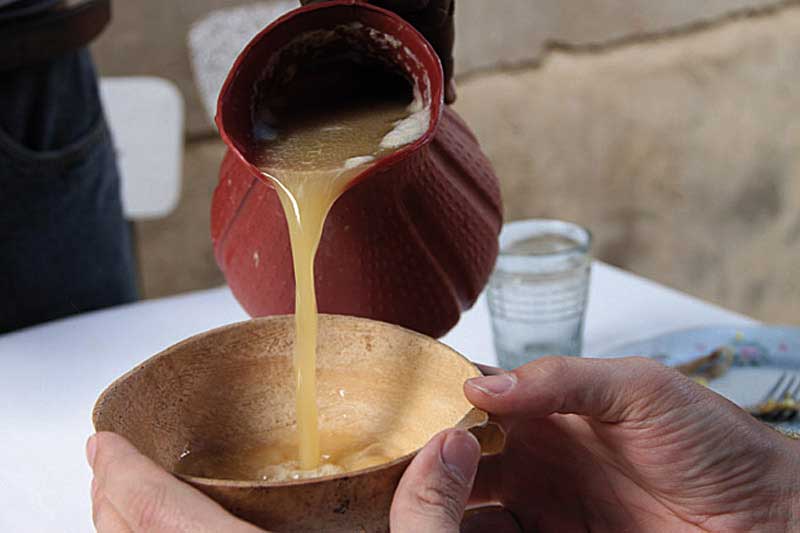
The craft of making chicha changed little over the years and always involved grinding maize into a sticky cake—usually between the teeth of women—with plenty of spit to initiate fermentation. The art of this ancient sweet beer included a clay pot for storing the ground corn, and the drink became standard-issue refreshment for farmers toiling in the fields.
Chicha became the national drink of the new Republic and held that position until unfortunate events nearly razed Bogotá to the ground, following the widespread rioting that erupted after the assassination of Liberal populist leader Jorge Eliécer Gaitán, shot as he stepped out of an office building in downtown Bogotá. For 40-year chicha drinker José Patiño, a sense of disillusionment is associated with the artisanal brew. “Chicha was banned when they assassinated Gaitán. The authorities blamed chicha for the violence of April 9, 1948.”
But even before the tragic events of the Bogotazo, big business was attempting to muscle in on chicha’s revered status. Bavaria Brewery, founded by German immigrant Leo S. Kopp in 1889, had, after half a century of operations, grown into a powerful company and a leading employer of working-class Bogotanos. The company began placing advertisements in the local press promoting beer as the superior brew of the moment—one that required neither spit nor the grinding of gums.
Bavaria was set on taking control of all fermented drinks and establishing a monopoly on maize. Chicha quickly became suspect, discredited in the media as the drink of the disenfranchised—vagrants and the smelly underbelly of Bogotá. Those who drank chicha were portrayed as more likely to fall into vice, commit crimes, and gamble away their money in a drunken stupor. The propaganda campaign worked. Chicha was deemed unhygienic and loathed by the whisky-drinking upper classes.
National issues began to take centre stage, including the expansion of health coverage and education for the poor. Colombia struggled with its democracy, eventually caving in as the two-party system allowed the military, under General Rojas Pinilla, to take control of the nation. Chicha was relegated to rural markets and banned in the capital. Indeed, everything that could be wrong with the underclasses was blamed on chicha. The brew became “an obstacle to progress.”
As far back as 1859, during the first Conservative government of the Granadine Confederation, President Mariano Ospina Rodríguez issued a decree stating that any substance capable of intoxicating the masses and of dubious origin had to be stopped. The statesman most likely had chicha on his mind.
Although chicha has not made a full comeback and will most likely remain in the shadows of other brews, a yearly festival in Bogotá celebrates—under controlled circumstances—the rituals and traditions of the Muisca drink. Since 1995, the Festival de la Chicha has educated Bogotanos about the many uses of this ancient maize, including its potential future in gastronomy. The 17th edition of the festival was held in May this year.
The festival draws crowds to La Perseverancia—fondly known as La Perse—a traditional working-class neighbourhood that gained notoriety during the Bogotazo as a flashpoint of Liberal resistance. Ten years ago, Juan Carrasco began rediscovering the roots of his barrio, which were closely linked to chicha production. “Proud to be ranked among the farmers,” Carrasco has kept the oral traditions surrounding chicha alive, along with the potency of a drink he still considers sacred.
Doña Lilia, the owner of a small store in La Perseverancia, describes how chicha is produced today. “You grind the maize on a stone and put it in a large pot with black panela (raw cane sugar). The mix is covered for 15 days, and boiling water is added. Over eight days, the concoction becomes a brew. Then it is ready to be served.”
Despite the often negative publicity surrounding chicha, many Bogotanos believe it to be an essential part of their cultural heritage—an artisanal drink which, thanks to the perseverance of one city barrio, may yet bring happiness to more than a few.