
During four years of Gustavo Petro’s presidential term, Colombians have witnessed the symbolic resurrection of flags and banners that many believe should be relegated to the country’s violent past. The president has brandished Simón Bolívar’s sword at political events, invoked images of the M-19 guerrilla movement of which he was once a member, and even appeared before supporters beneath a 19th Century red-and-black “Libertad o Muerte” flag to defend his legislative reform agenda.
Yet, as Colombia enters the decisive final ten days of a fiercely contested presidential run-off, the country’s courts have ruled that right-wing candidate Abelardo de la Espriella cannot wear the official jersey of the national football team at campaign events, nor can his movement invoke patriotic slogans or employ certain national symbols in political advertising.
The decisions arrive at an extraordinary moment. Colombians will return to the ballot box on June 21 to choose between two starkly different political projects represented by hard-leftist Iván Cepeda and conservative Abelardo de la Espriella. Less than a week earlier, on June 16, Colombia will face Uzbekistan as the FIFA World Cup 2026 gets underway in North America. Once again, football and politics are colliding in a country where both stir powerful emotions and competing visions of national identity.
The controversy surrounding the use of the national team’s yellow jersey began shortly after the first round of voting on May 31, in which De la Espriella secured 10.3 million votes, representing 43.7 percent of the electorate, while Cepeda obtained 9.6 million votes, or 40.9 percent.
On June 4, Bogotá’s 120th Municipal Criminal Court admitted a protection measure – tutela – ordering De la Espriella to refrain from using or displaying the official Colombian football jersey in campaign events, publicity materials, social media posts and communications with the media.
The court argued that the jersey and symbols associated with the national team should be reserved for “sporting contexts” and that, during a sensitive electoral period, “the state had a duty to protect the rights of a broader social collective”.
Cepeda had previously questioned the use of the jersey by his rival’s campaign, writing to the Colombian Football Federation to argue that the national team “belongs to all Colombians” and should not become a partisan emblem.
The issue escalated further this week when Bogotá’s Superior Tribunal ordered De la Espriella to withdraw political propaganda featuring national symbols, including the Colombian flag, coat of arms, and references to the Armed Forces under his campaign slogan, “Firmes por la Patria.”
The ruling, prompted by another tutela action, gave the campaign 24 hours to remove the material from its website, social media platforms and other forms of mass communication.
The Barranquilla-based criminal defense attorney responded by vowing to challenge the court’s decision through legal channels while openly encouraging supporters to continue using the symbols in question.
“Every cellphone, every national team jersey, every video saying ‘Firmes por la Patria’ is a cry for freedom,” he declared during a campaign rally in Cartagena. “The justice system will have to imprison half the country.”
His VP running mate, former Finance Minister José Manuel Restrepo, framed the issue as one of individual liberties.
“I will wear this jersey whenever I want, wherever I want and as many times as I want,” Restrepo wrote on social media. “The free development of personality and individual freedoms are fundamental principles of our democracy.”
For supporters of the judicial decisions, however, the issue is not freedom of expression but the monopolization of symbols that should unite Colombians regardless of ideology.
“The national team belongs to everyone,” Cepeda argued while receiving the endorsement of supporters’ groups linked to professional football clubs. “We cannot allow anyone to steal it and claim that it exclusively represents their ideals.”
The dispute raises difficult constitutional questions.
Can the state determine how citizens express patriotism during an election campaign? At what point does the regulation of political messaging become an infringement upon freedom of expression? Should national symbols be treated differently from other forms of political speech?
Perhaps most significantly, critics have pointed to what they view as an inconsistency in the application of these principles.
If the Executive has been permitted to invoke Simon Bolívar’s sword, protect cultural “relics” such as the sombrero of the M-19’s commander Carlos Pizarro, should ordinary citizens face judicial restrictions for wearing the jersey of the national football team?
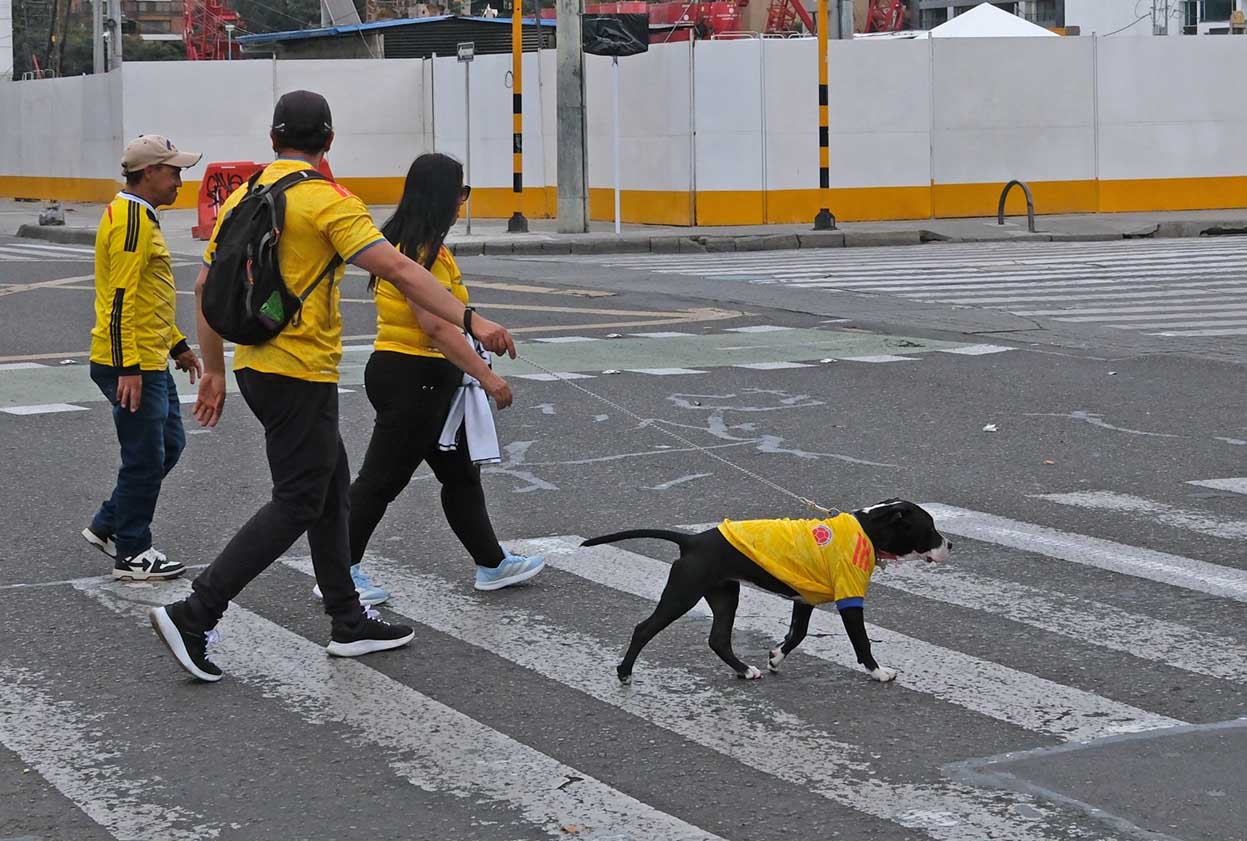
The timing only intensifies the debate. Presidential elections in Colombia have frequently coincided with football’s greatest tournaments. Politicians across the ideological spectrum have sought to harness the emotional power of the yellow jersey, a garment that has become one of the country’s most potent expressions of shared identity.
De la Espriella’s use of the national team jersey constitutes not only strategic political branding but it has also caught the Cepeda camp unprepared to deal with the mass outpouring of patriotic sentiment.
As the World Cup begins and millions of Colombians prepare to cheer for their national team before returning to the polls days later, the yellow jersey has become something few could have anticipated: the latest battleground in Colombia’s struggle over identity, democracy and the boundaries of liberty.
The real question may not be whether a presidential candidate should wear Colombia’s tri-colours. It may be whether the court’s ruling may prompt many more citizens to do so, especially on voting day.