
In the gilded stillness of one of Bogotá’s most striking colonial spaces, a new exhibition is quietly unsettling centuries-old certainties. Entonces llamó a un arcángel, the latest show by Colombian artist David Felipe Escobar, opens this week at the Museo Santa Clara, inviting visitors into a dialogue between baroque religious iconography and contemporary queer identities.
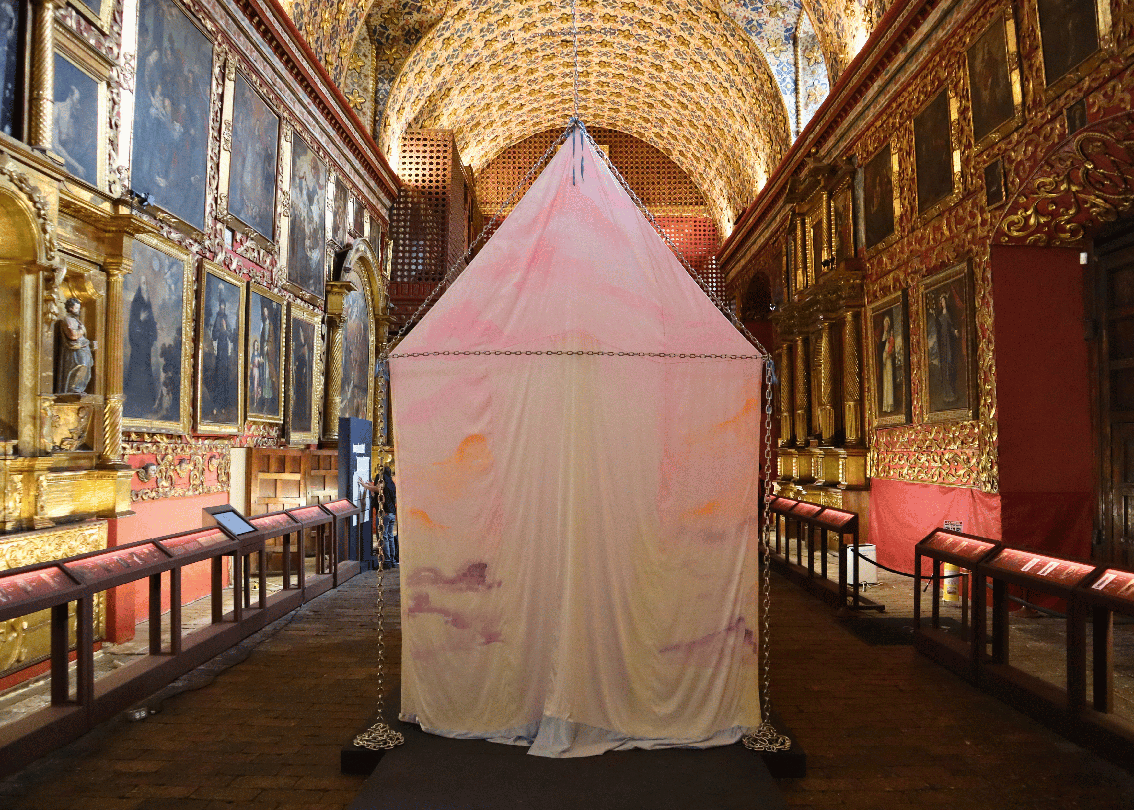
The exhibition, which opens on April 9 and runs until June 28, unfolds within the former church of the Real Convento de Santa Clara, a desacralised 17th-century site renowned for its lavish altar pieces and paintings of angels and archangels. Rather than treating these works as static relics, Escobar reactivates them—drawing them into conversation with bodies and identities historically excluded from the narratives they once upheld.
Taking its title from a verse by Saint John of the Cross, the exhibition imagines a meeting point between celestial beings and “queer, disobedient bodies” that exist beyond traditional gender norms. The result is not a confrontation with religious imagery, but a reframing of it—one that suggests ambiguity and fluidity were always present within baroque visual culture.
Indeed, Escobar’s premise rests on a subtle but powerful observation: that angels, often depicted as androgynous figures suspended between heaven and earth, already occupy a space of indeterminacy. By foregrounding this ambiguity, the exhibition reveals latent connections between colonial representations and contemporary non-binary identities, without imposing anachronistic readings onto the past.
The show is organised into two thematic sections. The first, centred on fluid identities in dislocated spaces, physically reshapes the museum environment. Selected paintings of archangels are removed from their traditional placements, disrupting long-standing visual hierarchies within the former temple. This curatorial gesture invites a more intimate engagement with the works, while questioning notions of permanence—both in museography and in gender constructs.
The second section, Una nueva Iglesia, shifts from disruption to speculation. Here, Escobar assembles apocryphal figures alongside materials such as chains and silks, constructing a symbolic space where alternative forms of belief can coexist. It is an imagined sacred realm—one that embraces multiplicity and offers refuge to identities historically marginalised by institutional religion.
Together, these interventions transform the Museo Santa Clara into a site of active reinterpretation. The building itself, once a place of rigid spiritual authority, becomes a stage for reconsidering how the sacred has been represented, contested and lived. In this sense, the exhibition does not position itself in opposition to religion, but rather proposes a space of encounter—where past and present converge to open new possibilities for understanding spirituality.
Born in Bogotá in 1992, Escobar’s practice spans visual art and writing, often exploring the intersections of violence, desire and the divine. A graduate of Parsons School of Design and Hunter College, he has participated in international residencies across Latin America. His literary work includes the novel Soap Bubble (2024) and the poetry collection 7 Iridescent Prayers (2026), further extending his exploration of spiritual and corporeal themes.
As Bogotá’s cultural calendar continues to foreground conversations around memory, identity and inclusion, Entonces llamó a un arcángel stands out for its quiet radicalism—suggesting that even within the most traditional of spaces, new meanings can still emerge.
The exhibition runs from April 9 to June 28, 2026, Tuesday to Sunday, 9:00 a.m. to 4:30 p.m., with a programme of guided tours, workshops and public discussions designed to deepen reflection on the relationships between body, spirituality and diversity. Admission is free.