
Eight kilometres beyond the whitewashed streets and polished boutiques of Villa de Leyva, the traffic fades into birdsong and the landscape begins to exhale. The road winds through vineyards, olive groves, patchwork fields and ochre hills before arriving at one of Colombia’s most quietly extraordinary places: the Monastery of Santo Ecce Homo in Sutamarchán.
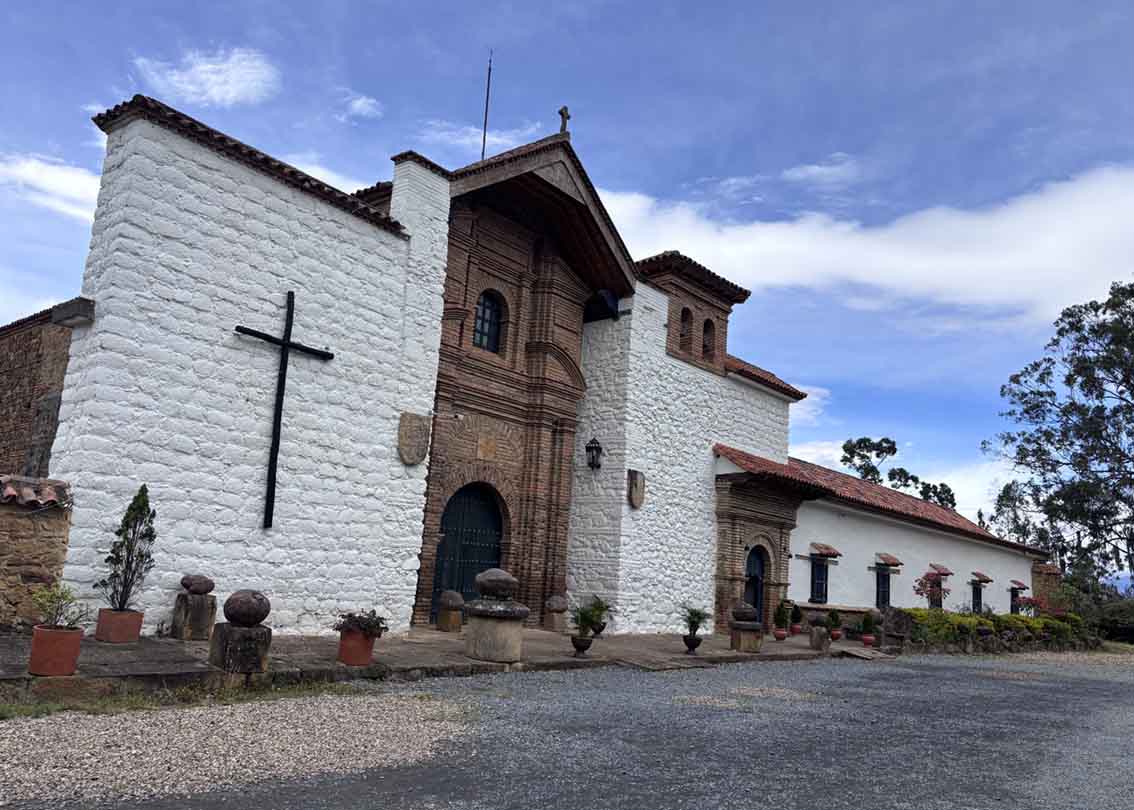
It is easy to miss. There are no dramatic gates or towering spires announcing its presence. Instead, thick stone walls emerge almost organically from the countryside, as though the monastery had always belonged to the valley. Built more than four centuries ago, this Dominican sanctuary remains one of the country’s finest surviving examples of colonial religious architecture—and one of Boyacá’s best-kept secrets. Founded in 1620, it continues to function as a place of contemplation while welcoming visitors seeking history, architecture and an increasingly rare luxury: silence.
The approach alone feels cinematic. Dry Andean light washes over vineyards that produce some of Colombia’s most surprising wines, while ancient cacti stand beside fertile farmland where peaches, figs and tomatoes thrive in the valley’s unusually mild climate. The pace slows almost instinctively. It is impossible not to breathe more deeply.
Crossing the threshold is like stepping through a portal into another century.
The monastery’s design reflects the restrained elegance of early Spanish colonial architecture. A central cloister frames an open courtyard where sunlight shifts slowly across weathered stone arcades. Tuscan columns support wooden galleries darkened by age, while thick adobe walls keep interiors remarkably cool, even during Boyacá’s warmest afternoons. Every corridor seems designed not simply for movement but for reflection.
Unlike the richly ornamented churches found elsewhere in Latin America, Ecce Homo favours simplicity. The beauty lies in proportion rather than excess. Wooden ceilings display subtle Mudéjar influences inherited from Moorish Spain, while hand-carved doors, quiet chapels and intimate courtyards reveal craftsmanship that has survived generations of political upheaval and changing fortunes. The complex was declared a National Cultural Heritage site, preserving not only its architecture but also its place in Colombia’s historical memory.
Every monastery carries its legends, and Ecce Homo is no exception.
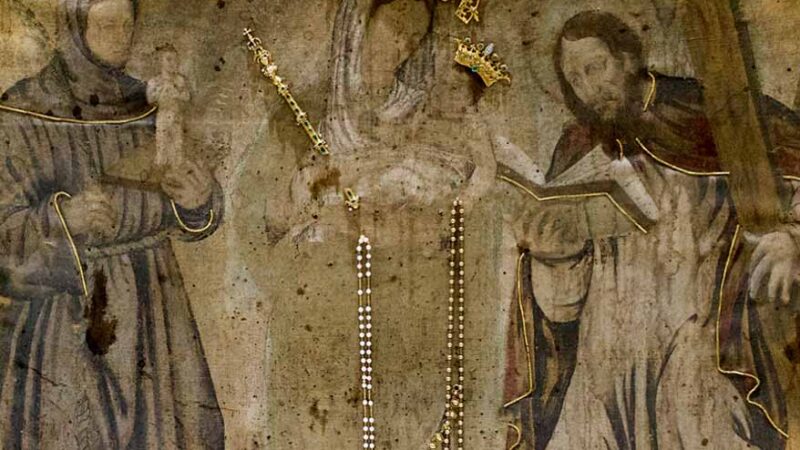
Its name derives from an image of Christ—”Behold the Man”—believed to have travelled from Europe to the New Kingdom of Granada after the 1527 Sack of Rome. According to local tradition, the estate itself was donated after Catalina de Mayorga experienced a vision urging the creation of a Dominican monastery on the site. Whether one approaches these stories through faith or folklore hardly matters; they have become inseparable from the atmosphere of the place itself.
Yet perhaps the monastery’s greatest treasure is not its history but its stillness.
Visitors often arrive expecting another colonial landmark before continuing to Villa de Leyva’s restaurants or museums. Many stay far longer than planned. There is something profoundly restorative about watching shadows move across the cloister, listening to the wind pass through eucalyptus trees or sitting beneath centuries-old arches where Dominican friars once studied theology and astronomy.
The surrounding landscape rewards exploration as well. Walking trails meander across the monastery grounds, revealing native vegetation and sweeping views across the valley towards the rugged mountains of Boyacá. It is easy to imagine why the Dominican order chose this secluded location as both a spiritual retreat and a centre for evangelisation among Indigenous communities during the colonial period.
For travellers using Villa de Leyva as a base, the monastery offers the perfect half-day excursion. Combine it with lunch in Sutamarchán—widely celebrated for its traditional longaniza sausage—or continue onwards to nearby attractions such as El Infiernito, Colombia’s enigmatic pre-Hispanic astronomical site, or the fossil museum that tells the story of a landscape once submerged beneath an ancient sea.
But unlike many destinations in the region, Ecce Homo asks remarkably little of its visitors. There are no elaborate itineraries to follow or checklists to complete. Simply wander. Sit. Observe.
In an age when travel often becomes a race between Instagram locations, the Monastery of Santo Ecce Homo offers something increasingly uncommon: permission to slow down.
Its stone walls have witnessed more than 400 years of Colombian history—colonial expansion, independence, political transformation and modern tourism—yet the monastery remains remarkably unchanged. The silence that enveloped Dominican monks in the seventeenth century still settles gently over today’s visitors.
And perhaps that is the true miracle of Ecce Homo. Not that it has endured for four centuries, but that in a world growing ever louder, it continues to remind us that the most memorable journeys are often measured not by what we see, but by the moments when everything else finally becomes quiet.
How to Get There: The Monastery of Santo Ecce Homo is located some 10 Km northwest of Villa de Leyva in the municipality of Sutamarchán, Boyacá. The journey takes around 15 minutes by car via the Villa de Leyva–Santa Sofia – Sutamarchán road, with clear signage leading to the monastery. Regular buses and taxis also operate between Villa de Leyva and Sutamarchán, making the historic site an easy half-day excursion for visitors exploring the region.