
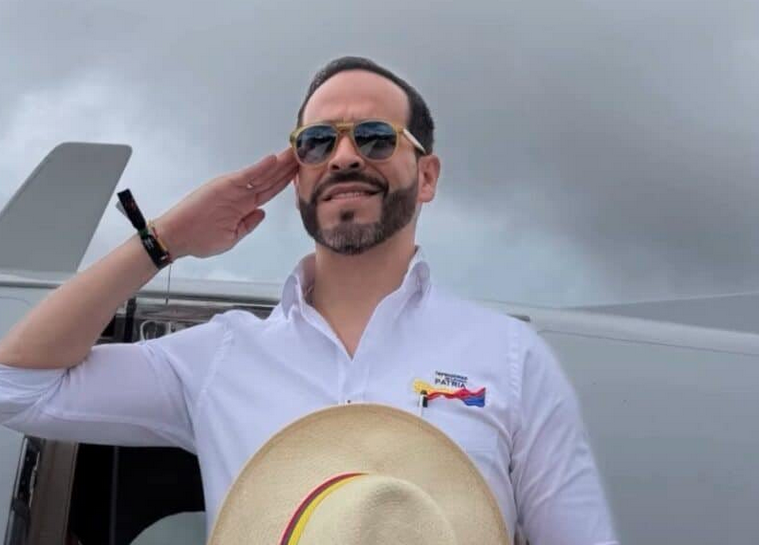
Colombia’s president-elect Abelardo De la Espriella announced Sunday, a sweeping overhaul of the country’s diplomatic network, pledging to close 14 embassies and 15 consulates. He also pledged to sever diplomatic relations with Cuba and Nicaragua, and redirect budget cuts toward security and public investment after taking office on August 7.
In a video message posted on his social media platforms, the criminal defense lawyer outlined what he described as a fundamental shift in Colombia’s foreign policy, arguing that the country’s diplomatic service had become bloated and ineffective.
“There will be no ties whatsoever with tyrannies in my government,” De la Espriella said, referring to Cuba and Nicaragua, two governments that have maintained close relations with outgoing President Gustavo Petro.
The president-elect said Colombian embassies in Algeria, Azerbaijan, Barbados, Cuba, the Czech Republic, Ethiopia, Ghana, Haiti, Hungary, Malaysia, Nicaragua, Romania, Senegal and South Africa would be closed. He also announced the elimination of 15 consulates, although he did not immediately specify their locations.
De la Espriella stressed that, aside from Cuba and Nicaragua, Colombia would maintain diplomatic relations with all other countries affected by the restructuring. Consular services for Colombian citizens abroad would continue through neighboring embassies or alternative diplomatic offices, he said.
The diplomatic shakeup marks one of the first major policy reversals from the Petro administration, which looked to expand Colombia’s international foothold with left-leaning governments that supported the International Criminal Court’s (ICC) accusastions against Israel.
Another significant change will be the restoration of Colombia’s diplomatic mission in Israel. De la Espriella confirmed that his government will reopen the embassy in Jerusalem and suspend Petro’s initiative to establish one in Palestine.
Petro severed diplomatic relations with Israel in 2024 in protest over Israel’s military offensive in Gaza, ending decades of close cooperation between the two countries on defense and security matters. During his presidential campaign, De la Espriella pledged to restore ties with Israel, calling it a “strategic ally”. On Saturday, Israel announced the appointment of Vivian Aisen, as the country’s incoming Ambassador to Colombia.
The president-elect also announced plans to establish a new Colombian embassy in Nigeria, saying the mission would improve the country’s diplomatic reach in Africa while making its regional presence more efficient.
As part of the restructuring, De la Espriella said Colombia would merge diplomatic missions that currently operate separately but share the same location. The Colombian Embassy in France would be combined with the country’s delegation to UNESCO in Paris, while the embassy in Italy would be unified with Colombia’s permanent representation to the United Nations Food and Agriculture Organization (FAO) in Rome under a single ambassador.
He added that during the first 100 days of his administration, the Foreign Ministry will conduct a technical audit of Colombia’s remaining embassies and consulates to determine whether additional closures or restructuring are warranted.
According to De la Espriella, the savings generated by reducing the diplomatic network will be redirected toward strengthening security, healthcare, education and infrastructure.
“Every peso we save on bureaucracy will be a peso that we can invest in security, health, education, infrastructure and, above all, opportunities for the poorest Colombians,” he said.
The president-elect said his administration’s foreign policy would prioritize attracting foreign investment, expanding export markets and promoting Colombia’s economic interests abroad rather than increasing the size of the diplomatic service.
He also reaffirmed his intention to hold his inauguration ceremony in the southwestern city of Cali rather than Bogotá, breaking with more than a century of tradition. The proposal still requires congressional approval before it can proceed.
The decision has been welcomed by regional leaders in Valle del Cauca, who see the move as a symbolic recognition of southwestern Colombia after years of calling for greater national government attention.
Valle del Cauca Governor Dilian Francisca Toro said the region was ready to work with the incoming administration and described Cali as an appropriate starting point for what De la Espriella has branded his Patria Milagro (“Miracle Nation”) agenda.
Toro also urged the incoming government to prioritize the creation of a High Mountain Battalion in the municipality of Jamundí and requested that Cali host the administration’s first National Security Council meeting at the Marco Fidel Suárez Air Base, citing persistent security challenges in the region.
Cali Mayor Alejandro Eder likewise welcomed the announcement, saying the city had long sought a stronger presence from the national government. “Our city has waited for many years for greater attention from the national government,” highlighted Eder, adding that the inauguration would reinforce the administration’s commitment to the department of Valle del C and Colombia’s southwest.
If implemented, De la Espriella’s diplomatic reforms would represent one of the most significant reorganizations of Colombia’s foreign service in decades, signaling a sharp departure from the hard-left foreign agenda of Petro.