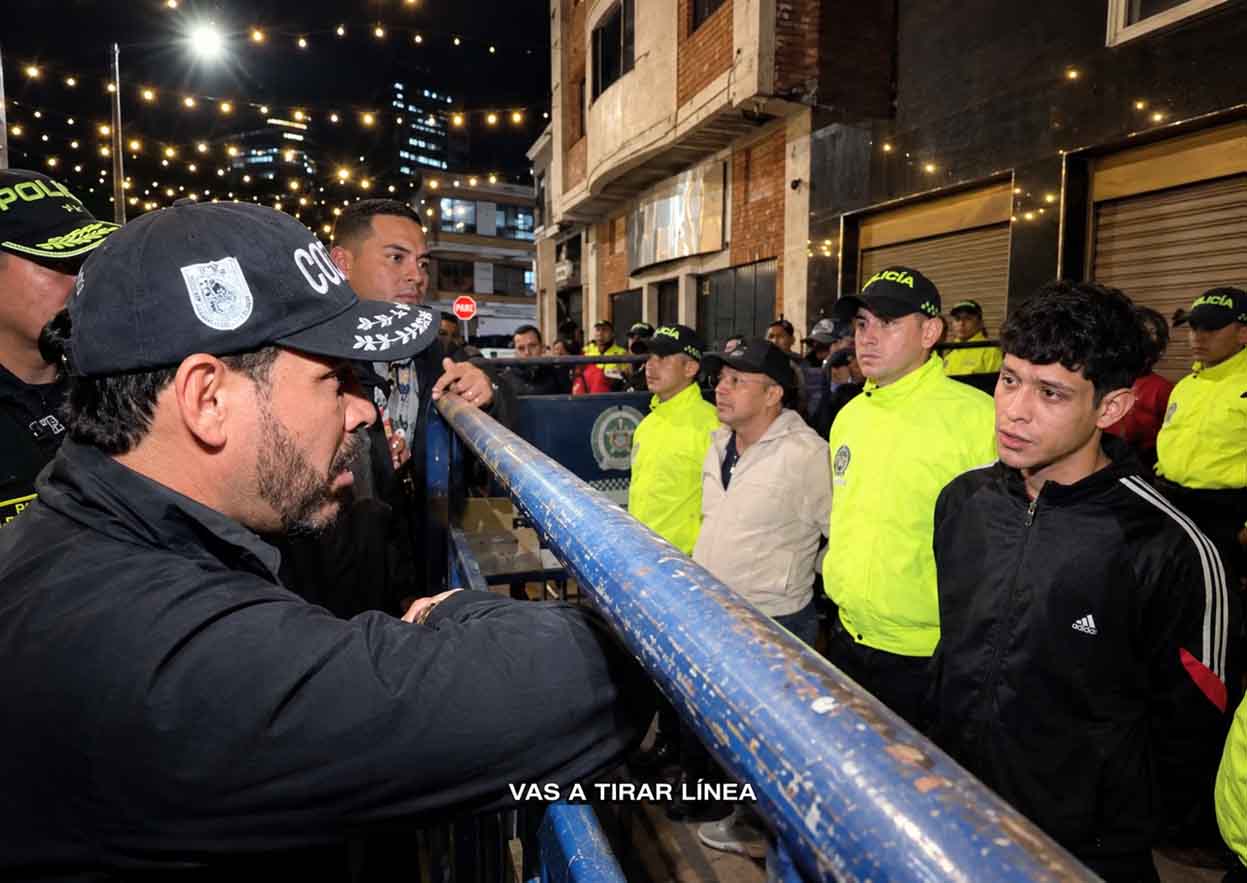
The President’s personal involvement in high-profile police raids, his pledge to govern from within Colombia and proposal for military control in southern Bogotá is putting a hardline security strategy to the test.
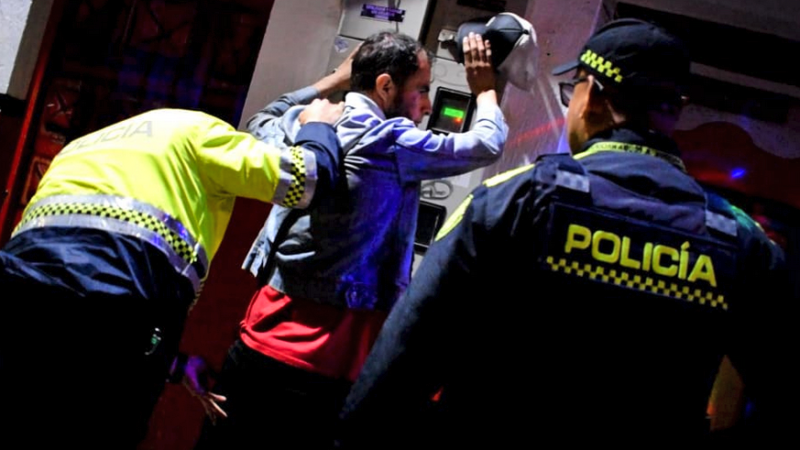
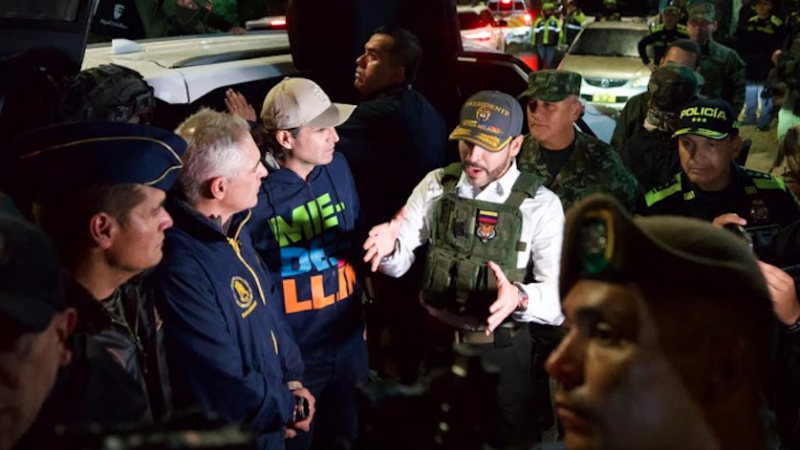
President Abelardo de la Espriella took his escalating campaign against urban crime to Bogotá on Wednesday, personally accompanying security forces during Operation Kratos, a major overnight offensive that resulted in 172 arrests, 114 searches and the seizure of firearms, grenades, ammunition, narcotics and cash.
Conducted across eight localities in the early hours of October 28, the operation involved more than 1,400 personnel from the National Police, the Army and the Attorney General’s investigative police unit, the CTI. Authorities reported 104 arrests under judicial warrants and 68 in flagrante delicto, targeting criminal structures investigated for offences including organised crime, drug trafficking, robbery, illegal weapons possession and homicide.
The haul included 11 firearms, three grenades, 72 rounds of ammunition, 34 mobile phones, 4.6 kilograms of narcotics, 250 individual doses of pink cocaine – tusi – and approximately COP 10.1 million in cash. Authorities also reported the seizure of a motorcycle and the recovery of another stolen vehicle.
For De la Espriella, the operation represented more than a police mobilisation. Following highly visible crackdowns in Barranquilla and Medellín, his personal presence in Bogotá reinforced the central message of his security policy: criminal organisations should expect a coordinated response from a government determined to restore public order and territorial control.
Confrontation with ‘alias Mailo’
One of the most striking moments came when the president confronted alias Mailo, a suspect accused of involvement in a January 22 grenade attack in Bogotá’s Santa Fe neighbourhood that killed an elderly street vendor.
De la Espriella described the victim as a humble man who had worked at the location for 20 years. The president’s anger was evident as he challenged the detained man over the killing and warned him of the consequences he could face.
“You’re a wretched murderer. You’ll see how hard the tiger bites,” De la Espriella told him. “Do you think this is a game? Do you think this government is playing around?”
The exchange grew more confrontational when Mailo, smirking, appeared to justify the vendor’s killing as part of his criminal activities, suggesting that he had been “doing his job.” The remark visibly angered De la Espriella, who retorted by calling him “payaso” – “clown” – and accused him of “throwing his weight around”.
De la Espriella responded by warning that the suspect could face more than 40 years in prison and said he would seek his transfer to a maximum-security facility, among the toughest in Colombia.
The encounter has captured the administration’s determination to confront violent crime directly, particularly where vulnerable civilians are targeted. For residents and business owners exposed to extortion and intimidation, the government’s willingness to pursue alleged perpetrators offers a clear signal that their security is a priority.
Military control in southern Bogotá
Following the operation, De la Espriella called for military control in Sumapaz and the corridor linking the rural locality with Usme, arguing that a stronger security presence was necessary to contain the expansion of criminal networks.
The president identified threats associated with organizations including the Tren de Aragua, the ELN, Los Ingenieros and El Mesa. The district administration has linked El Mesa to alleged homicides, extortion and other violent crimes in parts of Usme.
The proposal introduces a significant policy question. Bogotá already receives military support for certain security operations, but expanding that role into a more explicit system of military control would require clarity about its legal basis, operational responsibilities and relationship with civilian policing.
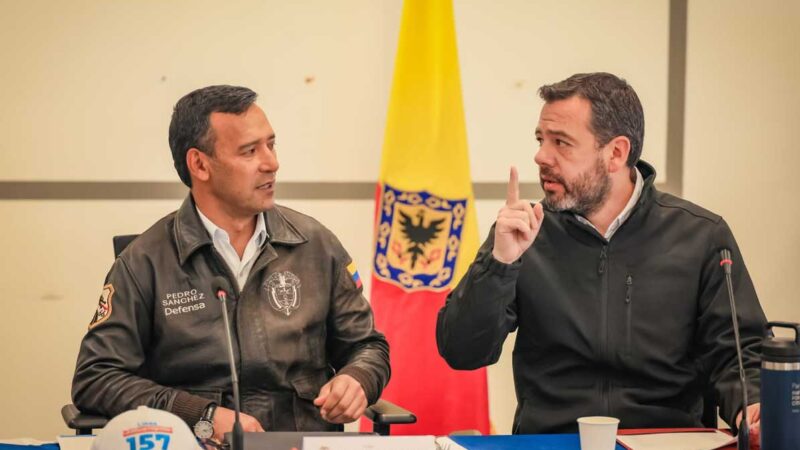
Mayor Carlos Fernando Galán has emphasized the importance of cooperation between the district and national authorities. The challenge now is to ensure that coordination produces sustained security improvements while protecting the rights of residents in affected communities.
De la Espriella has also directed greater attention towards extortion affecting merchants and transport operators, particularly in areas including Kennedy, Bosa and Ciudad Bolívar. His administration says its Bogotá strategy will include measurable targets and regular security reviews.
A president who promises to stay
The crackdown also reflects De la Espriella’s pledge not to leave Colombia during his four-year presidential term. In September, he reaffirmed the commitment when Vice President José Manuel Restrepo represented the country at the United Nations General Assembly in New York.
The president has presented the decision as part of his determination to govern from Colombia’s regions, remaining close to local authorities and communities rather than personally attending international engagements.
That approach reinforces the image of a hands-on commander-in-chief. But it raises a practical question: can a president sustain a security strategy that places such emphasis on his personal presence at police operations?
No commander-in-chief can accompany every raid or patrol in every neighbourhood. Lasting results depend on police intelligence, effective investigations, prosecutors capable of securing convictions, and institutions able to maintain pressure on criminal networks after the presidential delegation has departed.
From arrests to lasting results
Accompanied by Mayor Carlos Fernando Galán, Operation Kratos is a substantial security offensive, and its reported seizures and arrests demonstrate the scale of the authorities’ effort to target the crime wave that has gripped the Colombian capital. The next test will be whether such efforts in districts such as San Bernando and Centro will also disrupt the criminal networks responsible for violence and intimidation.
How many of those arrested will face formal charges? How many cases will result in convictions? Will extortion and homicide decline in the affected neighbourhoods, and can the security forces sustain their presence without repeated presidential intervention?
These are the measures by which the operation should ultimately be judged.
De la Espriella has placed the authority of the presidency visibly behind the security forces. His message to violent criminal networks is that the government intends to pursue them across Bogotá and other Colombian cities, with no assumption of impunity.
The decisive test, however, will come after the raids, the arrests and the televised confrontations. If the administration can translate its hardline approach into effective prosecutions, dismantled criminal networks and safer streets, its strategy will have delivered something more enduring than a dramatic night of arrests.