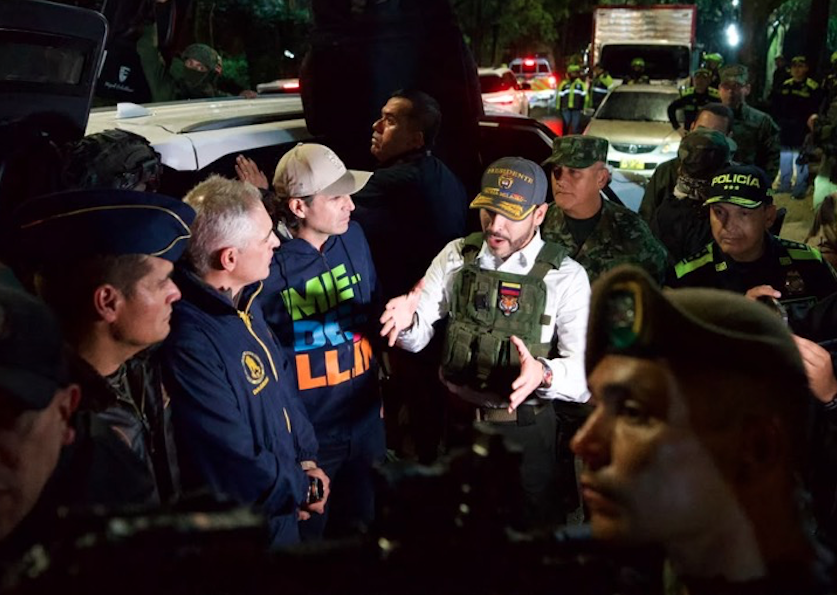
President Abelardo de la Espriella personally accompanied a major security operation in Medellín overnight on Monday, as police, military personnel and prosecutors carried out coordinated raids targeting criminal networks accused of involvement in homicide, extortion, theft and drug trafficking.
The operation, which extended into the early hours of Tuesday, October 27, initially produced a reported 60 arrests and more than 100 searches, according to Mayor Federico Gutiérrez. Governor Andrés Julián Rendón also accompanied the president during the deployment, which extended beyond Medellín into other parts of Antioquia.
By later Tuesday morning, the reported figures from the National Police had increased to 135 arrests and 153 searches. Authorities said the offensive was intended to weaken criminal structures responsible for high-impact crimes and restore security to communities affected by intimidation, drug distribution and violent theft.
The operation brought renewed attention to Medellín’s wider security challenges, including the controversy surrounding Parque Lleras. The epicenter of El Poblado’s club scene has become a focal point in the city’s struggle against drug trafficking, exploitation and dangerous activities targeting foreigners.
Among those initially reported captured was a man known by the alias ‘Risas’, whom authorities associate with the criminal structure La Roja. According to Mayor Gutiérrez, the group is linked to the theft of valuable personal belongings, including luxury watches.
The operation involved the National Police, the Colombian Army and the Attorney General’s Office, with the participation of national, departmental and municipal authorities. The initial results were presented as a preliminary assessment while operations were continuing.
De la Espriella’s presence alongside the mayor and governor gave the operation a prominent political dimension. It also reinforced the administration’s message that the fight against organized crime requires coordinated action across government and law enforcement agencies.
Parque Lleras caught between security and commerce
The security offensive comes amid growing disagreement over the sustained police presence in Parque Lleras, historically one of Medellín’s best-known destinations for restaurants, bars and international nightlife.
Business owners have complained that repeated inspections, identity checks and police interventions are discouraging customers and contributing to the district’s economic decline. Some operators maintain that they support efforts to remove criminal networks but object to controls they consider excessive or indiscriminate.
According to El Colombiano, the number of clubs and bars in the area has fallen from 24 to seven. Some operators have reported sales declines of as much as 80% to 90%, attributing their difficulties to a combination of fewer visitors, rising operating costs and the impact of repeated inspections.
The complaints have placed the administration of Mayor Gutiérrez in a difficult position. Business owners argue that legitimate establishments should not be penalised for criminal activity elsewhere in the district. The mayor, however, has defended the intervention, arguing that Parque Lleras has been overrun by the mafia, and transnational organisations involved in sexual exploitation and other criminal offences.
The dispute raises a central question for Medellín: how can authorities dismantle micro-trafficking networks without driving legitimate commerce and tourism out of one of the city’s most recognisable entertainment districts?
The darker side of Medellín’s international appeal
The controversy cannot be separated from the reputation that has accompanied Medellín’s growth as an international tourism destination.
Foreign visitors have become an important part of the city’s hospitality economy, but authorities have also raised concerns about sexual exploitation, trafficking, drug distribution and robberies involving substances such as scopolamine. The challenge is to distinguish legitimate tourism from activities that expose vulnerable people to abuse or make visitors targets for organised theft.
Recent figures from Medellín’s System of Information for Security and Coexistence, indicate that reported robberies involving scopolamine rose from 299 in 2025 to 566 during the first ten months of 2026, an increase of approximately 89%. A separate comparison using different reporting periods has produced a higher percentage increase, underlining the importance of specifying the statistical cut-off when comparing the figures.
El Poblado and Laureles have been identified among the areas particularly affected by these crimes. The authorities have also announced cooperation with US Homeland Security Investigations to pursue networks involved in the use of drugs to incapacitate victims and facilitate robberies.
Meanwhile, police operations in Parque Lleras between 2024 and October 2026 have reportedly resulted in more than 430 arrests, alongside the seizure of narcotics and other enforcement measures. Authorities have presented these figures as evidence of sustained action against criminal networks, while some business owners argue that the consequences of the campaign are falling too heavily on legitimate operators.
The debate is complicated by the district’s association with overt sex tourism. Some visitors come to Medellín specifically for its nightlife and gastronomy, while criminal investigations have raised more serious concerns regarding the rise in exploitation and offences involving minors.
For Medellín, the challenge is not simply to increase the number of arrests or police inspections. It is to demonstrate that enforcement produces lasting improvements in public safety while allowing legitimate restaurants, bars, hotels and other businesses to operate without being caught indiscriminately in the crackdown.