After nearly ten months abroad, Venezuela’s opposition leader has returned to a country still governed by Nicolás Maduro’s former deputy, raising fresh questions about the role of Colombia, the Trump administration and the prospects for free elections.
María Corina Machado’s return to Venezuela over the weekend has reopened the central question confronting the country after Nicolás Maduro’s removal: whether the transition now being managed by Washington and interim president Delcy Rodríguez will lead to genuine democratic change, or consolidate a new political arrangement that leaves much of the decades-old chavista apparatus intact.
The Nobel Peace Prize laureate announced her return on Sunday, 25 October, with a brief message to her supporters: “I am here. With you.”
Her first confirmed public appearance was in Barquisimeto, in the western state of Lara, where she attended Mass at the Santuario de la Divina Pastora. From there, she travelled towards Caracas, where crowds gathered along the highway to welcome a leader who had spent much of the previous year in hiding before leaving Venezuela in December 2025 to receive the Nobel Peace Prize in Oslo.
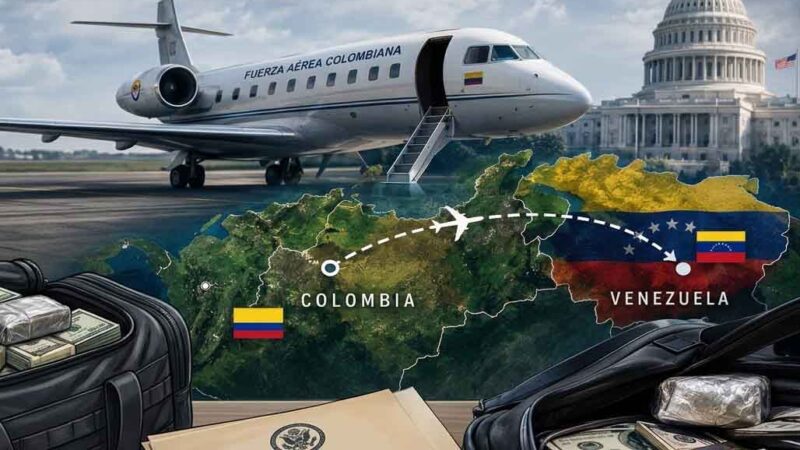
The journey was remarkable not simply because Machado had returned, but because the circumstances of her entry remained largely undisclosed. Reports indicate that she had made at least seven unsuccessful attempts to return, involving air and sea travel. Two Venezuelan exiles told AFP that she entered overland from Colombia, while other reporting has pointed to coordination involving Colombian, Panamanian and US authorities. The precise route and the arrangements that enabled her return have yet to be independently established.
That uncertainty places Colombia at the centre of a potentially important diplomatic story. If Colombian authorities or intermediaries helped facilitate Machado’s passage, the details could offer insight into the negotiations surrounding Venezuela’s uncertain transition. For Bogotá, the question is whether any involvement was logistical, diplomatic or part of a broader understanding involving Washington, the goverment of Abelardo de la Espriella and ultimately, Caracas.
The political backdrop is equally significant. Since US forces captured Maduro in January, Rodríguez, his former vice-president, has remained in power with the backing of President Donald Trump’s administration. Washington has pursued cooperation with the interim government on economic stabilisation and Venezuela’s oil industry while supporting negotiations intended to establish a path towards democratic elections.
Machado, however, has remained largely outside those negotiations. Talks involving another opposition bloc have addressed institutional reforms, including changes to the judicial and electoral systems, but have not produced a definitive timetable for presidential elections.
Her return therefore presents a challenge to both the Venezuelan government and Washington’s preferred approach. Machado has argued that Venezuela needs a credible electoral process, and her presence in the country gives her an opportunity to rebuild direct contact with supporters rather than conduct opposition politics from abroad.
The response from Washington has been revealing. Secretary of State Marco Rubio said the conditions permitting Machado’s safe return were the direct result of US-backed reconciliation talks, which he said had facilitated the release of political prisoners and the return of opposition figures from exile. He urged all political actors to support the negotiations, describing them as an opportunity to achieve free and fair elections and a lasting democracy. “We expect all political actors to support these talks which represent the best chance for Venezuela has had in thirty years,” he stated on X.
Undersecretary of State Christopher Landau offered a more personal message, saying he was praying for “peace, justice and reconciliation in Venezuela” following Machado’s return. Republican lawmakers also welcomed the development, while Democratic Senator Tim Kaine called for guarantees of Machado’s safety and concrete progress towards free and fair elections.
Trump’s response was more restrained. He said he had not known about Machado’s return but hoped she would be safe. That statement sits uneasily alongside the administration’s continued support for Rodríguez, whose government Washington regards as a partner in managing the post-Maduro period.
For Venezuelans who backed Machado and the opposition’s challenge to the disputed 2024 presidential election, the return represents an opportunity to reclaim political space. But public enthusiasm is not the same as institutional change. The government still controls the machinery of the state, and Machado’s presence alone cannot guarantee an electoral timetable, independent institutions or the restoration of political freedoms.
The next phase will depend on whether her return translates into meaningful negotiations, a wider mobilisation of the opposition and concrete commitments to democratic elections. It will also test whether Washington is prepared to move beyond a transition defined primarily by stability and economic cooperation.
Machado is now home. The more difficult question is whether her return will change who ultimately decides Venezuela’s political future.