The controversy surrounding the alleged Pacto de Valledupar escalated on Wednesday after Enrique Vargas Lleras, co-director of the Cambio Radical party, announced plans to file a complaint against former president Gustavo Petro over allegations that his administration sought to persuade former paramilitary commanders to make accusations against political opponents.
Vargas Lleras, the brother of the late former vice-president Germán Vargas Lleras, said the complaint would be submitted to the House of Representatives’ Accusations Commission and would allege witness bribery and conspiracy to commit a crime.
He said the action would be brought on behalf of the Vargas Lleras family and in coordination with Cambio Radical’s congressional representatives.
The announcement followed allegations that government representatives had approached former commanders of the United Self-Defence Forces of Colombia (AUC) during meetings in Valledupar in October 2025, allegedly urging them to make false statements against Senator Germán Vargas Lleras, former president Álvaro Uribe Vélez and Abelardo de la Espriella, as the 2026 presidential election campaign was starting.
Clemencia Vargas, daughter of Germán Vargas Lleras, has separately called on the United States government to investigate allegations emerging from the so-called “Valledupar Pact”. Enrique Vargas Lleras also indicated that the family would examine possible avenues for legal action before international authorities.
The timing of the ‘Valledupar Pact’ adds a particularly sensitive dimension to the explosive allegations. According to the timeline, the meeting in the departmental capital of César took place in October 2025, approximately seven months before Germán Vargas Lleras died on 8 May 2026 following a prolonged battle with a brain tumour.
His family, rightfully alleges that, while the former vice-president was seriously ill, the Petro administration was involved in an effort to secure accusations against him. If substantiated, the allegations would raise questions not only about the alleged use of former paramilitary commanders for political purposes, but also about an attempt to damage the legacy of a high-profile statesman during the final months of his life.
The death of one of Colombia’s most important political figures of the last two centuries, came after the assassination of presidential frontrunner for Uribe’s Centro Democrático party, Senator Miguel Uribe Turbay, on June 7, 2025.
A family demands answers
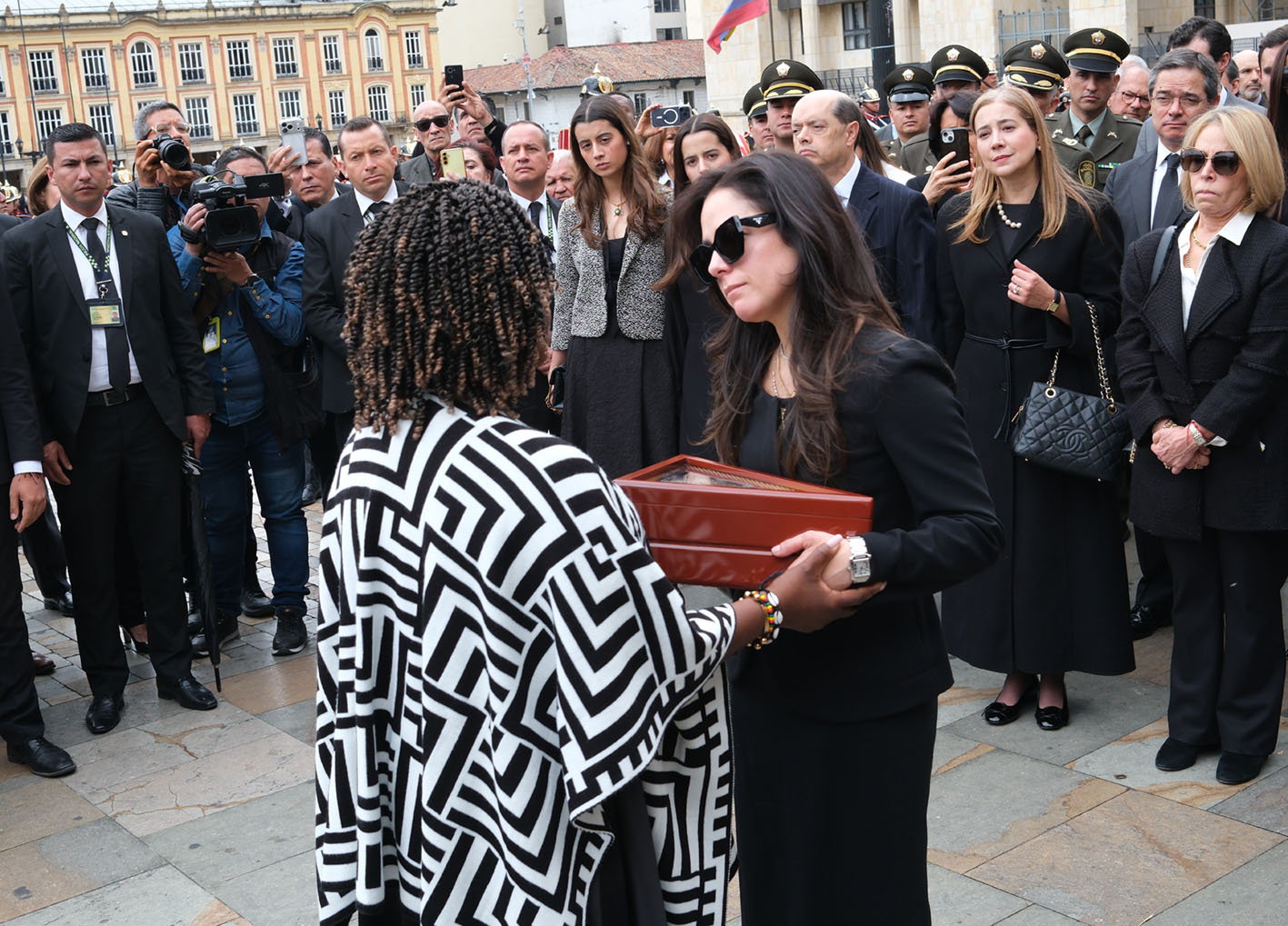
Enrique Vargas Lleras described the allegations as particularly disturbing because, according to his account, the alleged manoeuvres were being planned while his brother was critically ill in intensive care in Bogotá.
He accused Petro and officials in his administration of attempting to arrange for former paramilitary commanders to implicate the three political figures.
The accusations remain allegations and have not been established by a court. Nevertheless, the family’s announcement represents a new development in the controversy, moving the dispute into a formal legal arena and raising the possibility of requests for international scrutiny.
The family’s focus is on whether the former government attempted to use statements from former paramilitary commanders to damage centrist and right-wing political figures who could challenge the left’s political objectives to remain in control of Casa de Nariño with the 2026 elections.
What happened in Valledupar?
The controversy centres on a meeting held between October 22 and 24, 2025, at the Hotel El Bosque in Valledupar. According to reporting by investigative journalist Melquisedec Torres, ten of the 16 principal former AUC commanders appointed as peace managers by the Petro administration attended the gathering.
The official purpose was to advance outstanding commitments arising from the Santa Fe de Ralito process, the 2003 agreement associated with the demobilization of the AUC.
However, Torres reported that the meeting had a potentially different political dimension. He said former commanders had been approached with a request to make statements implicating Uribe, Vargas Lleras and De la Espriella with paramilitary activity.
Salvatore Mancuso, one of the AUC’s most senior commanders, subsequently corroborated the central allegation in public statements. “Delegates of the Petro government asked us, the former commanders of the self-defence forces, to accuse three men with the upcoming elections: Uribe, De la Espriella and Vargas Lleras. None of us agreed,” Mancuso said, according to El Colombiano.
Mancuso’s lawyer, Juan Carlos Villamizar, said he witnessed the meetings. His account supports the allegation that government representatives sought public statements concerning the three political figures, but he has also made an important qualification: according to his account, no pact was ultimately concluded because the former commanders rejected the request.
There is, at present, no publicly established written instruction explicitly ordering the fabrication of false testimony. The central question for investigators is whether the reported verbal requests and the circumstances surrounding the meeting provide evidence of an attempt to manipulate testimony for political purposes.
Benedetti and Rodríguez under scrutiny
The controversy also places former interior minister Armando Benedetti and former presidential administrative department director Angie Rodríguez under scrutiny.
A virtual conference with former paramilitary commanders took place on October 1, 2025, coordinated by Benedetti and Rodríguez. Torres reported that Benedetti subsequently publicly declared that the former commanders had committed themselves to telling the truth about political figures allegedly connected to past paramilitary violence.
At the time, the statements were presented in the context of efforts to advance peace and historical truth. The subsequent allegations have raised questions about whether the meetings were also intended to generate politically damaging statements against specific figures.
Rodríguez, formerly one of Petro’s closest presidential aides, has made allegations concerning the objectives of the Valledupar meeting. Mancuso’s account has added weight to the controversy, although the precise responsibilities of each participant remain matters for investigation.
The Inspector General’s Office has initiated preliminary disciplinary proceedings involving Benedetti and Rodríguez. Justice Minister Iván Cancino has also asked the Attorney General’s Office to examine whether benefits were offered to former paramilitary commanders in exchange for statements.
Separately, the Attorney General’s Office has forwarded material concerning a complaint against Petro to the House of Representatives’ Accusations Commission, which has constitutional responsibility for handling allegations against presidents and former presidents.
The document and the missing evidence
The controversy has also acquired a documentary dimension. On October 20, La FM reported that it had obtained a document produced following the Valledupar meeting, setting out a “work programme” involving former paramilitary commanders and government representatives.
According to the radio network, the document included commitments concerning agricultural settlements, possible release arrangements, improved prison conditions and study of extradition-related issues.
The document is relevant because it records discussions and commitments arising from the meeting. It does not, by itself, establish that the gathering was organized to secure fabricated accusations against political opponents.
That distinction is central to a criminal investigation. Investigators need to examine the document alongside witness accounts, communications between the participants, and eye-witness testimonies.
The fact that the alleged request to damage political opponents may have been made verbally does not automatically invalidate the verbal statements of those who say they witnessed it. Nor does testimony alone establish that a criminal offence occurred. The task is to determine whether the different accounts can be corroborated and whether the evidence supports the allegations.
De la Espriella targets Benedetti
The controversy prompted a sharp response from one of the politicians implicated in the scandal and now head of state – President Abelardo de la Espriella. The head of the Defensores de la Patria party directed his criticism at Benedetti in a public message. “This is the least serious of all the illegalities Benedetti has committed,” De la Espriella wrote. “He believes that because he is silent, he will escape scrutiny. Neither forgiveness nor forgetting for that criminal who has done so much damage to the homeland.”
The president added that justice would hold Benedetti accountable.
The comments underscore the political sensitivity of the allegations, particularly given that De la Espriella is himself one of the three figures allegedly targeted in the Valledupar meetings. His statements should therefore be understood as the response of a directly affected political figure, rather than an independent determination of Benedetti’s guilt.
A test for Colombia’s justice system
The allegations surrounding Valledupar raise questions that reach beyond the political fortunes of Petro, Benedetti and the figures named by Mancuso.
The AUC demobilisation process was intended to help establish the truth about paramilitary violence, identify those responsible and advance reparations for victims. If former commanders were pressured to make false statements for electoral purposes, the consequences would extend to the credibility of the transitional justice process itself.
The investigation must now establish what was requested during the meetings, whether any benefits were offered, who authorized the discussions and whether the alleged conduct violated Colombian law.
For the Vargas Lleras family, the next step is a formal complaint and a request for greater scrutiny beyond Colombia. For investigators, the challenge is to distinguish political accusations from evidence capable of establishing individual responsibility.
The central question remains unanswered: were the Valledupar meetings genuinely intended to advance peace and historical truth, or were they also used in an alleged attempt to secure politically damaging accusations against three prominent figures?
That is the question Colombia’s judicial institutions must now resolve with a malicious scandal orchestrated by the country’s first leftist government and that, so for, leaves a murky paper trail.