
President Abelardo de la Espriella has ordered Culture Minister Paola Holguín to remove images and references to former M-19 guerrilla commander Carlos Pizarro from government public spaces, opening a new front in the battle over how Colombia remembers its decades-long internal conflict.
Speaking at the Ministry of Culture on Thursday, alongside Holguín, De la Espriella declared that his government would no longer tolerate what he characterised as the glorification of terrorism in state institutions.
“Here, terrorists will never again have a place as if they were national heroes,” the president said, instructing the minister to ensure that representations of Pizarro and other former guerrilla figures disappeared from public spaces. “I do not accept the glorification of terrorism,” he added, according to reports of his remarks.
The directive was part of a broader campaign against what De la Espriella calls wokismo, which he argues has infiltrated Colombia’s cultural institutions and distorted the country’s national identity. He also announced plans to rename the Ministry of the Cultures, the Arts and Knowledge as the Ministry of Culture and Heritage, reversing a change made under former president Gustavo Petro.
But beyond the dispute over language and institutional names lies a more consequential question: whether Colombia’s recent history has been rewritten in ways that elevate former insurgents while marginalising the civilians who suffered at their hands.
Whose history is being told?
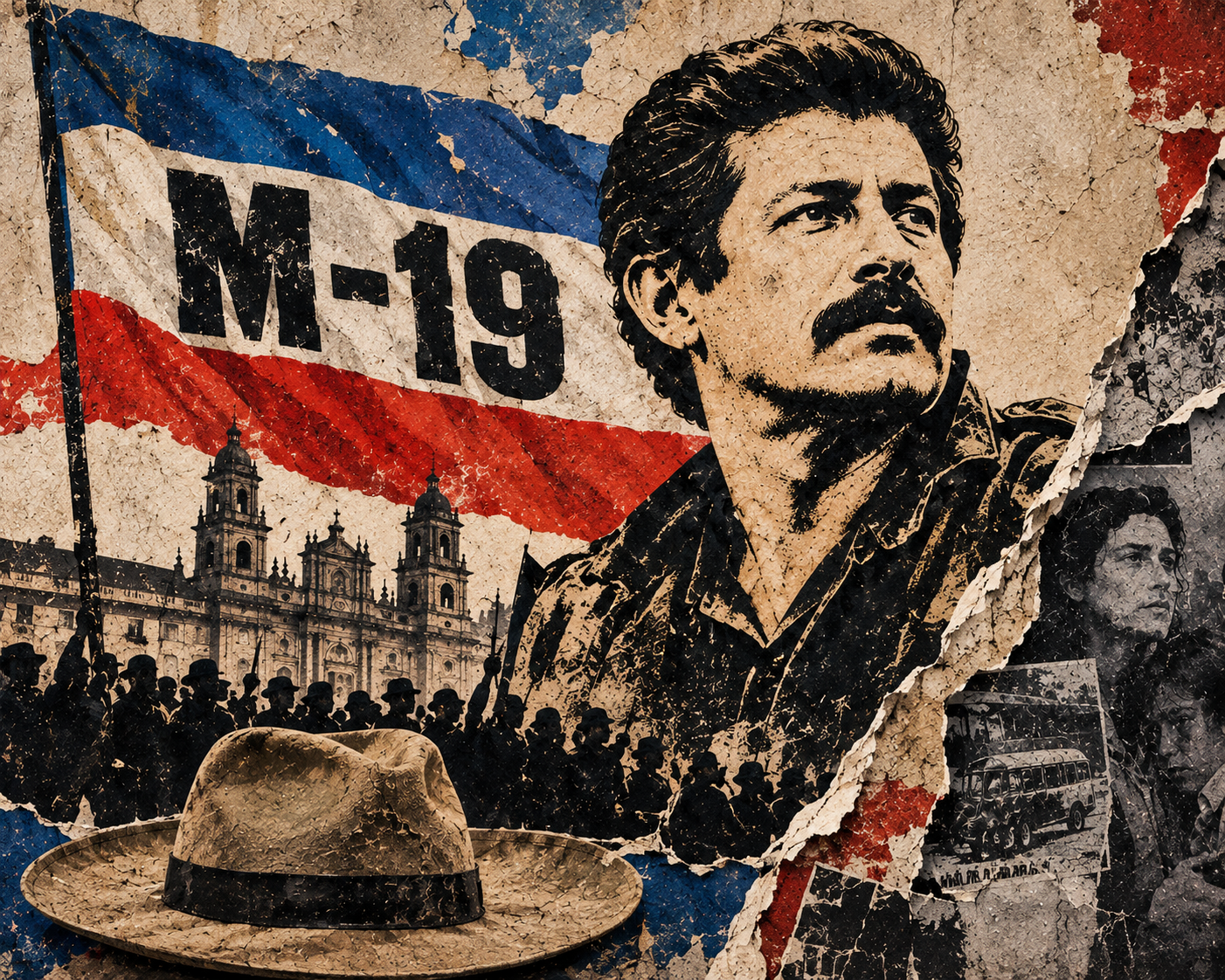
The controversy gained momentum after Bogotá councillor Andrés Barrios criticised displays at the National Museum following a visit with his daughters. Barrios objected to campaign posters featuring Pizarro and historical accounts that, in his view, offered justifications for the emergence of guerrilla organisations while relegating their victims to the margins. “Terrorists are given justifications; their victims are given a corner,” was the substance of his complaint, as reported by Caracol Radio.
De la Espriella subsequently took up the issue, directing Holguín to act against material he considers an endorsement of political violence.
Pizarro was the last commander of the M-19, the guerrilla organisation that demobilised in 1990 and entered electoral politics. He became a presidential candidate but was assassinated on April 26 that same year.
The M-19’s transition into democratic politics is an important part of Colombia’s modern history. It does not, however, erase the organisation’s record of armed insurgency, kidnapping and violence. Nor should its eventual participation in electoral democracy render the experiences of its victims secondary to the political rehabilitation of its former commanders.
That distinction has become central to the dispute over the historical narrative promoted during Petro’s presidency. Petro, himself a former M-19 member, has brought the movement’s legacy into public debate, presenting its revolutionary mission as part of Colombia’s political transformation.
A majority of Colombians argue that the emphasis on reconciliation and political redemption hasovershadowed the suffering inflicted during the internal armed conflict, especially since the November 1985 storming of the Palace of Justice by the M-19.
The politics of cultural memory
The controversy also reaches back to Petro’s 2024 decision to recognise Pizarro’s hat as an item of national cultural heritage, a gesture associated with the former commander’s close legacy with the country’s first leftist president.
That designation encountered a legal setback on September 30, 2026, when the Council of State provisionally suspended it. The court action concerned the heritage designation; it should not be confused with a final judicial determination of Pizarro’s broader historical legacy.
De la Espriella’s latest directive now takes the argument beyond a single object to the imagery and historical representations displayed in public institutions.
The president also used his visit to announce a wider cultural reorientation, including a renewed emphasis on national identity and religious heritage and a rejection of inclusive-language policies that he associates with the previous administration.
Holguín, whom De la Espriella has tasked with leading this cultural campaign, now faces the practical question of how to implement his instructions. The president has not publicly identified every display or work to be removed, leaving the precise scope of the directive unclear.
There is also a distinction between historical documentation and political glorification. A museum can document a guerrilla’s existence, its leaders and transition into civilian politics without endorsing its armed campaign. The question is whether the current displays adequately acknowledge the victims who suffered, and died, because of that at the hands of the M-19.
For Colombia, the stakes extend beyond a collection of posters, a hat or a ministry’s name. They concern the responsibility of public institutions to present a history in which victims are not eclipsed by the subsequent political ideology of those who once took up arms against the state.
De la Espriella’s announcement marks a direct challenge to the historical reset advanced under Petro. Whether his government can correct what it sees as a cultural imbalance without replacing one selective narrative with another will depend on the evidence it presents, the changes it implements and the space it leaves for a fuller understanding of Colombia’s decades-long conflict.