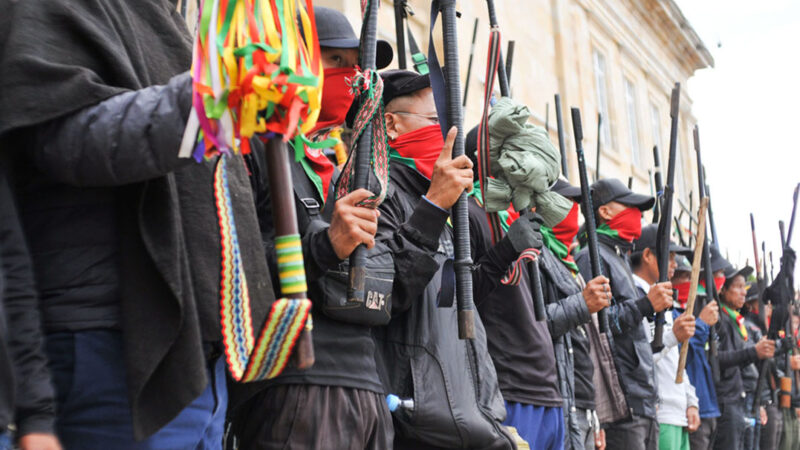


More than 4,000 members of the National police’s Anti-riot Squad – ESMAD – are expected to be deployed on Bogotá’s streets on Wednesday as former president Gustavo Petro prepares to join trade unions in a nationwide mobilization against President Abelardo de la Espriella. Wednesday’s rallies will test the government’s security guarantees in maintaing public order and the constitutional right to protest.
The demonstrations, called by Colombia’s main trade union confederations, teachers’ organizations and left-wing movements, come as the government prepares to implement new regulations governing public demonstrations. They also follow a two-hour security meeting chaired by De la Espriella on Tuesday at the Directorate of Police Intelligence (DIPOL) in Bogotá.
The president used the meeting to reinforce his administration’s security priorities, instructing the National Police to anticipate criminal activity, dismantle criminal organizations and restore public confidence in the authorities. “Go one step ahead of criminals, dismantle their structures and restore peace of mind to Colombian families,” De la Espriella told senior police officials.
The preparations reflect the government’s stated determination to maintain public order on Wednesday while ensuring that demonstrations can proceed peacefully. Petro’s announcement that he will attend the Bogotá marches is viewed by critics as a means to deflect attention to recent scandals involving his estranged wife and former First Lady Veronica Alcocer.
A line between protest and violence
In a televised address to the nation on Monday evening, De la Espriella sought to reassure both those planning to demonstrate and Colombians concerned about the impact of the marches on their daily lives.
“I want to speak to you with absolute clarity, both to those who will take to the streets and to those who will need to work, study, attend a medical appointment or travel across the country that day,” stated the president. “The right to peaceful protest is a constitutional guarantee. There is no debate about that. It does not depend on whether someone agrees with the president or with the decisions of this government. Anyone who thinks differently has the right to express their views, and be heard.”
The president said he had instructed authorities to coordinate with protest organizers and local governments on mobility, prevention, emergency response and public protection.
He also highlighted that police intervention should follow the principles of necessity and proportionality, with the protection of life taking precedence. “The priority is to protect lives, prevent violence and allow the day to unfold peacefully,” he said.
De la Espriella warned that the right to demonstrate did not give protesters permission to endanger others, damage property or obstruct emergency services. “Protest does not authorize anyone to assault other citizens. Protest does not authorize the destruction of property, threats against workers or preventing ambulances and emergency services from gaining access,” he said.
Authorities would respond to conduct constituting criminal offences in accordance with the law, supported by evidence and subject to judicial oversight, the president added. “We will under no circumstances confuse legitimate discontent with violence,” he said.
The remarks establish the administration’s stated position ahead of the first day under the new protest regulations. Wednesday will put that commitment into practice, with authorities expected to balance the protection of peaceful demonstrators against the need to respond to violence or serious disruption.
Bogotá prepares for disruption
The nationwide marches have been summoned by Colombia’s principal labor confederations, including the Central Unitary Workers’ Union (CUT), alongside the Colombian Federation of Education Workers (Fecode), the Capital District’s teachers’ association and other social and political organisations.
Among the concerns driving the demonstrations are public education, teachers’ healthcare, employment conditions and social benefits, alongside wider opposition to government policies. The mobilisation is expected to extend beyond Bogotá to other major Colombian cities.
In Bogotá, the District Education Workers’ Association has confirmed a 10 a.m. gathering at Parque Nacional, with demonstrators expected to march towards Plaza de Bolívar. Other scheduled activities include a march involving the CUT, CTC, CGT, CDP, Fecode, Pacto Histórico and Alianza por la Vida, to Bogotá’s Plaza de Bolívar.
A separate march on Tuesday afternoon, billed as “¿Cansado de los sionistas?” (“Tired of the Zionists?”), is scheduled to gather outside the US Embassy before proceeding towards Plaza de Bolívar, adding to the potential for traffic disruption along the Avenida El Dorado.
Plan journeys carefully
For Bogotá residents, the immediate concern is mobility. The expected police deployment and planned marches make it prudent to allow additional travel time, particularly during morning rush hour and around the city centre.
Potentially affected areas include the corridors around Parque Nacional, Carrera Séptima, Carrera Décima, Calle 26 and Plaza de Bolívar. TransMilenio services and other public transport routes could face diversions or delays if demonstrations affect major roads or exclusive bus lanes. The district government has advised residents to monitor official mobility updates and plan journeys in advance.
De la Espriella has taken a firm position against road blockades, but the extent of any disruption will depend on how the demonstrations unfold and how authorities respond. For commuters and anyone with medical appointments, checking updates from the Bogotá Secretariat of Mobility, TransMilenio and the police before leaving home will be essential.
Wednesday’s marches will test two commitments the president has made publicly: that peaceful dissent will be protected and that violence will not be tolerated. For Bogotá’s authorities, the challenge is to uphold both while preventing the vandalism of public transport infrastructure and private property that has repeatedly marred demonstrations in defense of Petro’s embattled presidency.