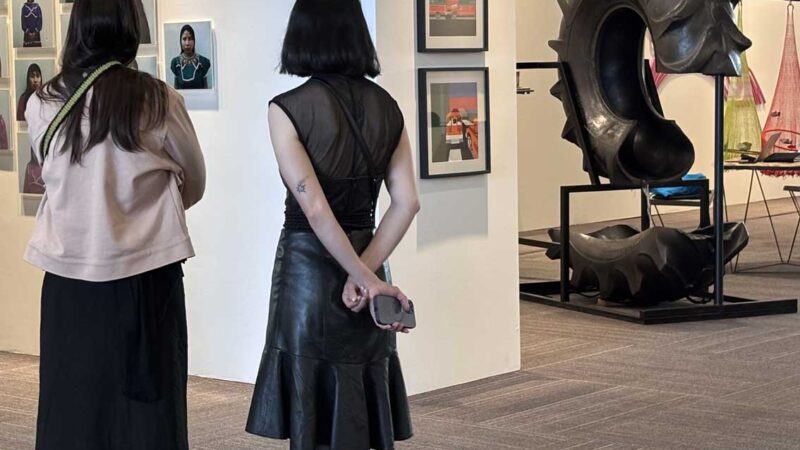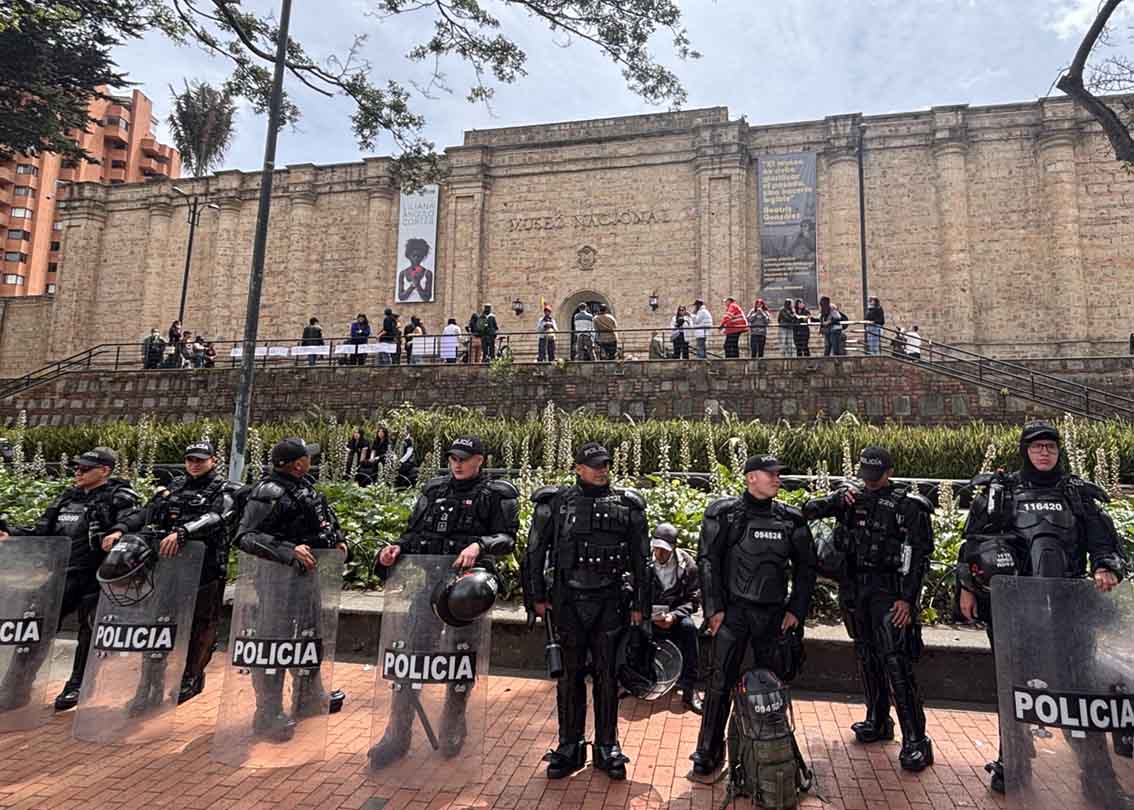
At least 30 National Riot Police officers stood outside Colombia’s National Museum on Monday as academics, artists and historians gathered to debate a question that reaches far beyond the objects recently removed from display: who gets to decide how the country remembers its past?
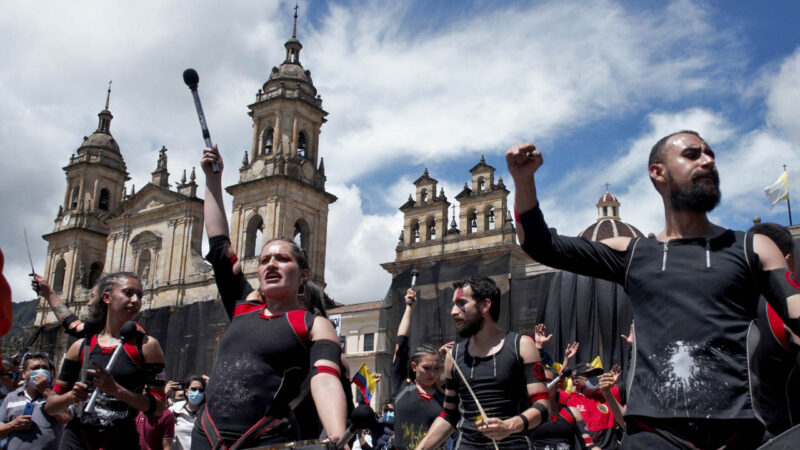
The museum was closed, as it is every Monday. But the controversy continued through Clase a la Calle (“Class on the Street”), a programme of public discussions running through October 24 on censorship, historical memory and the museum’s role in representing a country shaped by political violence and cultural diversity.
The government says a review of museum displays is necessary to ensure national institutions represent the entire country and respect victims of violence. Critics argue that changing exhibitions without sustained curatorial debate risks excluding communities and histories that have long been marginalised.
Culture Minister Paola Holguín set out the administration’s position over the weekend, saying the government would review “the museography, museology, and curatorship of this and all other museums under the government’s responsibility.”
“We will ensure that the National Museum preserves, restores, protects, and disseminates our culture,” Holguín said. “A culture that represents the entire nation and not just one sector.”
She also reaffirmed the government’s commitment to victims’ rights to “truth, justice, reparation, and non-repetition,” pledging to oppose any “manifestation that constitutes the glorification of crime.”
“Preserving the country’s memory—its tragedies and its achievements—requires efforts from society and public authorities,” she said, arguing that the state must act against displays that dishonour victims or invert “social values and historical responsibilities.”
For the museum’s critics, however, the question is whether the pursuit of a national narrative can accommodate the country’s competing and sometimes painful histories.
Andrés Góngora, one of the museum’s curators, said the response should begin with knowledge rather than confrontation. “We must combat ignorance with knowledge,” he said, warning that the humanities, social sciences and arts are increasingly being discredited.
Góngora described the museum’s older narrative as a procession of “big moustaches”: a chronological account of national history dominated by prominent white men, excluding people who did not fit a conservative vision of nation-building.
He linked that tradition to la Regeneración, the late-19th-century political project associated with Rafael Núñez and Miguel Antonio Caro. “Remember that word, because it may soon become fashionable again,” he said. “What we are experiencing now could be understood as a new Regeneración.”
That is Góngora’s political interpretation. His broader argument is that the museum should bring different histories into dialogue rather than separate them or privilege one version of the nation.
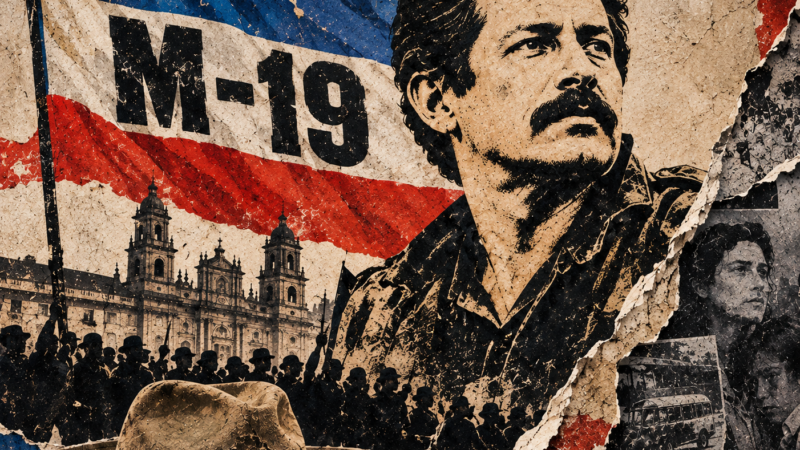
In the renovated Memoria y Nación (“Memory and Nation”) gallery, a ceremonial staff belonging to a Wayuu palabrero, or traditional mediator, was displayed alongside an ancestral stone necklace associated with the Wayuu, a gold fountain pen used to sign Colombia’s 1991 Constitution and an ingot made from weapons surrendered by the M-19 during its peace process.
For Góngora, the juxtaposition connects Indigenous heritage, constitutional democracy and the transition from armed struggle. He also noted that one object missing from the display had been removed before the latest controversy, making it important to distinguish earlier changes from the current intervention.
“Renewing a museum also means renewing its collections,” he said.
Historian Paolo Vignolo said the dispute threatens a process of institutional change that began decades ago.
“What is happening is outrageous because it brings to a halt a process that has been under way since the 1990s: the effort to bring institutions such as the National Museum into alignment with the 1991 Constitution.”
Vignolo stressed that the museum’s evolving approach was not simply a project of Gustavo Petro’s administration, but the result of work by generations of museologists, historians, anthropologists and communities. He described the recent intervention as “something that looked like a police operation and was, in fact, a presidential blitz.”
He also acknowledged that decisions under Petro, including changes in institutional leadership, had disrupted cultural and curatorial processes. The museum, he argued, should encourage debate rather than become an instrument of any administration.
For Ana María Forero, a philosopher and anthropologist at Universidad de los Andes, the National Museum has a responsibility that distinguishes it from institutions primarily devoted to displaying art.
“The National Museum represents something different from the Banco de la República museums or the MAMBO,” she said. Its constitutional role, in her view, is to represent Colombia’s multi-ethnic and multicultural identity through historical narratives that do not exclude entire communities.
Paola Castañeda, a professor at Universidad de los Andes, said the galleries under discussion had developed over several administrations, including initiatives during Iván Duque’s presidency. The changes, she argued, should not be reduced to a project imposed by one political camp.
“The danger here is not Petro versus Abelardo. It is a particular ideology against the diversity that is Colombia,” noted Castañeda.
She warned that a national narrative centred on a white or mestizo, Catholic, male and Andean ideal cannot marginalise Indigenous and Afro-Colombian communities, women and LGBTQ people. Recognising victims of guerrilla violence, she added, does not mean erasing those who suffered at the hands of paramilitaries or state actors.
Artist and professor Beatriz Eugênia Díaz likewise argued that the controversy concerned more than artworks. “What was removed included symbolic objects,” she said.
Díaz, 61, recalled supporting Carlos Pizarro’s presidential campaign in 1990. The former M-19 commander, who demobilised before running for president and was assassinated during the campaign, remains for her “a symbol of peace.”
“This is a country that is diverse — diverse in race, diverse in gender identities, and neurodiverse,” she said. “We are one of the most diverse countries, and that is a source of pride.”
The dispute cannot be resolved simply by declaring one political camp the guardian of historical truths. Whatever their format or medium, works that challenge established narratives, unsettle audiences or force uncomfortable questions should remain part of sustained public and curatorial debate. The answer to a difficult or controversial work need not be its removal, but a deeper examination of what it represents, whose history it tells and how it belongs within – or outside – the national story.
Art was never meant simply to make us comfortable. Its power lies in its ability to disturb, provoke thought and bring conflicting experiences into view. In a country as polarised as Colombia, a national museum should not seek consensus by smoothing over differences, nor deepen divisions by apologising for violence or imposing ideological revisionism on history. Or as a Spanish columnist Salúd Hernández-Mora believes: “The time will come when Colombia understands that we will not rid ourselves of violence if we continue down the path of glorifying criminals and eroding our values and principles. Nor will we overcome it by branding critics of a poorly conceived peace process as “war vultures” while praising those responsible for crimes against humanity.”
Its challenge for the new administration of President Abelardo de la Espriella is to reconcile spaces where difficult works and competing memories can be confronted, debated and understood — and where art might still help bring a nation together, however divided it remains.