
The 15th International Festival of Sacred Music of Bogotá enters its final week with a programme that brings together Renaissance polyphony, Latin American sacred traditions, and a grand adieu with Wolfgang Amadeus Mozart.
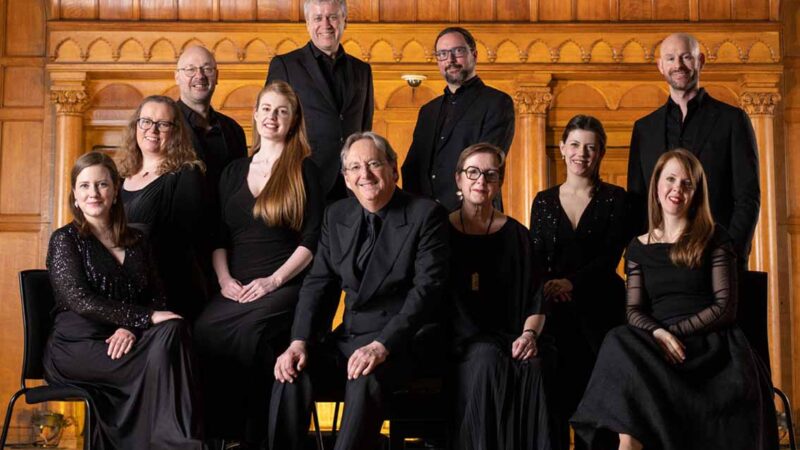
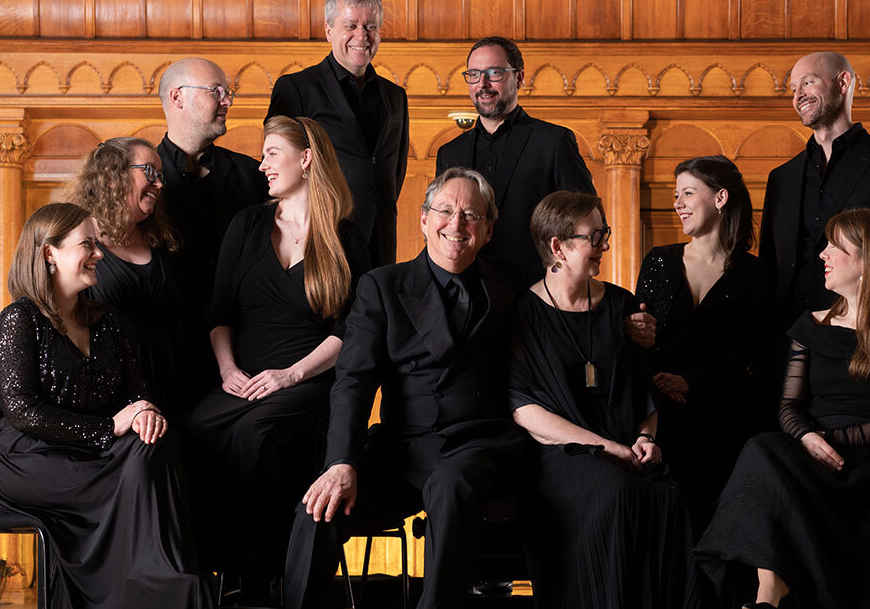
Among the week’s principal events is the Bogotá debut of The Tallis Scholars, the British vocal ensemble founded and directed by Peter Phillips, who has spent more than five decades developing one of the world’s most distinctive approaches to Renaissance choral music.
The ensemble performs on Thursday, October 1, at 6:30 p.m. at San Ignacio Church in Bogotá’s historic La Candelaria district. Their programme, Da Pacem: Paz en nuestros tiempos, brings together works by Palestrina, Gombert, Orlando di Lasso and Arvo Pärt around the theme of peace as both a spiritual and human experience.
Ahead of the concert, Phillips spoke with The City Paper about The Tallis Scholars, the sound he has pursued since founding the ensemble in 1973 and why, after more than half a century, very little has changed about what they do.
“We haven’t changed what we do,” Phillips says. “Over more than a half-century we have devoted ourselves almost entirely to Renaissance polyphony. What we were doing when we started is not very different from what we are doing now.”
The sound in his head
Phillips was still a second-year undergraduate at St John’s College, Oxford, when he founded The Tallis Scholars in November 1973. He had fallen in love with Renaissance choral music, but there was little opportunity to hear it outside the context of a church service.
He wanted to hear it in concert — and already had a very precise idea of how it should sound.
That idea became the foundation of The Tallis Scholars, grounded in the 16th Century English composer, Thomas Tallis.
Phillips’s approach emphasised exact intonation, vocal purity and transparency, avoiding the embellishments, swoops and fluctuations that can obscure the individual lines of Renaissance polyphony. The objective was clarity: every voice should be audible, balanced and part of a larger musical architecture.
“Our sound is still the sound I had in my head,” Phillips has said. “The music [is] sung with no embellishments, where you hear all the sounds clearly and transparently, evenly across the voices.”
It is an aesthetic that has remained remarkably consistent through generations of singers.
Phillips also resists describing The Tallis Scholars simply as part of the Early Music movement. For him, the ensemble occupies a different territory. “I don’t really think of us as part of the Early Music movement,” he says. “That was always about instruments, and we are only voices. Each and every individual singer is an instrument.”
Nor has his approach been based on recreating an imagined authentic Renaissance sound.
“It was never designed to be authentic,” Phillips says. “We have no idea what the choirs sounded like then. We have no idea what a choir sounded like inside the Sistine Chapel, back then.”
Instead, the project has been to make the complex architecture of Renaissance polyphony audible to modern ears.
That commitment has led The Tallis Scholars to remain unusually focused. There has been little interest in crossover projects, fragmented repertoires with a potpurri of musical genres and styles. For Philips, the repertoire on which Tallis Scholar was built is at the crux of the ensemble’s reputation.
The exception in Thursday’s Bogotá programme is Arvo Pärt, whose contemporary music is profoundly informed by the spiritual atmosphere and musical language of earlier centuries. “We aim to create musical atmospheres. The atmosphere is part of a musical narrative,” explains Phillips.
Pärt’s presence alongside Palestrina, Gombert and Orlando di Lasso gives Da Pacem a connection across time: Renaissance polyphony and contemporary sacred composition brought together around the idea of peace.
The final week of La Concordia
The Tallis Scholars’ concert is one of six major events marking the final week of FIMSAC 2026, whose 15th edition has been organised around the theme La Concordia.
The week began on Monday, September 28, at the León de Greiff Auditorium of the National University of Colombia, where the Coro Nacional del Perú, conducted by Javier Súnico, performed Alejandro Núñez Allauca’s Missa Andina. The work combines the structure of the traditional Mass with musical elements rooted in Andean cultures, creating a dialogue between Christian spirituality and Latin American identity.
On Wednesday, September 30, the Bogotá Philharmonic Choir and the Women’s Philharmonic Orchestra perform Cuban composer José María Vitier’s Misa a la Virgen de la Caridad del Cobre at the Minor Basilica of Our Lady of Lourdes. The work, written 30 years ago, brings together liturgical tradition and the musical roots of Cuba.
Then, on Thursday, The Tallis Scholars take the festival into the Renaissance and contemporary European sacred traditions.
The festival’s programme turns toward Mozart on Friday, October 2, when the Orquesta Sinfónica de Galicia begins a three-concert celebration marking the 270th anniversary of the composer’s birth.
At San Ignacio, under the direction of Spanish conductor and violinist Roberto González-Monjas, the orchestra will perform Mozart’s Violin Concerto No. 1 and the Requiem in D minor, K. 626, in Robert Levin’s revised and completed version. The performance, with the Coro Nacional del Perú, marks the Colombian premiere of this version of the Requiem.
The Mozart celebration continues on Saturday, October 3, also at San Ignacio, with González-Monjas performing Mozart’s Violin Concertos Nos. 2, 3 and 4 with the Orquesta Sinfónica de Galicia.
The festival closes on Sunday, October 4, with two concerts.
At 11 a.m. in the Luis Ángel Arango Concert Hall, the German duo Belli & Schmeding — trombonist Frederic Belli and organist Martin Schmeding — presents Que los ángeles nos acompañen, exploring the spiritual dialogue between trombone and organ.
The final concert takes place at 4 p.m. at San Ignacio, where the Orquesta Sinfónica de Galicia and the Coro Nacional de Colombia, again under González-Monjas, perform Mozart’s Violin Concerto No. 5 and Coronation Mass, K. 317.
Fifteen years of sacred music
The final week brings to a close a festival that has spent five weeks presenting sacred music across Bogotá. This year’s edition has brought together more than 1,000 artists from 16 countries at 25 venues across the city, placing Latin American, European and other sacred traditions in dialogue.
The festival’s theme, La Concordia, has been conceived not simply as a musical concept but as an invitation to encounter different cultures, periods, traditions and communities through music.
That idea is particularly resonant in the arrival of The Tallis Scholars.
For more than five decades, Peter Phillips has remained committed to a musical language first imagined while he was a student in Oxford: Renaissance polyphony sung with precision, transparency and restraint.
The sound he had in his head in 1973 has since become the defining sound of his renown vocal ensemble. On Thursday in San Ignacio, Bogotá will hear it for the first time.
Visit the festival’s official site www.festivalmusicasacra.com for the complete listing of concerts and ticket prices.