
A new exhibition at the Banco de la República in Bogotá brings together 19 recently acquired works exploring spirituality, ancestral knowledge, memory and the rituals of everyday life.
In a world defined by acceleration, information overload and increasing disconnection, the ritual has taken on a renewed significance. It can be a ceremony, a prayer, a meal, a journey, a medicinal preparation or simply a repeated act that connects one person to another, or to a place.
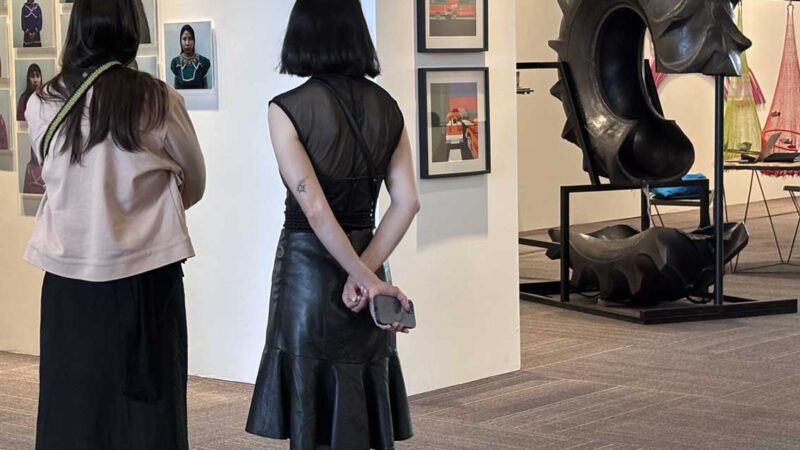
It is this idea that lies at the heart of Rituales, a new exhibition at the Biblioteca Luis Ángel Arango’s Casa Republicana in Bogotá, bringing together 19 works recently acquired by the Banco de la República between 2023 and 2026.
The exhibition considers ritual not simply as an inheritance from the past but as a living practice through which individuals and communities create meaning, preserve memory and negotiate their relationship with nature, territory and one another.
The works explore ceremonies of healing, religious practices, symbolic landscapes, funerary traditions and ancestral knowledge. Together, they move between the intimate and the collective, examining identity, memory, resistance and the ways in which cultural knowledge survives across generations.
The selection also reflects the breadth of the Banco de la República’s art collection. More than 200 works have been incorporated into the collection over the past three years, spanning a period from the 17th century to 2025 and encompassing a wide range of techniques, formats and artistic approaches.
Spirituality and resistance
Among the works on display are two videos by Medellín-born artist Astrid Milena González, whose practice explores Afro-Colombian knowledge and spirituality.
In Hablar a plantas, singing, medicinal plants and knowledge transmitted through Afro-Colombian communities become forms of resistance to poverty, violence and displacement. Traditional medicine appears not simply as a means of treating illness, but as a network of physical, spiritual and communal relationships with the natural world.
In Dale el señor el descanso eterno (2022), a black priest in a white cassock leads the viewer into a symbolic territory where Catholicism, Afro-descendant traditions, magic and memory intersect. The work constructs a ritual universe in which human, natural and supernatural forces coexist.
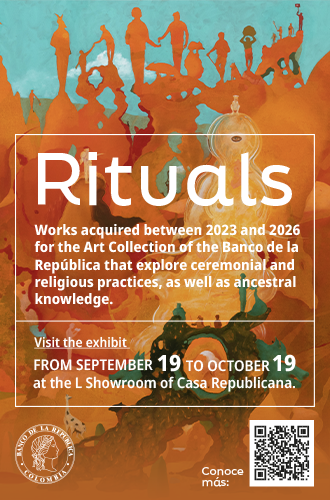
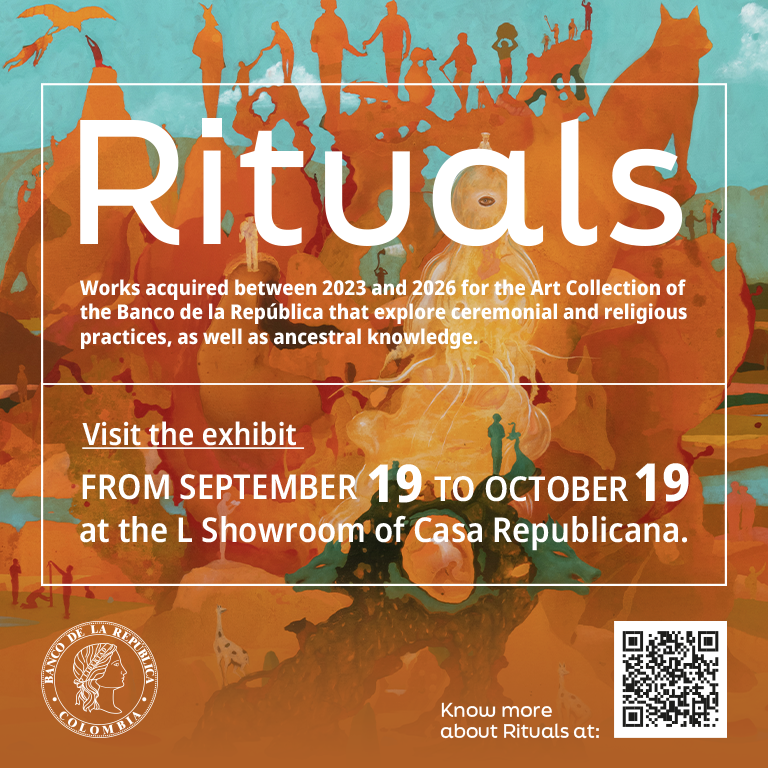
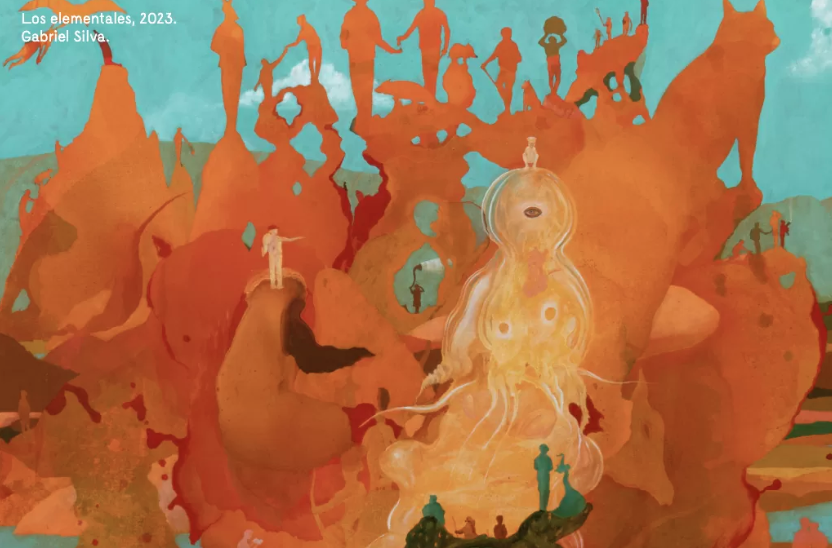
Gabriel Silva’s large-format painting similarly enters a dreamlike territory. Mythological and fantastical figures appear as silhouettes within an intensely coloured landscape, their bodies merging with an orange geography. The figures seem to participate in an enigmatic ceremony taking place in a primordial world.
For the late Colombian artist Luis Fernando Zapata (1951–1994), ritual becomes a metaphor for the final transition. His sculptural object evokes both a sarcophagus and a chrysalis, contrasting its substantial three-dimensional presence with the fragile materiality of paper. The work becomes a meditation on introspection, mortality and transformation.
Peruvian artist Adriana Ciudad takes the idea of passage into the landscape. Developed from research and fieldwork with communities on Colombia’s Pacific coast, her work draws on funerary and farewell rituals in which rivers are understood as pathways connecting different worlds. Painting becomes a means of exploring the relationship between memory, territory and spirituality, with the river functioning as a space of transition, encounter and transformation.
The theatre of nature
In El privilegio de las sobras (2024), Barranquilla-born artist Gonzalo Fuenmayor creates drawings that resemble the stage of a 19th-century European theatre. The curtain remains closed and lamps illuminate the scene, but the audience is not human. A tropical jungle occupies the stalls. The absurdity of the encounter creates a tension between European architectural opulence and tropical vegetation, suggesting a ritual about to begin but whose participants and purpose remain deliberately uncertain.
Bogotá artist Andrés Quintero’s Lenguas de alta montaña y aerolito ovino (2023–2024) takes ritual into the territory of the journey.
The installation, combining sculpture and video, began with a newspaper report about Raquel Vivas, born in La Floresta, Boyacá, and connected to the Nasa community, who participated in covering the interior of Apollo 11 with sheep’s wool.
From this unlikely connection between the Colombian highlands and the American space programme, Quintero began searching for meteorites in Boyacá. The journey became an exercise in attentive listening, observation and walking through the landscape.
Along the way, he encountered sculptural mounds of salt patiently shaped by sheep repeatedly licking them. The resulting installation transforms an apparently ordinary rural activity into a kind of ceremony.
Sacred and profane
The collision between ancestral traditions and contemporary urban culture is central to the work of Tahuanty Jacanamijoy, whose family heritage comes from the Sibundoy Valley in Putumayo and whose artistic formation has included Bogotá and London. In Tears in the club (2022), painting and neon bring together the sacred world of the Amazonian forest and the profane atmosphere of electronic nightlife.
A two-headed serpent, with one head resembling a bird and the other a jaguar, evokes complementary forces of light and darkness. Within Amazonian cosmologies, such forces contribute to the balance between different realms of existence.
In Testigo, a red neon sun fills the exhibition space with an otherworldly glow. It functions simultaneously as a sacred and spiritual figure and as an emblem of the nocturnal urban world.
The domestic sphere provides another entry point into ritual.
Medellín artist Yuli Andrea Cadavid’s Brebajes (2022–2023) consists of engraved aluminium cooking pots. The images depict plants associated with care and healing, while the worn surfaces of the vessels evoke the heat, intimacy and accumulated memory of the household.
Cadavid’s research into plants, cooking and regional traditions is closely connected to female lineages and the forms of knowledge transmitted through everyday life. The kitchen becomes a place where cultural memory is preserved and passed on.
Joyce Rivas’s photographic series Bien querer revisits archival material from the Inquisition concerning Afro-Caribbean women accused of witchcraft during the colonial period. Rivas reconstructs rituals of love magic, spells and ancestral knowledge involving plants and objects, treating them not as remnants of superstition but as forms of cultural resistance and survival.
The work establishes a dialogue between history, botany and contemporary art, reclaiming knowledge that was once persecuted and reframing it through questions of identity and memory.
In Semilla (2003), Santa Marta-born sculptor Teresa Sánchez reduces the idea of transformation to its most elemental form. Made from native marfil and cedar wood from Puerto Asís, the sculpture captures the moment of germination.
The enlarged seed becomes a metaphor for origin and passage. Its vertical growth connects earth and sky, turning a simple biological process into a meditation on spirituality and existence.
Elsewhere, ritual becomes intensely personal.
Daniela Acosta Parsons’s La Habitación (2019) emerged from the artist’s experience of hospitalization following a depressive episode. Through drawings of furniture, bedsheets, curtains and changing light, the work reconstructs fragmented memories of an institutional interior.
The room becomes both a physical space and a psychological landscape. Acosta transforms private experience into a visual diary, using drawing as an act of mourning, communication and reconstruction.
Across Rituales, these different approaches converge around a deceptively simple proposition: rituals are ways of making sense of being alive.
Some belong to communities and have been transmitted across centuries. Others are invented or rediscovered in kitchens, landscapes, nightclubs, bedrooms and journeys through the countryside.
What connects them is their capacity to create a pause.
At a moment when daily life is increasingly shaped by speed, distraction and information, Rituales suggests that repetition, memory and attention can themselves become acts of connection.
Rituales: Adquisiciones recientes en la Colección de Arte del Banco de la República runs from September 9 to October 19, 2026, at the Casa Republicana of the Biblioteca Luis Ángel Arango in Bogotá. Calle 12 No.4-37. Admission is free.
Visit BanRep’s official site for more information: https://www.banrepcultural.org/exposiciones/rituales