
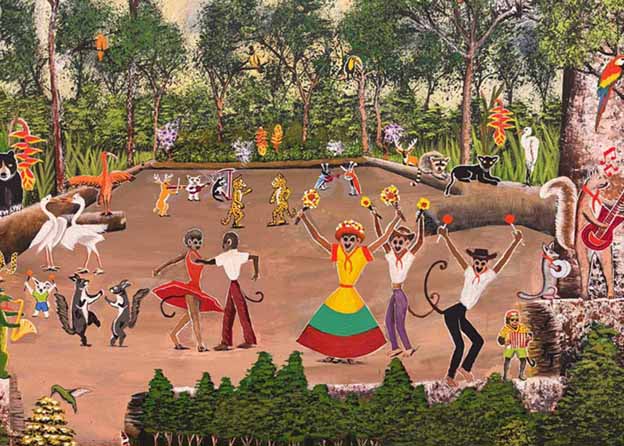
Imagen Regional 10: Insistir, resistir brings together artists from seven Colombian regions in an exhibition that examines the country’s cultural identity, ancestral knowledge and collective memory through contemporary art.
BOGOTÁ – Colombia’s artistic identity cannot be understood from its capital alone. Beyond Bogotá’s established galleries and cultural institutions, a diverse creative landscape is shaped by regional histories, ancestral traditions, environmental change and the experiences of communities often overlooked in the national conversation. Bringing these perspectives together, the Museo de Arte Miguel Urrutia (MAMU) presents Imagen Regional 10: Insistir, resistir, an exhibition that offers a compelling portrait of contemporary Colombian art beyond the country’s traditional cultural centres.
Organised by the Banco de la República, the exhibition brings together 70 artists from seven regions, selected following a nationwide process that attracted more than 1,200 participants. It marks the tenth edition of Imagen Regional, a programme established more than three decades ago to support artistic production, encourage cultural exchange and make visible creative practices emerging throughout Colombia.
The works presented in Bogotá originate from seven regional exhibitions held in 2025 at Banco de la República cultural centres in Santa Marta, Cartagena, Cúcuta, Ibagué, Armenia, Cali and Pasto. Fifteen artists from each region were selected, with seven invited curators developing individual approaches to the relationships between art, territory and society.
Rather than imposing a single interpretation of Colombian identity, Insistir, resistir creates a conversation between different geographical and cultural experiences. Its themes include collective memory, spirituality, displacement, environmental transformation, inequality, community relationships and the preservation of ancestral knowledge.
Among the works that particularly invite closer attention is El envenenamiento del pan (The Poisoning of the Bread), a 2024 oil painting by Boyacá-based artist Brayan Molina (Chiquinquirá, 1993). The work revisits one of the most devastating episodes in the history of his hometown: the mass poisoning of 25 November 1967, when flour contaminated with the agricultural pesticide Folidol was used in bread production, killing more than 85 people, most of them children.
Molina approaches the tragedy through a vivid composition that recalls the narrative and sequential imagery of early Renaissance painting. Rather than treating the event as a distant historical record, the artist confronts viewers with the human consequences of negligence, inadequate transport safeguards and commercial irresponsibility. The painting is associated with the exhibition’s curatorial theme of Territories and Social Tensions, reflecting how poor infrastructure, unsafe transportation and the pursuit of commercial interests contributed to a catastrophe that affected an entire community.
Born in Chiquinquirá, Molina brings an unmistakably local perspective to this painful episode. His painting becomes an act of remembrance, transforming a chapter of regional history into a contemporary reflection on accountability, collective trauma and the responsibility owed to communities.
A different relationship with memory and cultural inheritance emerges in Rastros y rostros: ancestralidad, by Óscar Darío Linares (Otanche, Boyacá, 1968). The artist travelled to Indigenous communities in the department of Cauca, particularly the Tierradentro area of the municipality of Páez, where he spent time with Nasa elders and traditional knowledge holders, participating in rituals and spiritual ceremonies. He documented moments from these encounters through photography, recording practices and experiences that left a lasting impression.
The journey prompted a personal reconnection with the cross-stitch embroidery practised by his mother. Linares began transferring photographic imagery into textile work, bringing together two visual languages that might initially appear unrelated: photographic documentation and traditional embroidery.
The resulting dialogue invites reflection on interculturality, the transmission of knowledge between generations and the ways cultural identities survive through everyday practices. In Linares’s work, embroidery moves beyond its domestic associations to become a vehicle for memory and cultural expression.
The encounter between his family history and the spiritual traditions of the Nasa community also raises questions about how artistic practice can create connections between different forms of knowledge without erasing their particular identities.
Together, Molina and Linares offer two distinctive approaches to the exhibition’s central concerns. One looks back at a historical tragedy to confront the consequences of human negligence; the other explores the continuity of ancestral knowledge through encounters between photography, spirituality and textile tradition. Both demonstrate how artistic creation can preserve experiences that might otherwise fade from collective memory.
Their works form part of a much wider curatorial conversation. Across the seven sections, artists examine the relationship between individuals and their territories, the fragile conditions of coexistence, the movement of communities and the environmental and social pressures reshaping everyday life.
There is also a broader institutional significance to Imagen Regional. For 31 years, the Banco de la República programme has worked to make artistic production outside Colombia’s principal cultural centres more visible, supporting exchanges between artists, curators and communities. Its tenth edition reinforces the importance of looking beyond the capital when considering the country’s contemporary cultural landscape.
At the MAMU, these regional voices are brought together without losing their individual character. The result is not simply a survey of contemporary Colombian art, but an invitation to reconsider the histories, traditions and social realities that shape the country.
For visitors to Bogotá, Imagen Regional 10: Insistir, resistir offers an opportunity to encounter a Colombia that is diverse, complex and continually redefining itself. Its artists remind us that resistance is not always expressed through confrontation. Sometimes it takes the form of a painting that refuses to let a tragedy be forgotten, a photograph translated into a grandmother’s or mother’s embroidery tradition, or the quiet preservation of knowledge passed from one generation to the next.
Imagen Regional 10: Insistir, resistir is on view at the Museo de Arte Miguel Urrutia (MAMU), Banco de la República, in Bogotá, from 12 November 2026 until 8 February 2027.