
After confronting FARC dissidents for the car bombing in Villavicencio, Colombia’s Abelardo de la Espriella travelled to Cartagena, where an overnight operation freed the remaining 20 hostages in the Éxito supermarket siege.
BOGOTÁ – Colombia has witnessed 24 hours of extraordinary security pressure, as a car bomb in Villavicencio was followed by a hostage crisis inside an Éxito supermarket in Cartagena. At the epicenter of both events was the country’s hardline President Abelardo de la Espriella, who moved from the aftermath of an attack on a government building in Meta to the scene of a tense, 16-hour standoff on the Caribbean coast, ending with the release of every hostage.
The two incidents were unrelated, involving different perpetrators and very different security challenges. But together they provided an immediate test of the government’s promise to confront criminal and armed organizations through a more forceful deployment of the state.
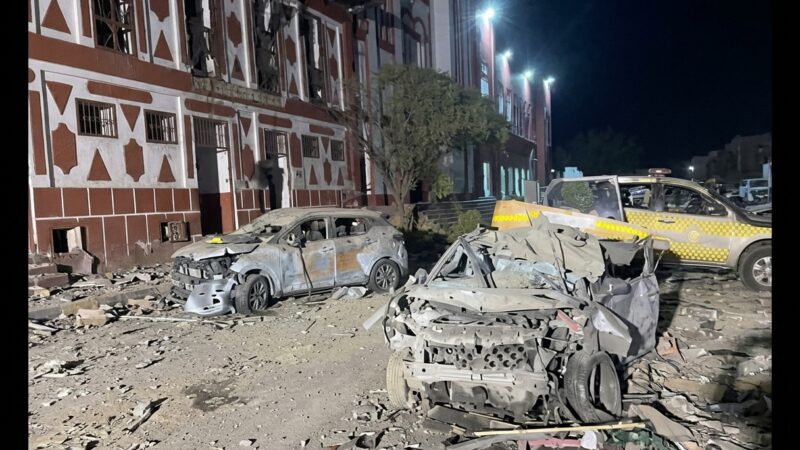
The crisis began late Monday, November 23, when a car bomb exploded outside the Meta Governor’s Office in central Villavicencio. The blast injured at least 23 people and caused extensive damage to the government building, nearby businesses and vehicles. The explosion also damaged the city’s cathedral and destroyed a restaurant, leaving a scene of shattered glass, debris and wreckage.
On Tuesday morning, De la Espriella travelled to Villavicencio, where he directly blamed the attack on Antonio Medina, a commander of FARC dissident forces associated with the Estado Mayor Central (EMC). The president said the bombing was retaliation for the government’s military offensive against armed groups in the region. “Antonio Medina is responsible. We are going after him and will make him pay with blood for all the damage and terror he is sowing,” De la Espriella told reporters at the scene.
He argued that the attacks were a consequence of the pressure being applied by the state. “Do you know why they are doing this? Because we are confronting them,” he said, adding that the government would pursue the dissidents with the support of the security forces. “We cannot allow criminality to do whatever it wants,” he stated emphatically.
The president also announced that resources had been made available for the reconstruction of the governor’s headquarters and other damaged structures. His message was that the bombing would not force the government to retreat from its security strategy. “The narco-terrorists are running wild, launching desperate attacks, because they know we are defeating them and that their end is near,” he wrote in a statement on social media.
But as the president addressed the aftermath of the Villavicencio bombing, another security emergency was unfolding some 900 kilometres away in Cartagena.
At approximately 8:30 a.m. on Tuesday, armed men entered the Éxito supermarket in the La Castellana neighbourhood, following a failed attempt to rob an armoured cash-in-transit vehicle. According to authorities, the suspects were trapped by the rapid police response and took refuge inside the supermarket, where they seized approximately 30 people, including employees and customers.
The situation quickly developed into a major hostage crisis. Police and military personnel surrounded the commercial complex, specialist units were deployed and negotiations began. Ten hostages, including several elderly women, were released during the day. Around 20 people remained inside as night fell.
The operation also disrupted activity at Cartagena’s Rafael Núñez International Airport, where landings were temporarily suspended for approximately 45 minutes while the Armed Forces used a runway in connection with the security response. The interruption underscored the wider implications of a crisis unfolding in one of Colombia’s principal tourist destinations.
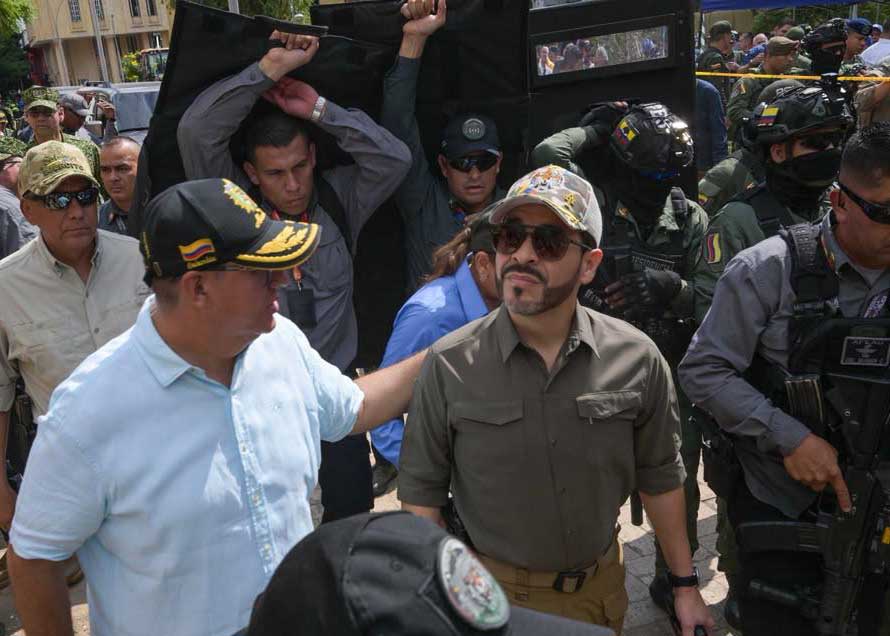
De la Espriella, who happened to still be in Villavicencio when the hostage crisis began, announced that all available capabilities of the National Police and Army had been deployed, including elite special forces and the anti-kidnapping unit (GAULA). He subsequently travelled to Cartagena, arriving at the scene on Tuesday night, where he met senior military and police commanders.
Wearing military fatigues and carrying a radio, the president was visibly present as the operation entered its decisive phase. He said the priority was to protect the hostages while giving the perpetrators an opportunity to surrender.
The remaining captives were freed at approximately 1:30 a.m. on Wednesday, November 25, when police and military units entered the supermarket in a coordinated operation. De la Espriella confirmed outside Éxito that all the hostages had been rescued. One of the captors was killed during the intervention. “In an extraordinary joint operation between the National Police and Armed Forces, all the hostages have been rescued,” the president announced in a video message.
“This operation was absolutely impeccable,” he said. “As soon as I arrived in Cartagena and reviewed what was happening with the military and police leadership, I authorized the operation, which, as I say, has been absolutely successful.”
De la Espriella said the perpetrators had been given the opportunity to surrender and release their captives but had rejected it. “We gave them the opportunity to surrender and free the hostages. They rejected that opportunity, and we acted decisively.”
His most forceful declaration came in a statement that reflected the central message of his administration’s security policy. “When the State makes up its mind, it never loses,” he said. “Anyone who seeks to bring the State, the Government or working citizens to their knees will find a lethal response from this Government and our Public Forces.”
He also went on to congratulate the members of the National Police and Armed Forces who participated in the rescue, ending his remarks with a public expression of support for the country’s security institutions.
The Cartagena operation represents a significant victory for the new government. A hostage situation involving some 30 people, in a busy commercial district in a city that depends on tourism, could have ended in a devastating loss of life. Instead, every captive was freed.
The two events over 24-hours also illustrates the scale of Colombia’s security challenge. In Meta, the government must now launch a decisive offensive against alias Antonio Medina and FARC dissidents capable of carrying out attacks in populated civilian areas. In Cartagena, an attempted robbery escalated into a prolonged hostage siege that threatened the lives of workers and customers.
For De la Espriella, the message to Colombians is unmistakable: the state will not surrender authority to any criminal group. In Cartagena, at least, that message was accompanied by the safe return home of every hostage.