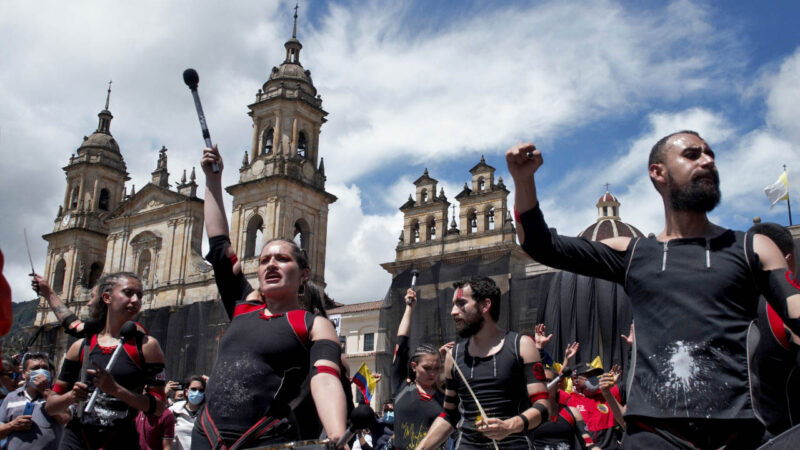

There is nothing particularly controversial about protecting the right to protest. Colombia’s Constitution does it. A democracy needs it. Governments should expect citizens to march, demonstrate, criticize and, when necessary, confront those in power.
But there is an equally important principle: the right to protest cannot become a licence to destroy.
That is the premise behind the Ley Anticapuchos, a new bill presented to Congress by representatives Jaime Arizabaleta of Centro Democrático and Julio César Triana of Cambio Radical, together with lawmakers from several regions and political parties. The proposal would create a specific criminal offense for people who conceal their identities in order to commit vandalism during public demonstrations.
The proposed punishment is substantial: between 54 and 96 months in prison, or four-and-a-half to eight years, accompanied by fines of between 50 and 200 monthly legal minimum wages. The penalty could increase by two-thirds where explosives, improvised dangerous devices, corrosive substances or other means capable of seriously injuring people or damaging property are used.
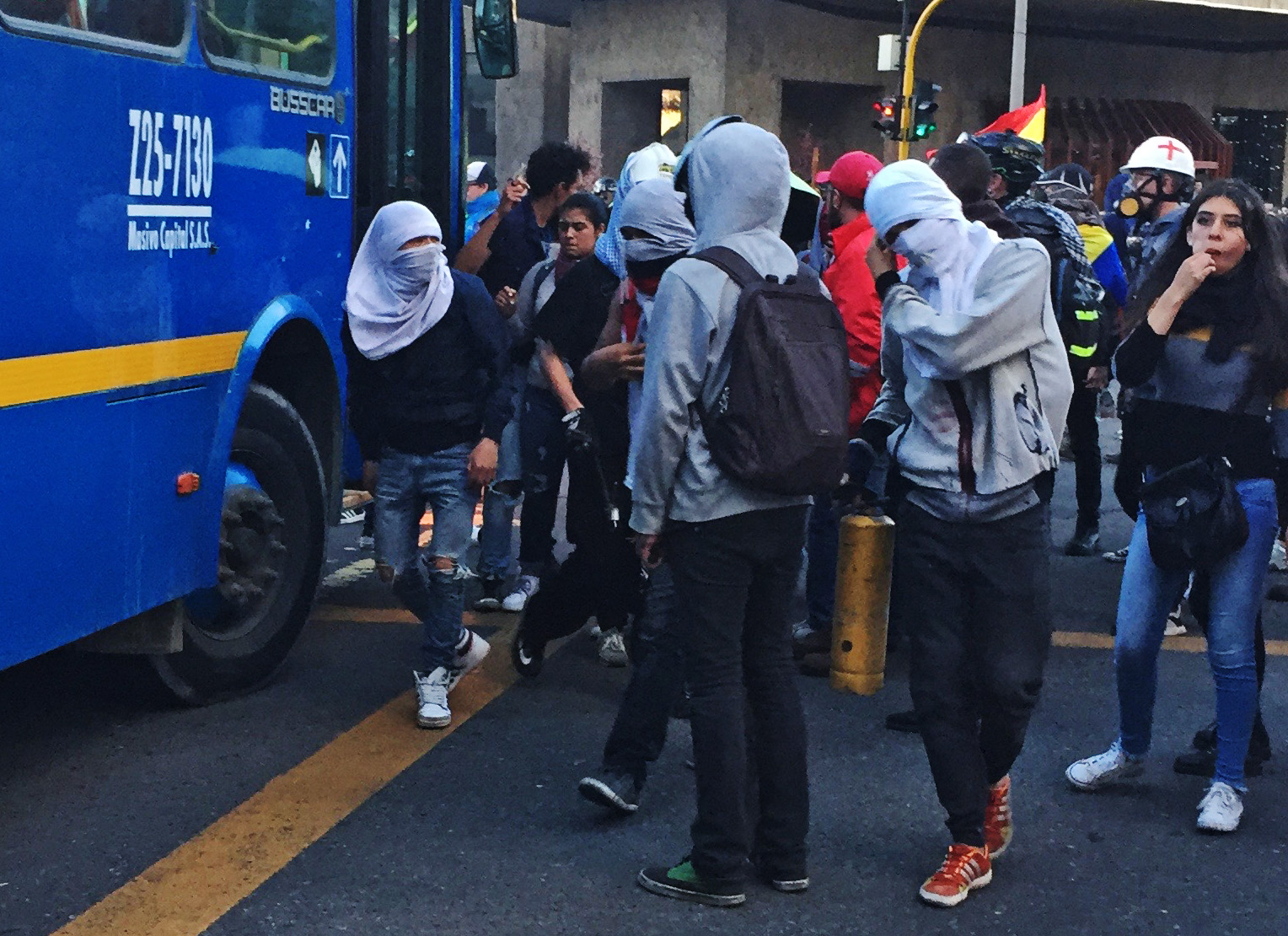
The important point — and one that should not be lost in the inevitable political argument over the bill — is that the proposal does not make wearing a hood or covering one’s face a crime. It targets the use of concealed identity as a means of facilitating vandalism or other criminal conduct during a demonstration.
That is a reasonable distinction. Colombia has already seen where the line can disappear. Colombia has spent years learning what happens when that distinction becomes blurred.
The country’s Paro Nacional of 2021 remains the clearest example. Beginning on April 28, the mobilization produced enormous demonstrations across Colombia. But alongside legitimate protests came violent confrontations, attacks on police facilities, destruction of public and private property and prolonged blockades of roads and transportation infrastructure.
In Bogotá, the CAI — Comandos de Atención Inmediata, the small police posts embedded in neighbourhoods throughout the capital — became particular targets. Public transportation infrastructure was attacked, commercial premises were damaged and city streets were repeatedly transformed into battlegrounds.
Whatever one’s political interpretation of the 2021 uprising, the destruction cannot be dismissed as an incidental detail. Nor can the prolonged road blockades, which at their height disrupted the movement of food, fuel, workers and essential goods during a period when Colombia was still confronting the COVID-19 pandemic.
The lesson should not be that Colombians should stop protesting. It should be the opposite: peaceful protesters deserve better protection from those who turn demonstrations into opportunities for violence and destruction.
That is where the Ley Anticapuchos makes its strongest argument.
Anonymity should not become a shield for criminal conduct
A person who marches peacefully, carries a sign, chants a slogan or criticizes the government should not be treated as a criminal.
But someone who uses the anonymity of a crowd and a concealed face to smash windows, torch police stations, destroy transportation infrastructure or assault another person should not be able to invoke the right to protest as a defense against the consequences of that conduct.
There is an obvious practical problem with masked vandalism: identification becomes harder and accountability more difficult. Police investigations do not always have the resources to identify people who deliberately conceal themselves while committing crimes.
The bill attempts to address precisely that problem.
Under the proposed legislation, people who illicitly incite, direct, coerce or provide the means for blockades that threaten life, public health, food security, the environment or the right to work could face the same basic range of prison sentences and fines.
This is significant because a road blockade would be considered a criminal act when it prevents ambulances from moving, interrupts food distribution, prevents workers from reaching their jobs or cuts off communities from essential supplies.
Congress must protect protest while defining criminal conduct precisely
The challenge for Congress will be to ensure that the final legislation is drafted with sufficient precision to withstand constitutional scrutiny.
The state must not be given a vague instrument that could be used against peaceful demonstrators. Nor should legitimate civil disobedience automatically be equated with criminal vandalism.
But precision should not become paralysis.
The Ley Anticapuchos is ultimately about accountability. Its sponsors are arguing that Colombia has spent too long allowing the symbolism of protest to obscure the reality of criminal acts committed within protests.
As Triana argues, the objective is not to prevent demonstrations but to give authorities stronger tools against those who use anonymity to evade responsibility. Arizabaleta has made essentially the same case, arguing that the overwhelming majority of people who protest do so without concealing their identities or committing vandalism.
The distinction is fundamental.
Protest is an exercise of freedom. Vandalism is an abuse of it.
The dubbed “Hooded Law” is an attempt to inscribe this distinction into Colombia’s criminal code while preserving the constitutional safeguards that protect peaceful protest. That is a legitimate objective in any democracy.
The test for Congress will be whether it can achieve it without criminalizing dissent. If it can, Colombia will not have weakened the right to protest. It will have strengthened the principle that makes peaceful protest possible in the first place: freedom comes with responsibility, and anonymity cannot be a shield for harrassment or politically-motived victimization.