
A craggy sandstone escarpment skirting the rural township of Nuevo Tolima, in the department of Guaviare, holds more ancient images than many of the world’s most celebrated museums. Painted high on a sun-bleached rock face, these ochre figures – once abandoned for millennia by their creators and long concealed from most Colombians by the fog of armed conflict – are now emerging as one of the most extraordinary archaeological treasures in the Americas.
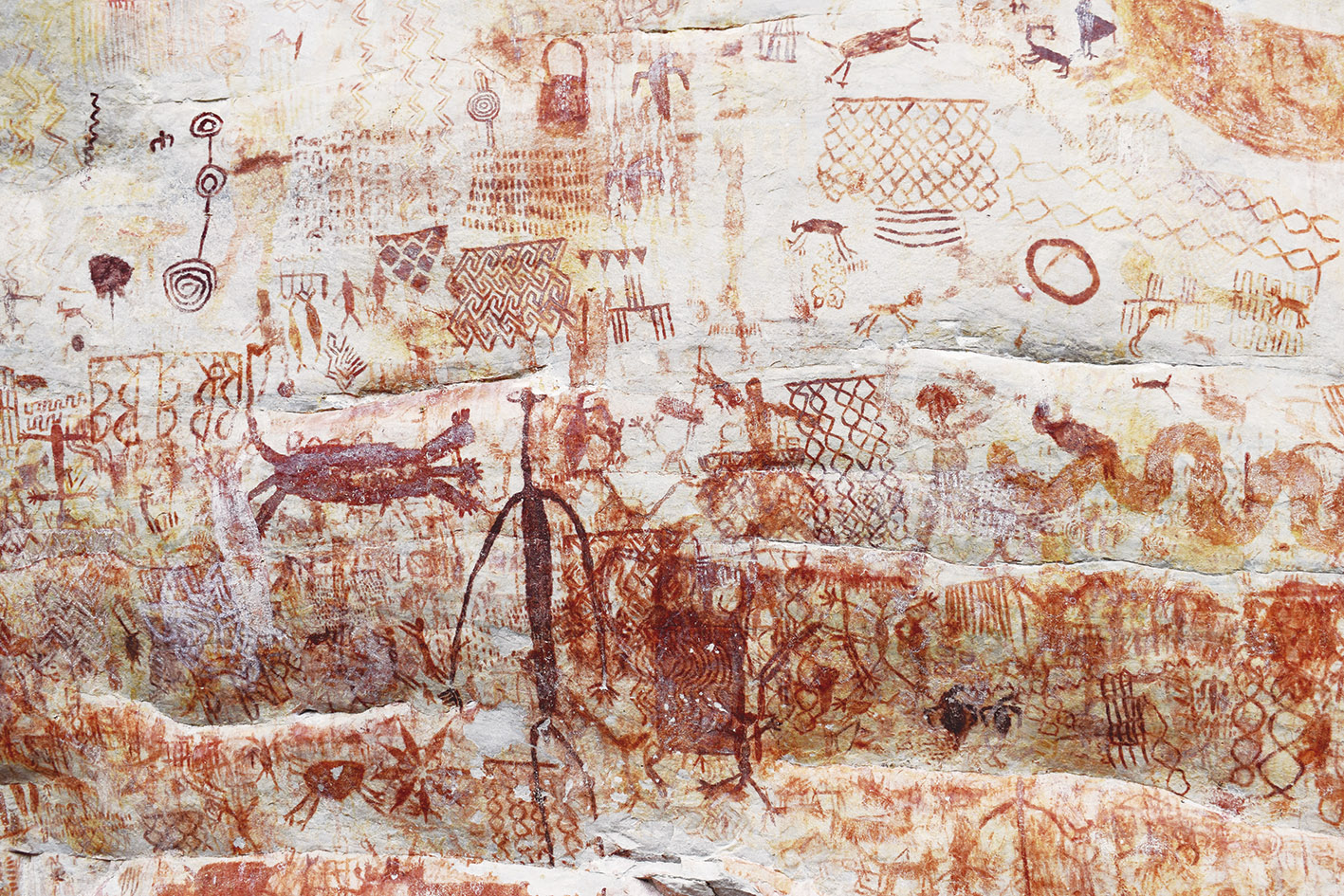
For decades, few outsiders reached Serranía La Lindosa. These reddish cliffs were wedged within a landscape contested by the Colombian Army and the Revolutionary Armed Forces of Colombia (FARC) guerrilla, a rugged hinterland where patrols, ambushes, and aerial surveillance rendered scientific exploration nearly impossible. But peace opened a window. And that window revealed thousands of pictograms—fiery red silhouettes of armadillos, deer, monkeys, boas, birds, geometric shapes, and towering anthropomorphic figures—stretching across the cliff walls in long, continuous tapestries.
Anthropologists and archaeologists now believe that the artists who painted these scenes inhabited the region as early as 10,000 B.C., at the end of the last Ice Age. If dating continues to confirm early occupation, the murals of La Lindosa could rank among the oldest known pictorial records on Earth, potentially predating Europe’s famed Paleolithic caves at Lascaux. But while Lascaux receives busloads of visitors, La Lindosa still feels like a secret whispered between the forest and the sky.
Reaching the site requires more grit than guidance. After paying a local farmer roughly 2,000 pesos—less than a U.S. dollar—visitors must cross a field patrolled by nervous Brahman bulls before climbing a steep ravine cut by tropical rains. The path narrows into a chute of exposed roots and mud; ladders, slick with moss, connect one ledge to another. Vines, neon green and twitching in the wind, can resemble coiled snakes to the anxious eye. Only after negotiating these obstacles does one step onto a narrow platform where the landscape suddenly unfurls—the Eastern Plains sweeping toward the horizon, the walls of La Lindosa rising above like a cathedral carved by time.
It is here, in the hush of this natural gallery, that the paintings begin to speak.
Some figures appear freshly brushed, their red pigments bright against the stone. Others have faded to ghostly outlines. Together they record a world long vanished: giant sloths, ancient birds, early domestications, and ritual scenes whose meaning, though obscured by time, hints at a cosmology deeply rooted in the forest. The sheer scale of the imagery – kilometers of painted rock, perhaps thousands of individual motifs – suggests a tradition maintained by generations of artists.
Despite the remoteness, the human footprint is increasing. Guaviare has become a post-conflict frontier for adventurous travelers, local school groups, and Colombians rediscovering regions once closed by violence. Several hundred visitors now reach La Lindosa each year. Most tread lightly. But not all.
Trophy vandals have chipped at the achiote-colored surface of the cliffs. Others have scrawled hearts, initials, or football club logos over the animal figures. Even small scratches can permanently destabilize ancient pigment, and each careless mark erases information scientists have only begun to decode. With tourism rising and infrastructure still minimal, the urgency to protect these panels has reached a critical moment.
Responding to appeals from Guaviare’s department authorities and researchers from the National University of Colombia—who have led major field studies in the region—the Colombian Institute of Anthropology and History (ICANH) has officially designated Serranía La Lindosa a Protected Archaeological Area (AAP). The protection covers 893 hectares, placing the site under the same legal safeguarding as some of Colombia’s most revered archaeological landscapes: Piedras del Tunjo in Facatativá; El Infiernito in Boyacá; Teyuna–Lost City in Magdalena; and the monumental sculptures of San Agustín and Isnos in Huila.
It is a timely decision. La Lindosa lies at the natural doorstep of Chiribiquete National Natural Park, Colombia’s largest protected area and an ecological sanctuary for jaguars, rare primates, and endemic flora. Chiribiquete is itself home to vast galleries of ancient rock art—thousands of walls still closed to visitors to preserve the park’s fragile ecosystems and the Indigenous groups living in voluntary isolation within its boundaries. La Lindosa, therefore, functions as an accessible threshold to a much larger, still-hidden world.
With La Lindosa’s new status, Colombia now counts 21 Protected Archaeological Areas—a network that stretches from high Andean valleys to Caribbean coastal mountains. Yet the task is only beginning. Protection on paper must translate into real management: trained guides, defined trails, educational programs, and community stewardship that supports local livelihoods while safeguarding the art.
Standing before the cliff paintings at dusk—when the sun ignites the red pigments and turns the forest canopy into a glowing sea—it is easy to understand why researchers describe La Lindosa as a message from the deep past. These figures seem to address us through a veil of time, reminding us of a world more intertwined with nature, more attuned to cycles of life and spirit.
If protected well, this Amazonian masterpiece will continue speaking long after us. Its creators may be unknown, but their legacy endures—etched on a sandstone wall that has become Colombia’s own Sistine Chapel of the Amazon, a living tapestry of hues and memory to be safeguarded by all generations across the annals of time.