

After meticulous planning and several arduous journeys to Colombia’s easternmost frontiers, British photographer Piers Calvert reached the tiny hamlet of Puerto Córdoba, a settlement tucked into a bend of the lower Caquetá River. Here, deep in the Colombian Amazon, the forest closes in like a breathing wall of green, and travel is measured not in miles but in hours of river currents and shifting light. Calvert had come in search of something extraordinarily fragile: the living tradition of indigenous body painting, a practice that endures among a handful of Amazonian peoples despite decades of conflict, displacement, and cultural upheaval.
Calvert, who has spent years documenting Indigenous cultures across Latin America, was granted rare permission by the leaders of the Yucuna and Tanimuca communities to photograph the Baile del Chontaduro – an ancestral celebration held each February when the peach-palm fruit ripens. The festival is part ceremony, part gathering of extended clans, and part reaffirmation of identity. For outsiders, it is seldom witnessed; for photographers, almost never recorded. “Access like this depends entirely on trust,” Calvert says. “You arrive not as an image-maker but as a guest.”
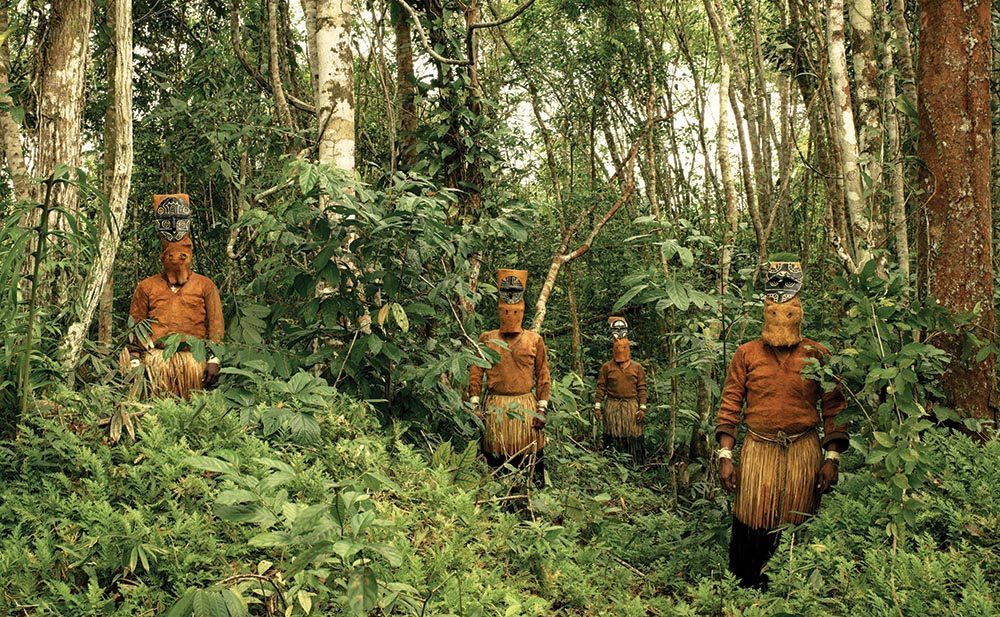
The Baile del Chontaduro begins at dusk. As the sky dims, the community prepares with pigments made from genipa juice, charcoal, and ground achiote seeds—organic materials that stain the skin in earthen blacks and radiant reds. Under the glow of firelight, intricate lines and symmetrical patterns emerge on faces, chests, and arms, transforming dancers into embodiments of ancestral stories. For the Yucuna and Tanimuca, these designs do more than adorn: they link the living to their mythic origins, to spirits of the forest, and to cycles of fertility and renewal.
Calvert’s portraits capture this liminal moment between person and persona. His images—rich in texture, striking in their intimacy – celebrate the aesthetic diversity of Colombia’s more than 100 Indigenous groups. Yet they also document something increasingly at risk. The photographic record of Indigenous communities in Colombia remains surprisingly thin, a gap widened by the country’s five decades of internal conflict. “For years, the only photographers who spent time in Amazonas, Vaupés, or Guaviare were conflict correspondents,” Calvert notes. “And conflict was all they could safely cover.”
Calvert’s The Way We Are Now reached the Colombian Consulate in London, and highlights both beauty and fragility: cultural practices that have endured against overwhelming odds. Calvert’s approach owes a quiet debt to earlier explorers. Among his inspirations is the ethnobotanist Richard Evans Schultes, whose mid-20th-century expeditions revealed the botanical and cultural wealth of the northwest Amazon. Another is a single, haunting black-and-white photograph taken in 1908 by British explorer Thomas Whiffen, depicting painted Okaina girls along an Amazonian tributary.
More than a century later, Calvert’s images echo that same sense of suspended time. They stand as a testament to body art not as ornament but as language – a visual archive carried on the skin. In a forest where cultural memory can be as fragile as the wings of a morpho butterfly, his work reminds us that the Amazon’s stories are still being told, still being danced, and still being painted in patterns older than any map.