
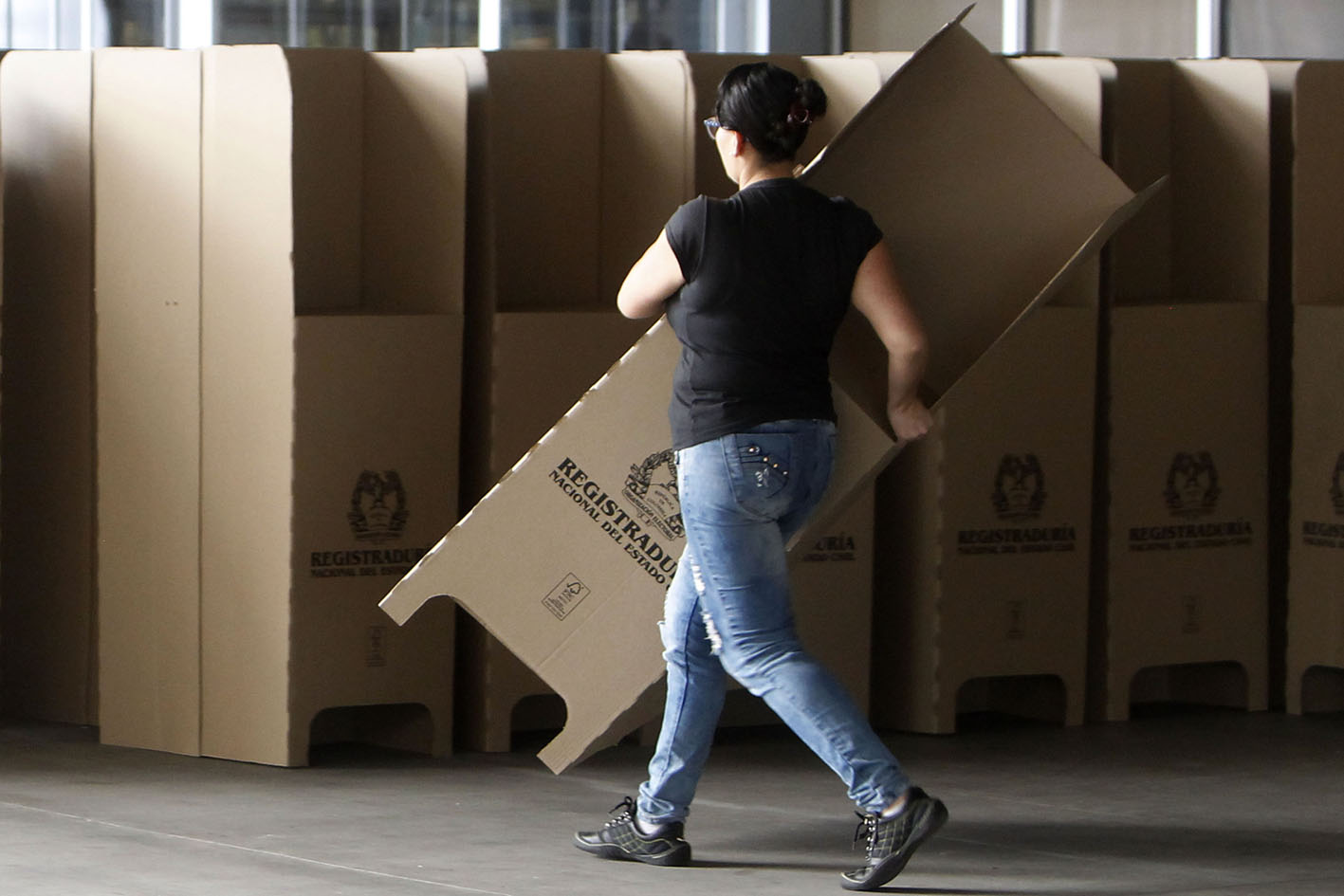
Colombians head to the polls on March 8 for what is, formally, a legislative election. In practice, it is something more consequential: a stress test of the country’s political coalitions ahead of the May 31 presidential race already defined by fragmentation – and by mounting security concerns for right-wing candidates.
The vote for Congress matters. But the country will be watching the consultas presidenciales—three parallel primaries that function as a de facto first round. In them, Colombians vote less for programs than for trajectories: continuity, rupture, or something in between.
On the right, Paloma Valencia is poised to dominate La Gran Consulta, a coalition spanning moderate conservatives, independent liberals, and slate of well-known political leaders. Polling places her far ahead of her rivals, with margins large enough not merely to win, but to define the bloc itself. In a pre-Petro era, such a coalition might have fractured under its contradictions, but today, it coheres around one single objective: opposition to the government of Gustavo Petro and the restoration of order- political, fiscal, and territorial.
Valencia’s strength is not only electoral; it is structural. She inherits the Centro Democrático machinery and the disciplined base loyal to former two-term president Álvaro Uribe, whose legacy continues to shape Colombia’s right. But her challenge begins the moment she wins. The right is not unified—it is merely aligned. To convert alignment into victory, she will need to reach out to Abelardo de la Espriella, a pro-Bukele, pro-Milei, lawyer whose mass appeal is rooted in a more visceral, anti-left electorate. If Valencia succeeds in clinching La Gran Consulta, the right could reach May 31 not only united, but energized. If she fails, she risks replaying a familiar Colombian pattern: ideological proximity undone by personal rivalries.
With “El Tigre” de la Espriella lurking in the shadows, the right looks ascendant. Uribe Vélez now faces the daunting challenge of fusing his CD base with Espriella’s fervent Defensores de la Patria.
A Spectral Center
Claudia López is expected to win her consultation comfortably, aided as much by the absence of strong rivals as by the presence of loyal supporters. Her likely vote total- perhaps around one million—will be spun as a comeback. In reality, it reflects the residual strength of her partisan mayoralty and Bogotá-based electorate.
The absence of Sergio Fajardo from the Consulta de las Soluciones underscores the fragmentation of Colombia’s center. A strong showing by López will force a choice: seek alliances quickly or face marginalization after March 8. Even a López–Fajardo ticket would face sharp criticism from within their respective bases, and risk a repeat of the 2022 election season in which Sergio Fajardo’s campaign imploded under the weight of Petrismo or Uribismo.
On the left, the situation is more fluid – and more revealing.
The exclusion of Iván Cepeda has transformed the Frente por la Vida into a contest between two practitioners of political adaptation: Roy Barreras and Daniel Quintero. Neither represents the ideological hardline of Petrismo. Both instead offer variations of what might be called continuity without commitment – a “Petrismo 2.0” calibrated for chaise-lounge socialists.
Barreras relies on organization, his tenure as a loyal Petro “insider”, and the quiet efficiencies of Colombia’s territorial elites. Quintero counters with a direct, anti-Uribe narrative amplified through social media. Each seeks not to replace Petro, but to reinterpret him. Yet the Barreras-versus-Quintero contest feels less like a continuation of an embattled political project than an attempt for both candidates to repackage their political futures.
The most important actor on the left may be Petro himself – precisely because of his absence. By declining to endorse the consultation, he has deprived it of coherence. The result is a referendum on his government without his direct participation, and turnout that may struggle to reach even one million voters. In political terms, that is not a mobilization. It is a warning.
What emerges from these three contests is not a country coalescing, but one sorting itself into sharper, more disciplined minorities. The right is concentrated and motivated. The left is divided and improvisational. The center is present, but peripheral.
Then there is the largest bloc of all: those who will not participate. Polling suggests that a majority of Colombians will abstain from the primaries altogether. This is not apathy in the conventional sense. It reflects something more structural – a growing distance between citizens and political mechanisms that no longer seem to mediate power so much as ratify it.
In that respect, March 8 clarifies less about who will win than about how Colombia now conducts politics. Elections no longer aggregate a national will; they stage competitions between organized intensities. Victory belongs not to the broadest coalition, but to the most cohesive one.
By Sunday night, the candidates will claim momentum. Some will have earned it. Others will have inherited it. But all will confront the same reality: the path to the presidency no longer runs through the mythical Colombian center. It runs through blocs – disciplined, polarized, and increasingly unwilling to transcend partisan loyalties for the greater good.