

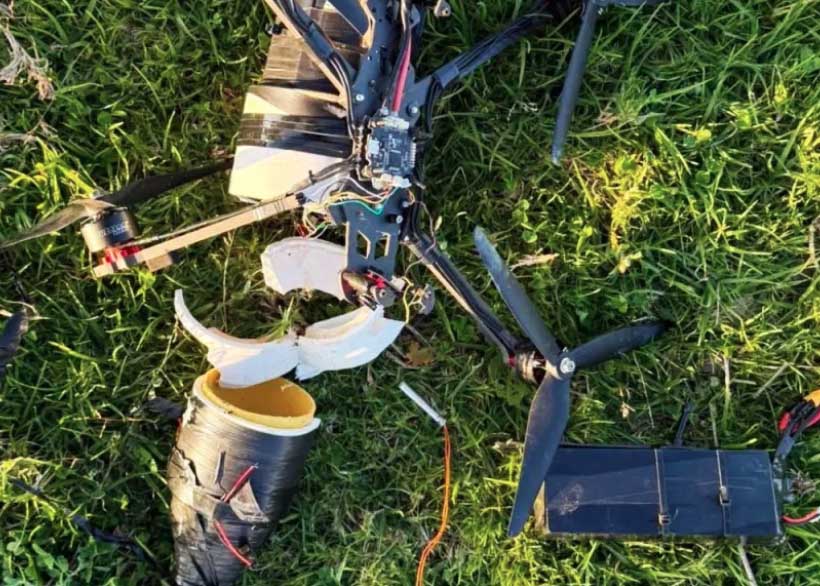
Colombian authorities have seized and safely deactivated a commercial drone carrying improvised explosive materials just 5.4 kilometers from Bogotá’s El Dorado International Airport and the nearby Military Air Transport Command (CATAM), raising fresh security concerns in the capital three weeks before the country’s May 31 presidential election.
The discovery marks a significant escalation from recent unauthorized drone sightings that twice forced temporary flight suspensions at El Dorado, Colombia’s busiest airport, and highlights growing fears that tactics once largely confined to conflict zones in the southwest and Catatumbo region are now reaching the capital.
According to preliminary police and military reports, the device was located in the locality of Kennedy, near the Río Bogotá, after a security alert issued by prosecutors in Popayán, Cauca, prompted specialized units of the Colombian Air Force (FAC) and National Police to track suspicious coordinates in southern Bogotá.
Authorities found what appeared to be a makeshift encampment before locating the commercial drone, its battery and an explosive charge separated from the fuselage.
Anti-explosives officers later confirmed the device had been modified with a non-conventional fiber-optic guidance system, a method increasingly used by illegal armed groups to evade electronic signal jammers designed to disable unmanned aircraft.
Investigators said the drone carried approximately 258 grams of C4 explosive material inside a PVC tube fitted with an improvised detonator.
The device was safely neutralized by National Police explosives experts and transferred to the Attorney General’s Office – Fiscalía General – for forensic analysis and the opening of a criminal investigation.
Authorities have not publicly identified those responsible or confirmed the intended target, but officials noted the location placed the drone within minutes of both El Dorado International Airport and CATAM, one of Colombia’s most strategic military aviation facilities.
Security analysts say the use of fiber-optic spools as a guidance mechanism resembles tactics recently documented in Catatumbo and southwestern Colombia, particularly among the National Liberation Army (ELN) guerrilla and FARC dissident factions under the command of alias “Iván Mordisco.”
A similar drone equipped with the same system was discovered in Popayán on April 25 during a wave of attacks blamed on FARC dissidents in Cauca, while another was found the same day in Villavicencio, the departmental capital of Meta.
The appearance of such devices in Bogotá has raised alarm among security officials, particularly given the proximity to civilian and military aviation infrastructure.
Pilots and aviation experts warn that even small commercial drones can cause catastrophic damage if they collide with an aircraft during takeoff or landing. A drone carrying explosives near an airport runway significantly increases the potential for a large-scale tragedy.
The discovery also comes at a politically sensitive moment, with Colombia entering the final weeks before its presidential election on May 31, as security and public order remain dominant campaign issues amid rising violence in the departments of Antioquia, Chocó, and Norte de Santander.
The leftist government of President Gustavo Petro has faced intense criticism over deteriorating security conditions, particularly following road bombing attributed to illegal armed groups in Cauca, Valle del Cauca, Nariño and Catatumbo, where the use of drones for surveillance and attacks has become increasingly common.
Last month, drone sightings near El Dorado airport twice forced authorities to suspend all air operations, disrupting domestic and international flights and exposing vulnerabilities near the country’s principal air gateway.
On April 30, Aerocivil halted airport operations after the Colombian Aerospace Force confirmed the presence of a drone in the Engativá district near the airport perimeter. Two aircraft were forced to carry out missed approaches, including an international LATAM Airlines Boeing 787 arriving from Santiago, Chile, while another domestic flight was diverted to Armenia, Quindío.
Just two days earlier, on April 28, another drone was detected near El Dorado, triggering a 45-minute suspension of takeoffs and landings while military personnel deployed anti-drone systems and visual searches.
Defense Minister Pedro Sánchez later confirmed that operations had been temporarily canceled because of the possible drone sighting, although no confirmed target was found.
Aerocivil has repeatedly warned that unauthorized drone activity near airports represents a grave threat to aviation safety and can result in criminal prosecution.
Thursday’s discovery, however, suggests the threat may extend far beyond operational disruption.
For Bogotá, the concern is no longer simply rogue recreational drones interfering with airport traffic, but the possibility that explosive-equipped devices linked to Colombia’s armed conflict are now within reach of the nation’s capital – and its most critical infrastructure.