
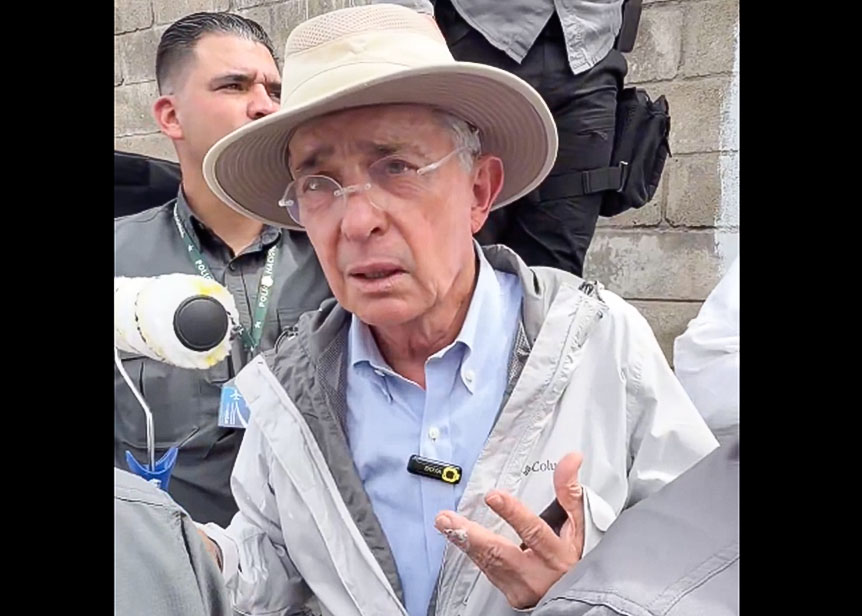
Former Colombian President Álvaro Uribe Vélez confronted a group of protesters outside his residence in Rionegro, Antioquia, on Wednesday after activists began painting a mural referencing victims of Colombia’s “false positives” scandal.
Videos and images shared widely on social media showed Uribe surrounded by security personnel while holding a paint roller near the wall where the mural was being painted. Wearing a light field jacket and broad-brimmed hat, the former president appeared visibly upset as tensions rose between demonstrators, supporters and members of his security team.
The incident quickly became one of Colombia’s most discussed political flashpoints this week, exposing deep divisions surrounding the country’s internal armed conflict with ex-FARC, the transitional justice system, and the increasingly polarized 2026 presidential race. The official candidate of Uribe’s Centro Democrático party, Paloma Valencia, is considered Cepeda’s strongest rival in the event of a run-off election on June 21.
Uribe later said he had interrupted a political meeting in Medellín after receiving a call informing him that a large group had gathered near the entrance to his property while his wife was home alone.
“Cowardly Cepeda, stop sending people to my house where my lady was alone,” Uribe wrote on X Wednesday, referring his political foe and presidential frontrunner Iván Cepeda.
In a separate statement, Uribe accused the hard-leftist senator and Hernán Muriel, a congressman from the governing Historic Pact coalition, of promoting what he described as “acts of provocation and intimidation” against his family.
According to Uribe, the protesters arrived in three buses and gathered close to the entrance of the estate while artists painted the mural. He claimed one of his supporters was injured with a knife during the confrontation and said a member of his security detail was also hurt.
“I told them that I was going to erase the mural,” Uribe wrote. “Before provoking violence against my family and our home, they would have to kill me.”
Later footage showed Uribe personally covering the painted wall with a roller while supporters and security personnel stood guard nearby.
The mural referenced the latest figures released by Colombia’s Special Jurisdiction for Peace (JEP), the transitional tribunal created following the 2016 peace accord with FARC. The tribunal recently updated estimates tied to the “false positives” scandal, in which civilians were allegedly killed by members of the armed forces and falsely presented as combat casualties during more than four decades of Colombia’s internal conflict.
Muriel, who organized the demonstration, rejected accusations that the protest was intended to threaten Uribe or his family. He described the gathering “as a peaceful act” organized by victims’ organizations, social movements and human rights defenders seeking to highlight the revised JEP findings.
“We are carrying out an act of social mobilization and memory pedagogy,” Muriel said in remarks shared online. “We are here with social organizations, victims and human rights defenders following the new figure of 7,837 false positives announced by the JEP.”
According to Muriel, the mural was painted on public property near the residence and was intended to commemorate victims of the conflict.
The confrontation prompted swift reactions from political allies of the former president in Antioquia, one of Colombia’s most conservative regions and a longtime bastion of Uribe’s “democratic security” agenda.
Medellín Mayor Federico Gutiérrez criticized the protest and accused supporters of President Gustavo Petro of fostering political hostility toward opposition figures. “It’s the same method used during the last mayoral campaign in Medellín,” he wrote on social media, adding that political tensions in the country were continuing to escalate.
Antioquia Governor Andrés Julián Rendón also condemned the incident and called for respect toward Uribe and his family.
The episode underscores how historical revisionism spread on social media continues to discredit the legacy of the country’s two-term president (2002-2010), and leading opposition leaders. By Thursday morning, the images from Rionegro — showing Uribe beside the mural with a paint roller in hand — had spread across Colombian media and social networks, becoming the latest symbol of how the left justifies ideologically-fueled protests to vandalize public space and infrastructure.