
Colombian President Gustavo Petro has toughened his rhetoric toward Venezuela and signaled a possible return to aerial fumigation of coca crops, a policy reversal that comes as Washington weighs whether to certify Bogotá as a reliable partner in the fight against drug trafficking.
The White House is required under U.S law to decide by Sept. 15 whether major drug-producing and transit countries are making sufficient efforts to combat narcotics. Colombia, the world’s largest producer of cocaine, has long depended on certification to secure billions of dollars in security and development aid.
Failure to certify – a step last taken against Colombia in 1996, under then-president Ernesto Samper – could strain one of Washington’s closest security relationships in Latin America. At that time, U.S. authorities accused Samper’s government of taking more than US$2 million from the Cali Cartel, and he was stripped of his U.S visa.
This year’s decision comes amid surging coca cultivation and a deep security crisis in rural areas where illegal armed groups have gained vast territorial control. The stakes are further heightened by the government’s defunding of the armed forces and his criticism of U.S. counternarcotics strategies.
On Tuesday, Petro posted messages on social media questioning human rights abuses in Venezuela, marking a notable shift in tone after months of warm ties with the regime’s Nicolás Maduro. Petro highlighted the detention of opposition politician and presidential candidate Enrique Márquez, who has spent eight months in arbitary detention in Caracas, as well as dozens of Colombian citizens who were imprisoned in the post July 28 election aftermath.
“Eight months detained carries Enrique Márquez and with him dozens of Colombians in Venezuelan prisons. One cannot defend Venezuela from injustice if injustice is exercised from power,” Petro wrote on X, while citing a heart-felt letter from Márquez’s wife, Sonia Lugo.
Calling for dialogue and reconciliation, Petro added: “The hour of the defense of Venezuela, which implies the union of its people, has arrived. A divided people is easy to invade. It is time for dialogue, reconciliation and unity in Venezuela.”
Petro had previously deflected direct criticism of Maduro’s government, instead presenting himself as a regional ally. His latest remarks come days before Washington issues its certification decision and as U.S. lawmakers increase scrutiny of Colombia’s role in curbing cocaine flows across the Venezuela border.
Petro Raises Prospect of Aerial Fumigation
At home, Petro has faced mounting pressure over the kidnapping of more than 70 soldiers in El Tambo, Cauca, where troops carrying out eradication operations were surrounded and detained by protesters allegedly organized by FARC dissidents. Forty-five of the soldiers were later released after several hours.
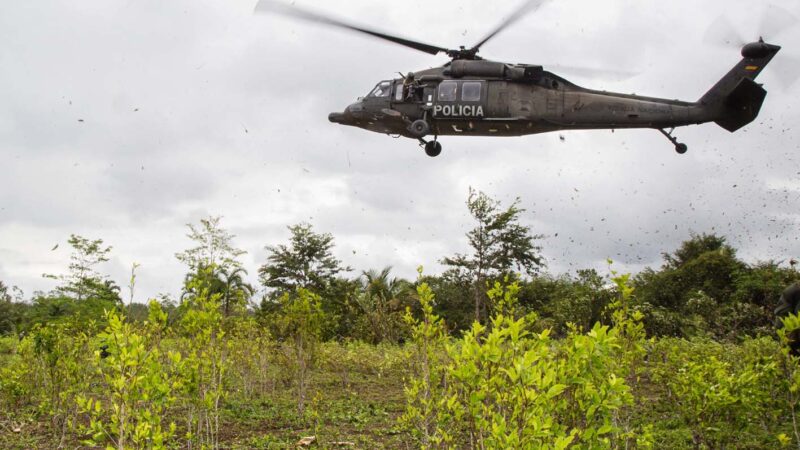
In response, Petro suggested Colombia’s Constitutional Court should reconsider its 2015 ruling that prohibits the aerial spraying of coca with glyphosate due to health and environmental risks. During his presidential campaign, Petro had pledged never to use the herbicide, saying in 2021: “In a government of the Historic Pact, not a single drop of glyphosate will be sprayed on our homeland.”
“Given the mafia tactic of confronting civilians with the army, the Constitutional Court must reconsider its ruling. Where citizens attack the army, there will be aerial fumigation,” Petro posted on X, linking the tactic to incidents in southern Colombia.
His comments mark a significant departure from his long-standing opposition to fumigation. Earlier this year, Petro had insisted his government would not employ glyphosate, even after documents surfaced showing the Defense Ministry had approved plans for limited ground use of the chemical.
The president’s remarks also coincide with heightened violence against security forces. In recent months, soldiers and police have faced ambushes, arson attacks, and kidnappings while attempting to manually eradicate coca crops in departments such as Cauca, Nariño, Caquetá, and Putumayo, which remain strongholds of illegal armed groups.
The potential return to fumigation and the sharper tone against Venezuela come as Colombia braces for Washington’s verdict on certification. U.S. authorities have expressed concern that despite record seizures of cocaine – more than 850 tonnes in 2024 – coca cultivation has soared past 250,000 hectares.
Analysts say that for Washington, the numbers point to an expanding supply of cocaine leaving Colombia, despite intensified interdiction efforts. Trump administration officials have not indicated how they will rule but have signaled frustration with Petro’s policies.
If Colombia were to be decertified, U.S. law allows the White House to restrict certain forms of aid and apply visa sanctions to officials, while preserving security cooperation. Officials in Bogotá fear such a move could embolden drug cartels and further destabilize conflict-prone regions.
Colombia’s Defense Minister, Pedro Sánchez, recently warned that withdrawing certification would undermine joint operations. “To decertify Colombia is to reward the criminals and the narcos,” he said. “Certification is a symbol of cooperation, alliance and trust – but also of the capabilities we need to act with greater force.”
The debate over fumigation has resurfaced at a politically sensitive moment. Petro’s call for aerial spraying is likely to trigger opposition from environmental groups, Indigenous communities, and farmers who claim that gylphosate destroys legal crops and is carcinogenic to humans.
At the same time, his comments are being interpreted in Bogotá as an effort to demonstrate toughness ahead of the U.S. decision. Two of the country’s most popular mayors – Medellín’s Federico Gutiérrez and Cali’s Alejandro Éder – have traveled to Washington to lobby Congress on security cooperation, sparking fierce criticism from Petro, who accused them of overstepping their authority.
The White House’s ruling on certification is expected by Sept. 15. Whatever the outcome, it will shape Colombia’s counternarcotics strategy at a time of mounting security threats at home, shifting alliances abroad, and Petro’s own recalibration on policies he once staunchly opposed.