
With Bogotá fading into the rearview mirror, the white van surged beyond the capital’s sprawling neighborhoods and climbed toward one of the most singular ecosystems on Earth. Less than three hours from the city lies the Páramo de Sumapaz, a vast high-altitude wetland adrift among the Andes and regarded as the largest páramo in the world. These mist-laden moorlands exist almost nowhere else — scattered only across parts of Ecuador, Peru, Venezuela, and Costa Rica — yet here in Colombia they unfold on an epic scale, a landscape suspended between earth and sky. The name Sumapaz translates loosely as “utterly peaceful moorland,” though its history tells a more turbulent story.
Our guide, Oswaldo Cortés of Bogotá Birding, explained that the region remains sparsely populated because of its unforgiving climate and fragile vegetation. Yet the road suggested otherwise. Beyond the windows rolled a dense tapestry of life: red-brick homes pressed against muddy hillsides, farmers crowding panaderías fragrant with sweet bread, women selling pyramids of guavas and mandarins, schoolchildren navigating puddled streets, and dogs darting between concrete buildings brightened by graffiti murals. Ranchers wrapped in traditional wool ruanas guided cattle through the rain as the van slowed behind them, the scene carrying the rhythm of an Andean frontier still shaped by the mountain.
Long before Spanish conquistadors arrived, the Sumapaz held sacred meaning for the Indigenous Muisca Confederation people, who believed these cloud-soaked highlands were tied to the creation of humankind. It was considered a realm where humans were not meant to wander freely. But curiosity, ambition, and survival repeatedly drew outsiders into the páramo. In the 16th century, German explorer Nikolaus Federmann crossed the Sumapaz searching for the elusive gold of El Dorado. Centuries later, botanists catalogued its extraordinary biodiversity while armed groups, including the Revolutionary Armed Forces of Colombia and National Liberation Army, used these isolated mountains as corridors through Colombia’s conflict. Today, military outposts stand watch over the same valleys once traversed by guerrillas and explorers alike.
As the road climbed above 4,000 meters, farmland replaced forests in widening patches of green and ochre. Farming at this altitude is an act of persistence against frost and poor soil. For decades, families surviving on only a few thousand pesos a day cleared grasslands for cattle, gradually eroding the ecosystem that feeds the rivers flowing toward Bogotá. In response, Colombia established the Sumapaz National Natural Park in 1977, protecting more than 223,000 hectares of wetlands that today provide much of the water sustaining the Colombian capital.
Outside the van, the air felt startlingly thin and cold. Scrubby bushes and bursts of crimson, yellow, and violet wildflowers lined the empty road, their colors glowing against the gray sky. Moisture lingered in the atmosphere long after the rain had stopped, wrapping the páramo in a permanent haze. It felt less like stepping into a mountain landscape than onto another planet.
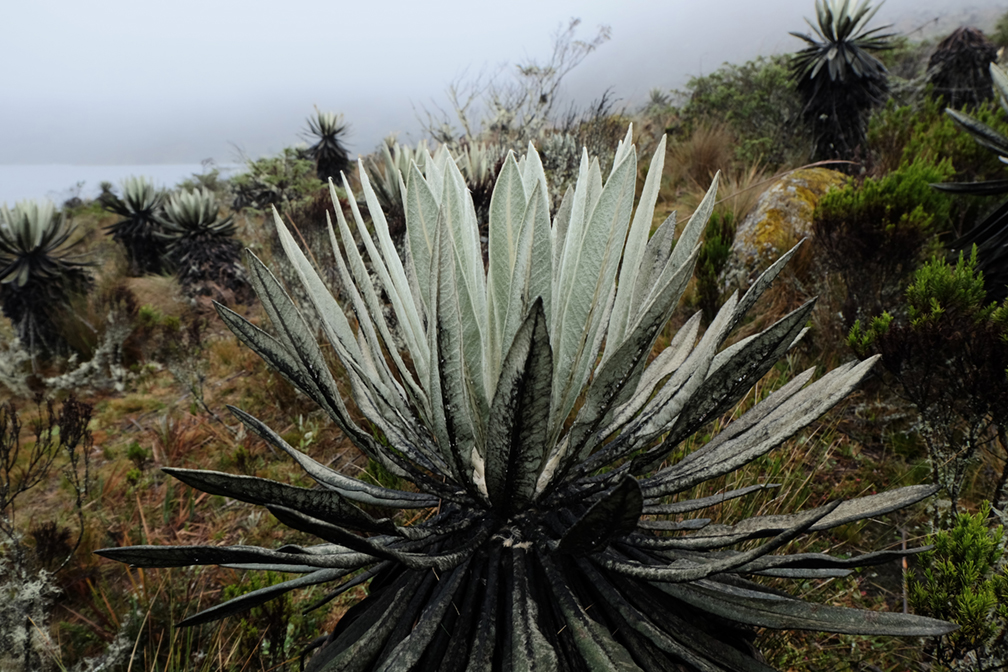
Across the hillsides rose endless colonies of frailejones — towering espeletia plants found almost exclusively in the northern Andes. Their pale, fuzzy leaves shimmered silver-green beneath the fog, surrounding dark glacial lagoons that mirrored the sky below. Oswaldo explained that some of these plants can live for more than a century. More remarkable still is their ability to capture water directly from passing clouds. Their sponge-like trunks absorb moisture from the mist and slowly release it into the soil, feeding streams, reservoirs, and wetlands far below. For the more than eight million people living in Bogotá, these silent botanical sentinels are indispensable guardians of water security.
The frailejón has evolved perfectly for this severe world of acidic soil, freezing nights, and relentless wind. Yet despite its resilience, the plant is increasingly threatened by climate change, agriculture, and human encroachment. Farmers and soldiers have long used its soft leaves as makeshift bedding against the cold, a reminder that even the harshest landscapes are deeply intertwined with human survival.
Hidden within these mountains is another rare inhabitant: the elusive Spectacled bear, South America’s only native bear species. Feeding on frailejón stems and berries, the bear moves quietly through the cloud forest with distinctive pale markings around its eyes that resemble spectacles. Closely related to the giant panda, the Andean bear remains among the world’s most endangered bear species, vulnerable to habitat loss and poaching across the Andes.
I tried to focus instead on the reeds ahead, where an endemic Apolinar’s wren called from the marshes. But Oswaldo warned us not to stray too far. Beneath the carpet of moss and low vegetation lay hidden pools known locally as chucas — deceptively shallow-looking wetlands capable of swallowing an unwary traveler whole. Moments later, his left leg plunged knee-deep into the saturated earth. I lunged forward to save his spotting scope from disappearing into the bog and quietly decided he might not be the safest person to follow.
Each step through the páramo produced a soft squelch beneath my rubber boots. The ground was layered with brilliant green sphagnum moss, a living sponge that stores immense quantities of water and slowly releases it downslope into rivers and reservoirs. Then came a shout from behind me. A flash of emerald and copper streaked overhead — the rare Green-bearded Helmetcrest, a tiny hummingbird found only in these high-altitude ecosystems and deeply dependent on the frailejón for survival. With tall iridescent feathers flaring from its head, it vanished into the mist almost as quickly as it appeared.
Laughing, breathless, soaked through, and half-blinded by encroaching fog, we stumbled back toward the van while another curtain of rain swept across the mountains. Somewhere behind us, hidden among the clouds and wetlands, the Sumapaz continued quietly performing its ancient work — gathering water from the sky and giving life to a city far below.