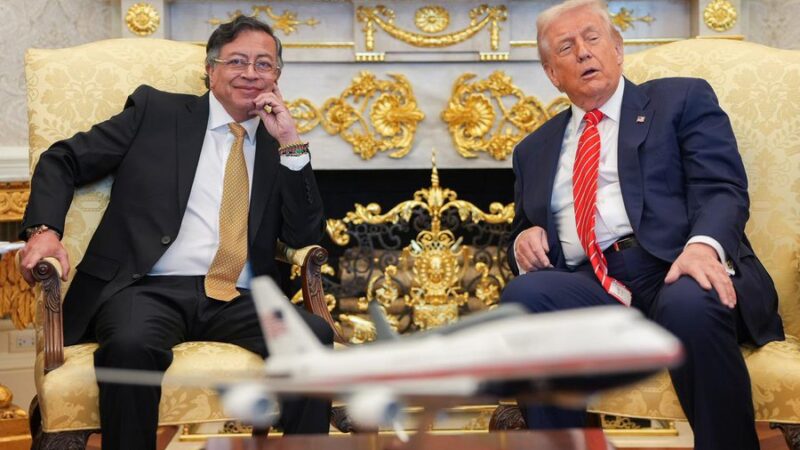

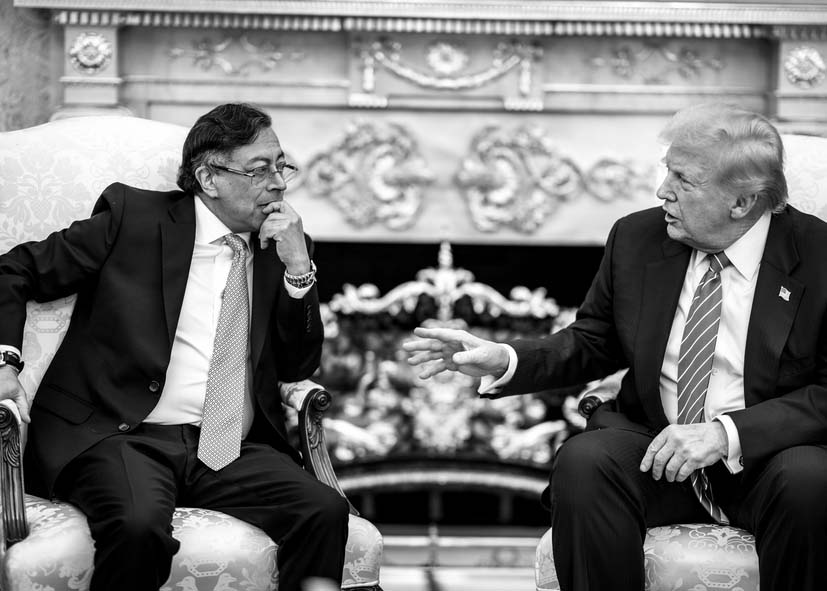
Nearly a week after Donald Trump hosted Colombia’s president, Gustavo Petro, at the White House, calm has returned to a bilateral relationship that only recently appeared headed for rupture. The insults have stopped. The social media theatrics have faded. Diplomacy, not spectacle, is back in charge.
This alone tells us that both governments have agreed to “disagree” and agree again.
The meeting itself produced no headline agreements. Instead, it marked something more consequential and less dramatic – a quiet end to illusions. In Washington, Petro’s flagship policy of “Total Peace” is now widely regarded as exhausted, if not outright discredited. What replaces it is a far more traditional, conditional partnership: security cooperation first, democracy under scrutiny, and patience in short supply.
The timing matters. Within days of the White House meeting, the U.S. State Department announced that John McNamara, Washington’s chargé d’affaires in Bogotá, will leave his post on February 13. McNamara arrived a year ago at a moment of open hostility between Trump and Petro, when the relationship was being tested not only by policy disagreements but by personal antagonism. His task was not to advance grand initiatives, but to prevent a collapse. That he succeeded says much about the value of professional diplomacy in an era of impulsive politics.
His departure now marks the end of a holding pattern. What comes next will be harder, more explicit, and less forgiving.
The Trump – Petro encounter was cordial, almost surprisingly so. Trump praised Petro as “terrific.” Petro shared a handwritten note from Trump declaring his affection for Colombia. The optics were deliberate. But the substance lay elsewhere.
According to officials and lawmakers briefed on the talks, Washington’s message was blunt: negotiations without consequences have failed. Petro’s Paz Total—a strategy built on ceasefires, open-ended negotiations, and the assumption that armed groups could be coaxed into disarmament—has not reduced violence. In many regions, it has coincided with territorial expansion by FARC dissidents, rising extortion, and a deepening humanitarian crisis. From Washington’s perspective, it has blurred the line between peace realpolitik and paralysis.
U.S. cooperation with Colombia is now explicitly conditioned on key demands. First, decisive military action against armed groups, especially the ELN along the Venezuelan border, where insurgents have long enjoyed sanctuary. Second, ironclad guarantees that Colombia’s upcoming electoral processes will be free, fair, and transparent ahead of a high-stakes 2026 presidential race.
This is not ideological hostility. It is strategic calculation – from Bogotá to Caracas, and ultimately, the Oval Office.
Colombia remains indispensable to U.S. interests: a capstone of regional security, a key counter-narcotics partner, and a democratic anchor in a hemisphere unsettled by authoritarian drift and Venezuelan instability. But indispensability does not mean indulgence. Washington’s conclusion is that leverage must now be used, not deferred.
The shift was visible almost immediately. Colombian forces bombed ELN encampments in the Catatumbo region near the Venezuelan border, killing several fighters and seizing weapons. The strikes signaled a return to military pressure after months of restraint under Paz Total.
Yet they also exposed the moral and political cost of the new course. According to Colombia’s forensic authorities and reporting by El Colombiano, one of those killed in Catatumbo was a child. Seven bodies were recovered after the operation, including that of a minor. The incident echoed last November’s bombing in Guaviare that killed seven minors, among them an 11-year-old girl.
Shift in tone and strategy
Petro, in the aftermath of the Trump encounter, has responded with a stark argument: armed groups recruit children precisely to deter military action. Halting airstrikes, he said, would reward a “cowardly and criminal” strategy and accelerate forced recruitment. It is a grim logic, but not an implausible one—and it illustrates the impossible trade-offs now confronting the Colombian state.
Peace negotiations have not been spared. The Clan del Golfo, one of the country’s most powerful criminal organizations, suspended talks with the government after reports that Colombia and the United States discussed targeting “high-value” leaders. From Washington’s perspective, this reaction only reinforces its skepticism: armed groups talk peace when it buys time, not when it requires surrender.
None of this suggests enthusiasm in Washington for a militarized Colombia. It suggests resignation. The United States has seen this cycle before – in Colombia and throughout the hemisphere. Negotiations without enforcement are a contradiction. Ceasefires without verification entrench armed actors. Elections held amid coercion corrode democratic legitimacy from within.
Which brings us to the second pillar of the new relationship: electoral transparency.
U.S. officials have made clear that Colombia’s democratic processes will now be watched closely – not as a moral abstraction, but as a strategic necessity. A Colombia that cannot guarantee free elections is not a reliable ally, no matter how aligned its security policies may be.
This is the bargain now on offer. Not a reset. No rupture. Conditional coexistence.
John McNamara’s departure symbolizes the transition. His tenure was about keeping the peace between governments. The next phase will be about enforcing terms.
For Petro, the challenge is severe. He must deliver security results demanded by Washington without losing legitimacy at home, where skepticism of militarization runs deep. He must demonstrate democratic integrity while navigating a polarized political landscape. And he must do so knowing that Total Peace, once his signature promise, no longer commands confidence abroad.
The calm in U.S.–Colombia relations is real- but it is not comfort. It is the quiet before accountability.