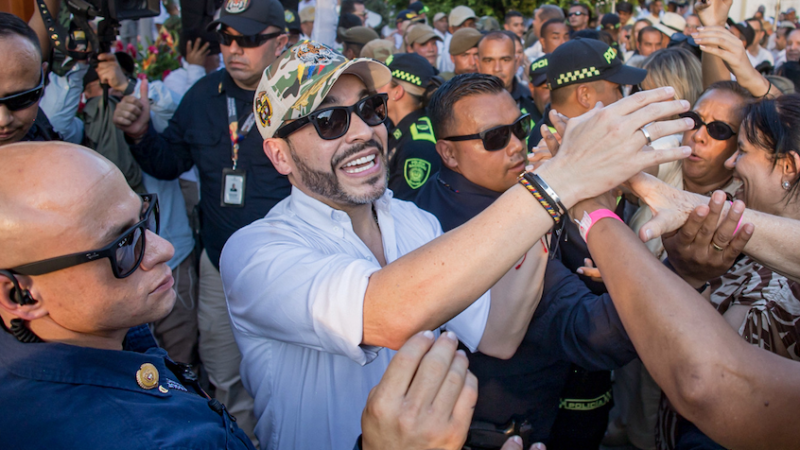


Right-wing presidential candidate Abelardo “El Tigre” de la Espriella emerged as the frontrunner in Colombia’s presidential election on Sunday, setting up a high-stakes runoff against left-wing senator Iván Cepeda in a contest that could reshape the political future of one of Latin America’s largest economies.
With more than 97% of ballots counted, National Registry Bulletin No. 15 showed De la Espriella leading with 43.77% of the vote, or approximately 10.1 million ballots, compared with Cepeda’s 40.88%, or slightly above 9.4 million votes. The margin of roughly 667,000 votes exceeded many pre-election forecasts and positioned the Barranquilla-based criminal defense lawyer as the favorite heading into the decisive June 21 runoff.
Election authorities reported that voting unfolded peacefully across the country, with preliminary results available just 90 minutes after polling stations closed at 4:00 p.m. More than 41 million Colombians had been eligible to participate in the election, including 1.4 million citizens residing abroad.
The result represents a significant rebuke to President Gustavo Petro’s political project and highlights growing voter concerns over security, economic performance and public confidence in state institutions.
Petro, who is constitutionally barred from seeking re-election, has thrown his support behind Cepeda, a leading figure within the governing coalition and one of the principal defenders of the government’s controversial “Total Peace” strategy. The policy sought negotiated settlements with FARC dissidents, criminal organizations and other armed groups operating throughout the country, but critics argue it failed to reduce violence in many regions.
While Cepeda entered election day as the favorite in most opinion polls, De la Espriella successfully capitalized on public frustration over extortion, insecurity, illegal armed groups and what many voters perceive as a deterioration of public order under Petro’s administration.
Known to supporters as “El Tigre,” De la Espriella built his campaign around a tough-on-crime platform inspired in part by the security policies of El Salvador’s President Nayib Bukele. He has promised to strengthen the military, restore state authority in conflict-affected regions and confront criminal organizations with what he describes as an uncompromising approach.
His message appears to have resonated particularly among middle-class voters, business sectors and residents of regions heavily impacted by drug trafficking and armed violence.
The election also exposed the weakness of Colombia’s political center, which for years attempted to position itself as an alternative to the country’s increasingly polarized political landscape.
Conservative candidate Paloma Valencia secured more than 1.5 million votes (or 6.9%) but remained well behind the two frontrunners. Although her campaign attracted traditional conservatives and followers of former president Álvaro Uribe Vélez, she struggled to expand beyond the party’s core support base.
Centrist Sergio Fajardo, the former mayor of Medellín and former governor of Antioquia, won just 4.6% of the vote, just shy of one million ballots. Once regarded as a politician capable of bridging Colombia’s ideological divides, Fajardo failed in his third attempt to reach the presidency as voters increasingly gravitated toward candidates offering sharply contrasting visions for the country’s future.
Former Bogotá mayor Claudia López suffered one of the day’s most dramatic defeats, capturing less than 1% of the national vote. The result marked a stunning collapse for a politician who only a few years ago was considered among Colombia’s most vocal leaders.
Analysts say the runoff campaign is now likely to become a referendum on Petro’s presidency and the future direction of the country.
For Cepeda’s supporters, the June 21 vote offers an opportunity to preserve and deepen many of the social and political reforms promoted by the current administration. For De la Espriella’s backers, it represents a chance to reverse those policies and return to a security-centered model associated with the administrations of former president Álvaro Uribe.
The key question over the coming weeks will be whether De la Espriella can consolidate support among conservative and independent voters while Cepeda seeks to unite the left and attract Colombians wary of a return to hardline security policies.
After a largely peaceful election day, Colombia now faces three weeks of intense campaigning before voters make what many observers consider one of the most consequential political decisions since the country’s historic shift to the left in 2022.