
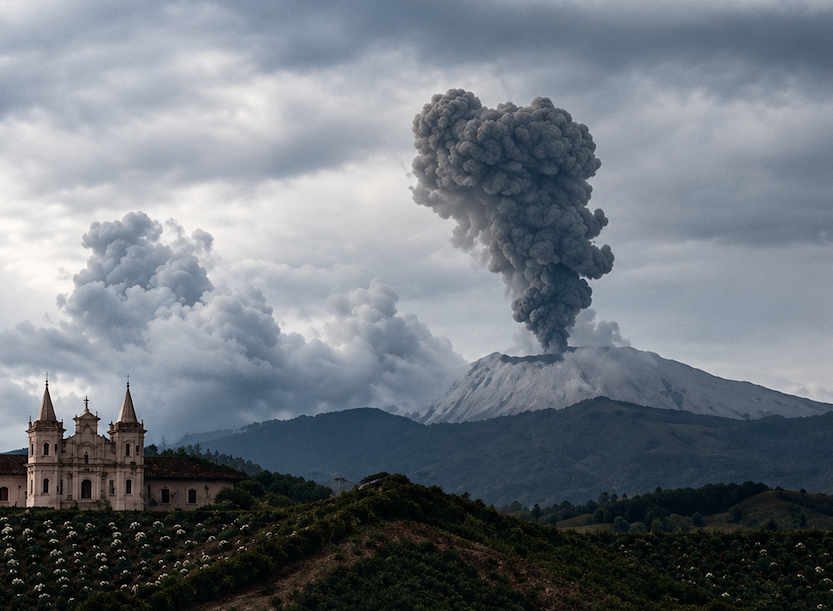
Colombia’s Puracé volcano remains under an orange alert after another episode of seismic activity was recorded in the southwestern department of Cauca on Sunday night, adding to a sustained period of volcanic unrest that has included ash emissions, volcanic tremor, gas releases and slow deformation of the ground.
A magnitude-4.1 earthquake was recorded at 8:58 p.m. on September 6 in the municipality of Totoró, within the area of influence of the Puracé volcanic complex, according to the Servicio Geológico Colombiano (SGC). The event was reported at a depth of around 10 kilometres. No injuries or material damage were immediately reported.
The earthquake came as scientists continued to monitor changes in the volcano’s behaviour, with the latest observations showing persistent signals associated with the movement of fluids beneath the crater.
The SGC has kept Puracé at orange alert since August 1, a level indicating that significant changes in the volcano have been detected and that the possibility of an eruption is greater than under normal conditions. It does not, however, mean that an eruption is underway or certain to occur.
The latest monitoring report on Monday recorded an emission of ash reaching approximately 200 metres above the volcano, with winds carrying the plume towards the northwest.
Scientists at the Observatorio Vulcanológico y Sismológico de Popayán have also identified a continuing predominance of signals associated with fluid movement inside the volcanic conduits. Volcanic tremor has been detected beneath the crater at depths of less than one kilometre. The entrance to PNN Puracé National Park is located only 30 east of the departmental capital Popayán and some 200 km from the Pacific coast.
Superficial earthquakes – at depths of between seven and 11 kilometres – associated with the fracturing of rock continue to occur around the Puracé volcanic complex with the SGC also reporting continuing emissions of sulphur dioxide (SO₂), and elevated carbon dioxide (CO₂) concentrations in the soil.
When the SGC raised the alert from yellow to orange on August 1, it said the increase in seismic energy, together with higher temperatures in ash and gas emissions, represented a significant alteration in Puracé’s behaviour. The agency noted that several monitored parameters had reached their highest levels since systematic monitoring began in 1993.
Puracé forms part of the Los Coconucos volcanic chain in the Central Andes, an area of high geological activity that extends from southwest Colombia to the departments of Huila, Tolima and Caldas in the central region of the country.
The SGC has repeatedly warned residents and visitors not to approach the craters of Puracé, Piocollo and Curiquinga or the headwaters of rivers originating in the volcanic zone. Sudden emissions of gases and ash, the expulsion of rock fragments and the accumulation of volcanic material that could generate localized mudflows remain among the potential hazards.
The erratic behavior of the Puracé comes as eruptions across the Pacific draw international attention.
From Puracé to Krakatau
Indonesia, one of the world’s most volcanically active countries, is dealing Monday with the aftermath of a large eruption at Anak Krakatau.
The eruption continued for over 25 hours before subsiding on Sunday, producing powerful explosions and enormous ash columns. Several Indonesian airports remained closed, including Jakarta’s Soekarno-Hatta. The Indonesian eruption provides a dramatic illustration of how volcanic activity can rapidly become a public-health, transportation and economic emergency.
So far, Colombia’s situation at Puracé is different as scientists monitor a series of geological signals that indicate that the volcano has moved well beyond its normal background or semi-dormant status.
For communities around Puracé, the immediate concern is not the activity of distant volcanoes but what the instruments beneath their own mountain are recording. The magnitude-4.1 earthquake on Sunday comes less than a month after a 7.4-magnitude earthquake struck Colombia’s Pacific region on August 10, resulting in 331 dead, 111 missing and over 4,500 injured.