
President Gustavo Petro has announced the start of a consultation process with ethnic communities to draft a new decree protecting the sacred “Black Line” of the Sierra Nevada de Santa Marta after Colombia’s highest administrative court annulled the previous legal framework governing the ancestral territory.
The announcement came late on March 4 during an interethnic assembly in the Caribbean city of Santa Marta attended by Indigenous authorities, Afro-Colombian representatives and members of Petro’s government.
The process follows a February 12 ruling by the Council of State of Colombia that struck down Decree 1500 of 2018, a measure issued under former president Juan Manuel Santos that formally recognized the “Black Line” as the spiritual and cultural boundary of the ancestral territory of the Sierra Nevada’s Indigenous peoples.
The ruling removed the legal recognition of 348 sacred sites across the mountain range, an area spanning the Caribbean departments of La Guajira, Magdalena Department and Cesar Department.
The court concluded the decree had not complied fully with the constitutional requirement of prior consultation with all ethnic communities potentially affected by the territorial delimitation.
Sacred geography
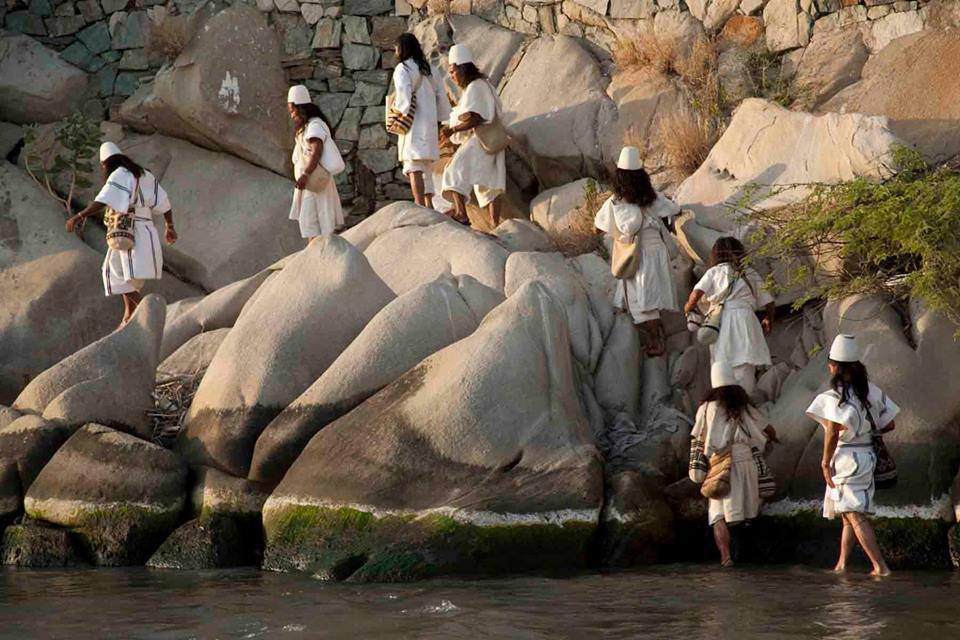
For the Indigenous peoples who inhabit the Sierra Nevada – Arhuaco, Kogi, Wiwa and Kankuamo p – the “Black Line” is far more than a geographic boundary.
It represents a cosmological network of sacred sites connecting coastal lagoons, rivers, glaciers and mountain peaks across what Indigenous leaders describe as the “Heart of the World.”
Through these sites, spiritual elders – known as mamos – maintain rituals they say preserve the balance between humans, nature and the spiritual realm.
“The Sierra is not only a mountain; it is a living being that breathes through its lagoons, its glaciers, its stones and its lines of energy,” Indigenous leaders said following the ruling, warning that removing the decree threatens decades of cooperation between the state and Indigenous authorities.
The now-annulled decree had been the product of years of negotiations between Indigenous authorities and the Colombian government following orders from the Constitutional Court of Colombia to formally recognize ancestral territories and sacred geography.
The mapping of the 348 sites was supported by technical studies conducted by the national mapping agency, the Instituto Geográfico Agustín Codazzi.
For Indigenous leaders, the decree served as the main legal instrument protecting the sacred network from outside interventions, including mining projects, infrastructure development, tourism ventures and energy exploration.
With its annulment, communities fear they are left without an effective legal mechanism to defend the territory and its ecosystems.
The Sierra Nevada is widely regarded by scientists as one of the most biodiverse mountain systems on Earth, rising from sea level to snow-covered peaks in less than 50 kilometres.
Speaking before Indigenous delegates in Santa Marta, Petro said the consultation process would now place communities at the centre of the decision-making process.
“Here a process begins in which you have the word, not the government,” Petro told the assembly. “Now corresponds a process of consultation. The consultation belongs to you. I hope it ends well and quickly so we can issue the decree again.”
The president urged participants to move forward without unnecessary delays while ensuring the key issues are discussed.
“Sometimes our own dialectic of discussion leads us to prolong processes or find contradictions where none exist,” he said.
Petro framed the protection of the Sierra Nevada not only as a territorial matter but also as a message to a world facing increasing geopolitical conflict.
“The Heart of the World must be at peace, because if the Heart of the World is not at peace, humanity will not be at peace,” Petro said. “Today humanity is not at peace – missiles fall everywhere.”
The government says the consultation will include not only the four Indigenous nations of the Sierra but also neighbouring groups such as the Ette Ennaka people and coastal communities including Afro-descendant groups and residents of Taganga.
According to Vice-Minister for Social Dialogue and Human Rights Gabriel Rondón, the current stage is an “intercultural dialogue” designed to define a roadmap toward a new decree that avoids the legal flaws identified by the Council of State.
“The purpose is to start from the beginning, clarify doubts and create a broad path that allows us to agree on a new administrative act without the failures of the previous one,” Rondón said.
PNN Tayrona reopens
Separately, the government confirmed that the nearby Tayrona National Natural Park will reopen to visitors on March 5 after a three-month closure over security concerns with illegal armed groups operating in the Sierra Nevada.
The Ministry of Commerce, Industry and Tourism (MinCIT), said it has mobilised institutional support and technical funding to ensure the park resumes operations with security and sustainability guarantees.
Tourism authorities also announced plans for light infrastructure investments of about COP$2.7 billion to improve visitor facilities and promote Colombia’s network of national parks as leading ecotourism destinations.