
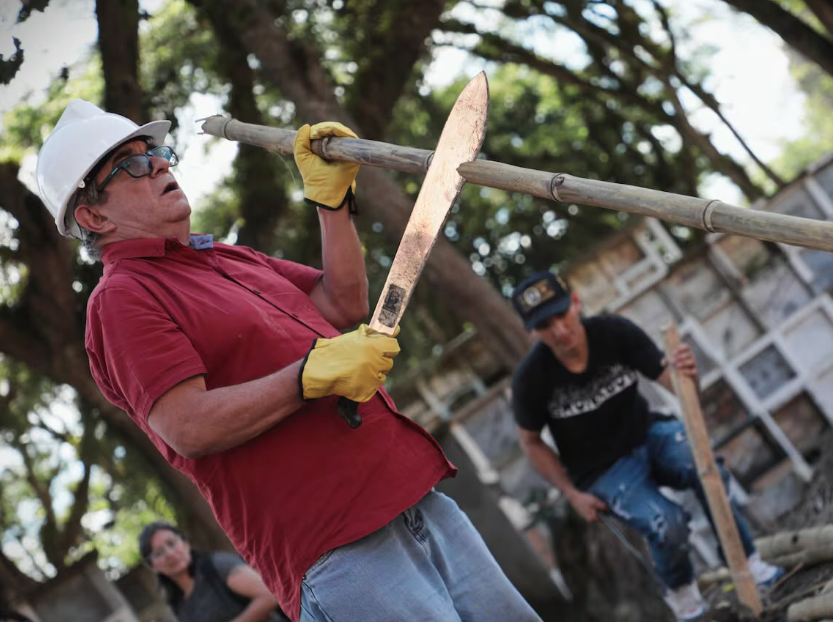
The image is striking. With machete in hand, Rodrigo Londoño Echeverri, better known by his wartime alias Timochenko, is clearing vegetation and debris among the graves at the San Antonio de Padua cemetery in Pitalito, Huila. The former top commander of the Revolutionary Armed Forces of Colombia (FARC) is there not as a guerrilla leader, but as a man serving restorative sanctions imposed by Colombia’s Special Jurisdiction for Peace (JEP) tribunal for war crimes committed during the country’s decades-long internal conflict.
The image is even more striking when one considers that the man who once commanded Latin America’s oldest insurgency is now participating in work connected to the recovery and identification of human remains and the search for Colombia’s disappeared. The cemetery assignment began on September 21 as part of sanctions imposed on former members of the FARC’s last Secretariat for their responsibility in thousands of kidnappings.
The measures are intended to contribute to reparation and reconciliation, although many victims have challenged the tribunal as to whether the work adequately addresses the suffering of those kidnapped by the guerrilla.
Yet Londoño’s appearance at the cemetery is only one part of a much larger reckoning with the FARC’s past. On October 8, a new U.S. indictment against former Venezuelan president Nicolás Maduro and his wife, Cilia Flores, again placed the former guerrilla commander’s name in an international criminal case.
According to the allegations described in the court filing, Maduro and Flores met with Londoño and other senior FARC leaders in 2013 to discuss a debt allegedly arising from a drug-trafficking arrangement. Subsequent reporting has described allegations that the debt was to be settled, in part, through the provision of explosives from Venezuela’s military stocks.
The distinction is crucial: Londoño’s appearance in the account of an alleged meeting does not, by itself, mean he has been charged in the United States. Nor have the allegations been proven in court. But the reported transaction raises serious questions about the alleged relationship between Venezuela’s political leadership, the FARC’s wartime command and the illicit economies that helped sustain Colombia’s armed conflict.
The Alleged Debt
The alleged meeting, described in reporting on the 30-page superseding indictment filed in Manhattan federal court, took place shortly after the death of Venezuelan president Hugo Chávez in March 2013. Alongside Londoño, the document reportedly identifies Luciano Marín Arango, known as Iván Márquez, and Seuxis Pausias Hernández Solarte, known as Jesús Santrich, as participants.
According to the allegations, Maduro and Flores met with the three FARC commanders to discuss money allegedly owed to the guerrilla organization through an arrangement connected to drug trafficking. One reported proposal to settle part of the debt involved the transfer or sale of explosives from Venezuelan military reserves to the FARC.
The allegation is consequential because it describes more than a political relationship between Caracas and Colombia’s insurgency. It suggests a potential exchange between a senior Venezuelan political figure and an armed organization that financed its campaign through illicit activities. If substantiated, such an arrangement would raise questions about the use of state resources and the extent to which Venezuela’s military infrastructure may have been exploited to support an armed group operating across the border.
The published reporting also describes allegations of oil sales and operations involving gold mines as possible means of providing financial resources to the FARC. The reported oil transactions allegedly continued until approximately 2015. The precise value of the alleged debt, the details of any transfer and the extent of the involvement of each individual would need to be established through the evidence presented in court.
Londoño’s name appearing in the account does not establish that he personally negotiated, authorised or received any shipment of explosives. Nor does it mean that he is a defendant in the new case against Maduro and Flores.
Havana Peace Negotiations
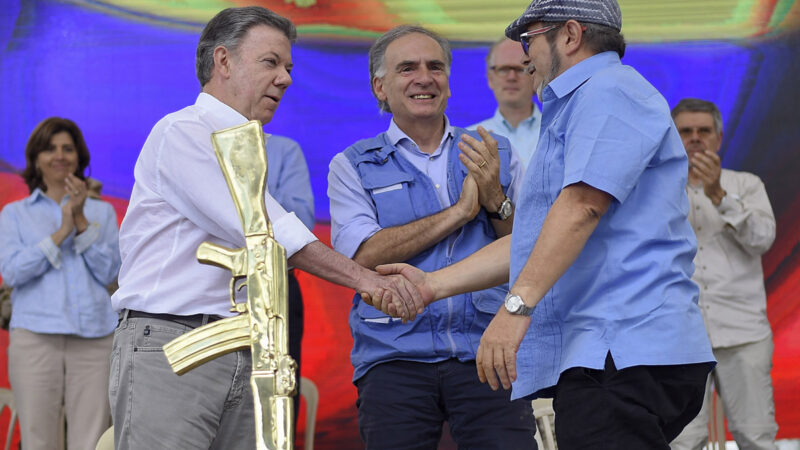
The alleged 2013 meeting also carries a particular weight for Colombia’s decade-old peace process. By that time, FARC and the government of President Juan Manuel Santos were negotiating an agreement intended to end a conflict that had lasted more than half a century.
The negotiations culminated in the 2016 Final Accord, which morphed FARC into a political movement with congressional representation. Londoño subsequently became the public face of the former guerrilla’s transition to civilian life.
The U.S. allegations now place an alleged discussion of a narcotics-related debt against that historical backdrop. They raise questions about the relationship between FARC’s political leadership, its wartime finances and its contacts with Venezuelan officials during a period in which the guerrilla was publicly negotiating an end to the conflict.
However, the reported meeting alone does not establish that the peace negotiations were a cover for continued arms transfers, or that the alleged arrangements were part of the negotiations themselves. Those conclusions would require evidence beyond the reported account of the meeting.
The distinction matters in a country where the peace agreement remains a central point of political contention. For victims of kidnapping, forced displacement, recruitment and other abuses, the question of accountability extends beyond the formal demobilization of an armed group to the disclosure of what sustained its military operations and whether those responsible have fully acknowledged their actions.
Maduro’s Network
The indictment’s significance extends beyond the ex-FARC’s Secretariat. U.S. prosecutors also describe alleged relationships between senior Venezuelan figures and other armed or criminal gropus, including Colombia’s National Liberation Army, or ELN.
According to reporting on the filing, the allegations include claims that Cilia Flores offered contracts linked to Venezuela’s state oil company, Petróleos de Venezuela (PDVSA), to groups aligned with the ELN. Other passages reportedly describe extortion in territories where armed groups exercised control and alleged arrangements to facilitate the movement of cocaine through Venezuela.
One official identified in the indictment as CC-3 is alleged to have travelled to areas near the Colombian border under ELN control to help ensure the passage of cocaine shipments. The reported allegations also refer to contacts between representatives of the official and Colombian narcotics traffickers continuing into 2025.
For Colombia, the security implications are immediate in geographical terms. Its 2,300-km long border with Venezuela has repeatedly been a concern for authorities confronting armed groups, trafficking routes and illicit economies. The October 8 indictment also adds a separate dimension to the proceedings against Maduro and Flores: allegations of conspiracy to commit torture against political opponents and U.S. citizens.
The U.S. Department of Justice says the superseding indictment describes alleged abuses including electric shocks, asphyxiation, sexual violence, forced nudity, prolonged isolation, deprivation of food and psychological torture through threats against victims’ families. Prosecutors allege that state security and intelligence structures were used to suppress perceived opposition and consolidate political power.
Back in Pitalito, Londoño’s work at the cemetery is part of a judicial process designed to address the consequences of the Colombian conflict. The restorative sanctions imposed by the Special Jurisdiction for Peace require former members of the FARC Secretariat to undertake work connected to the search for disappeared people and the construction of historical memory.
The measures are intended to contribute to reparation, but they have also drawn criticism from some victims who question whether the sanctions adequately reflect the scale of the suffering caused by kidnapping and other abuses. Their concerns underline the difficult balance between restorative justice and the demands of those who want fuller recognition of the crimes committed against them.
The sight of a former guerrilla commander clearing vegetation among graves is a powerful image of Colombia’s attempt to reckon with its past. The new U.S. allegations serve as a reminder that the history of the conflict may extend beyond the battlefield and peace table, into the networks of money, weapons and political relationships that prosecutors are now seeking to reconstruct.
Whether the allegations concerning Maduro, Flores and the former FARC leadership withstand judicial scrutiny remains to be seen. For now, the indictment has reopened questions about a period in which Colombia was pursuing peace while, according to U.S. prosecutors, illicit relationships involving armed groups and Venezuelan officials flourished. And relationships that now lead to a U.S District court and an abandoned graveyard in southern Colombia.