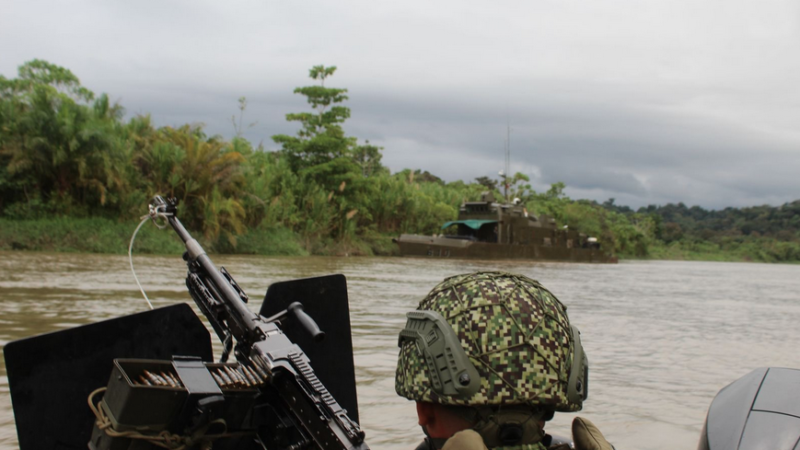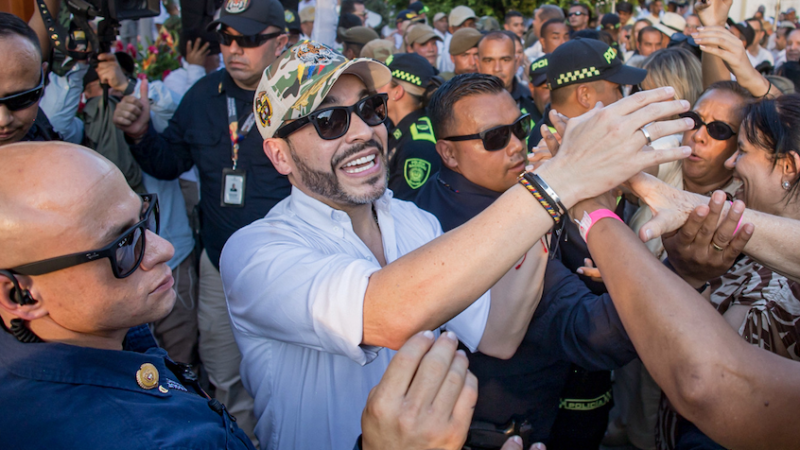

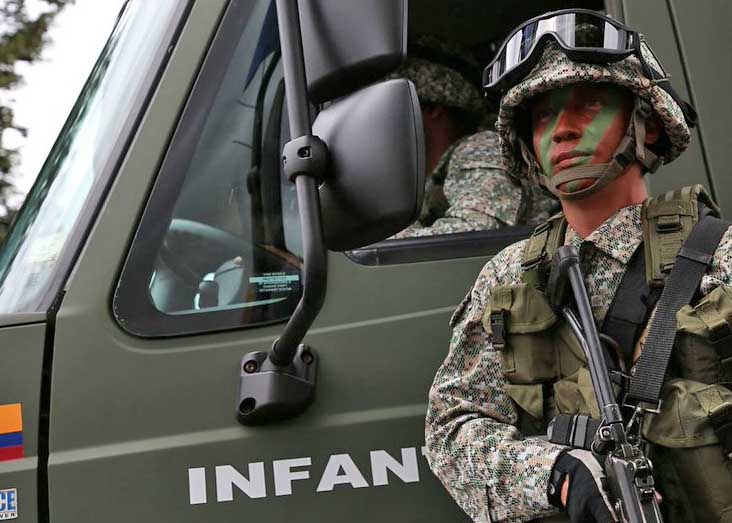
A proposal to deploy Colombia’s armed forces in three of Bogotá’s most populous localities has opened a new debate over the role of soldiers in urban security, days after President Abelardo De La Espriella ordered a military deployment in the Caribbean city of Santa Marta following a wave of violence attributed to a criminal organization.
José Jaime Uscátegui, a congressman from the right-wing Centro Democrático party, formally asked the national government to militarize the Bogotá localities of Ciudad Bolívar, Kennedy and Bosa, saying the military should support police operations in areas affected by criminal organizations and serious violence.
“I respectfully request that the government order the militarization, through the deployment of the Armed Forces, in support of the police in the areas most affected by criminal organizations and serious acts of violence,” Uscátegui said in his request to the Administrative Department of the Presidency, or Dapre.
His proposal calls for a special security plan involving operations against criminal organizations, weapons and explosives controls, action against illicit economies and protection of commercial areas affected by extortion.
Uscátegui has made military deployment in Bogotá a campaign issue. During the election campaign, billboards featuring him making a military salute appeared under the slogan “Bogotá must be militarized.”
The congressman says Ciudad Bolívar, Kennedy and Bosa were the three Bogotá localities with the highest number of homicides in 2024. They have continued to record high levels of violence this year. In 2026, Ciudad Bolívar has registered 126 homicides, followed by Kennedy with 105 and Bosa with 61, according to figures cited in the proposal, for a combined 292 killings.
The request comes as De La Espriella has made a more visible military presence a central part of his response to criminal violence. On Sept. 22, after the killing of José Luis Pérez Villanueva, alias “Cholo,” the second-in-command of the Autodefensas Conquistadoras de la Sierra Nevada, the president ordered Santa Marta to be militarized following threats and a so-called armed strike by the group.
The government subsequently said more than 500 soldiers and 600 police officers were deployed in Santa Marta, with additional security forces sent to nearby Ciénaga.
Uscátegui’s proposal has, however, met resistance from Bogotá’s administration.
César Restrepo, the city’s security secretary, said the Army already participates in security operations in the capital through coordinated work with the Metropolitan Police and the Army’s 13th Brigade.
“To think that the Army has not participated in building security in Bogotá is either a failure to understand the city’s conditions and the work being done here or, on the contrary, a poor reading of the strategic panorama,” Restrepo said.
Restrepo said the priority should be to increase the number of police officers and investigators rather than present the military’s participation as a new security strategy. The national government has not announced a new military deployment in Bogotá, and Mayor Carlos Fernando Galán has not said the city will formally request one.
The debate is complicated by the sheer size of the three localities.
Kennedy has more than 1 million inhabitants, Bosa about 734,000 and Ciudad Bolívar about 667,000, according to population figures cited in the security discussion. Together they account for roughly 2.4 million people, close to 30% of Bogotá’s population.
That scale raises questions about whether military personnel can meaningfully supplement the police in densely populated urban areas without blurring the distinction between military and civilian policing.
The debate in Congress will focus primarily on either strengthening the National Police, which has specialized units dealing with narcotics, public order, kidnapping (Gaula), intelligence (Dijin) and other forms of organized crime.
“Clearly, that is what the National Police is there for,” believes Colombian political commentator Hassan Nassar, arguing that the Army is designed primarily for external combat and protecting the nation’s sovereignity from external threats.
Nassar said the proposed expansion of police staffing — including an annual intake of 10,000 auxiliary officers, with 5,000 intended for rural areas and 5,000 for urban areas — would itself represent a major logistical challenge for the Ministry of Defense.
Additional police numbers, however, will not solve the problem of crime without stronger intelligence and more robust judiciary. ‘”Police operations ultimately depend on prosecutors and judges being able to build effective cases without the impunity we are seeing on out streets,” noted Nassar. “Bogotanos are tired of seeing the same people — thieves, those involved in express kidnappings and ‘millionaire rides’ – commit crimes and not be prosecuted, only to end up committing crimes over and over again.”
The issue, therefore, extends beyond whether soldiers should patrol Bogotá’s streets. It is also about how police, military, intelligence agencies, prosecutors and courts divide responsibility for confronting organized crime.
Uscátegui’s proposal, backed by a broader political campaign for increased military involvement in Bogotá, now puts that institutional question before the national government: whether the response to urban insecurity should involve a substantially expanded military role, or whether existing military support should remain complementary to a larger and more specialized police force that can respond to the needs of each community.
Uscátegui’s proposal, backed by a broader political campaign for increased military involvement in Bogotá, now puts that institutional question before the national government: whether the response to urban insecurity should involve a substantially expanded military role, or whether existing military support should remain complementary to a larger and more specialized police force capable of responding to the specific security needs of each community.
One alternative would be a Metropolitan Task Force combining all specialized police units with direct support from the Attorney General’s Office, or Fiscalía, to ensure that people caught in the act of committing violent crimes or vandalizing public or private property are promptly captured, investigated and prosecuted.
For now, Bogotá’s district administration, including Mayor Carlos Fernando Galán, is arguing for a softer stance, one centered on strengthening the police, investigators and judicial response, rather than expanding the military’s role in the city’s streets. But Abelardo de la Espriella has the final word, as the President can decree Uscátegui’s petition without the immediate backing of lawmakers.