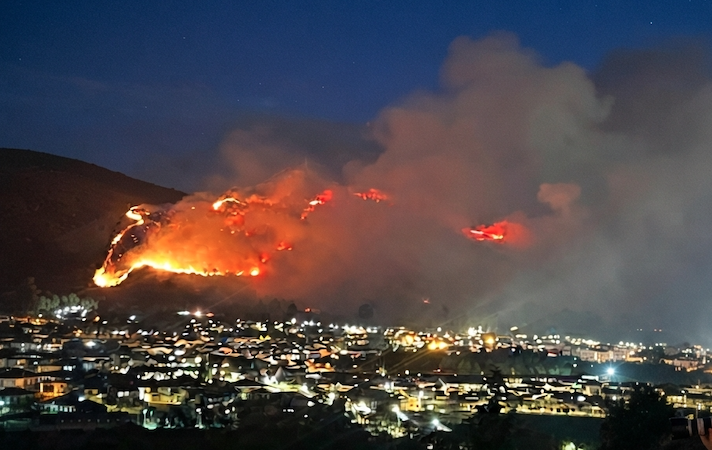

A wildfire that began on the hills above Colombia’s historic town of Villa de Leyva has spread into the Santuario de Fauna y Flora Iguaque, with more than 700 hectares of the protected area now affected and two fire fronts still active.
The emergency, which began on September 19 in the La Castellana area and on the San Marcos hillside overlooking Villa de Leyva, has expanded dramatically over four days. The latest assessment by Colombia’s National Unit for Disaster Risk Management, UNGRD, estimates that approximately 1,200 hectares have been affected across the region, including about 715 hectares inside the Iguaque sanctuary.
Authorities say the wider fire is approximately 75% controlled, and the flames have been confined in areas close to homes. But the most difficult section of the emergency has shifted higher into the mountains, where steep terrain is making access for ground crews particularly difficult.
Two active fronts remain, prompting continued operations by land and air.
The advance into Iguaque has transformed what initially threatened the tourist town of Villa de Leyva into a major environmental emergency.
The Santuario de Fauna y Flora Iguaque covers 6,889 hectares between the municipalities of Chíquiza, Arcabuco and Villa de Leyva. It protects a mosaic of páramo, high-Andean forest and glacial-origin lagoons in the Eastern Cordillera.
The sanctuary’s importance extends far beyond biodiversity.
Its high-altitude ecosystems help regulate and store water, while vegetation contributes to the recharge of aquifers supplying rural and urban water systems in the surrounding region. According to Parques Nacionales Naturales, Iguaque is the protected area within Colombia’s national parks system that supplies the largest number of municipal aqueducts, benefiting more than 30,000 people.
That makes the wildfire a threat not only to forests and wildlife but also to one of the region’s critical natural water systems.
The municipality of Sáchica has called for urgent reinforcement from the UNGRD, requesting additional aerial, ground and technical resources as the fire moves through areas surrounding the sanctuary.
Frailejones at risk
Among the species facing the greatest concern are the frailejones, the distinctive plants that dominate many Colombian páramo landscapes and play an important role in the capture and regulation of water.
Parques Nacionales identifies several species in Iguaque, including Espeletiopsis garciae, Paramiflos glandulosus and Espeletia tunjana. The latter is classified as endangered.
The ecological damage from a wildfire is not necessarily limited to plants directly consumed by flames. Fire can alter soils, destroy surrounding vegetation and change the conditions required for natural regeneration in fragile high-altitude ecosystems.
The sanctuary is also home to white-tailed deer, brocket deer, tigrillos and the ulamá, as well as more than 170 bird species. Among them are the Andean guan, páramo eagle and 19 species of hummingbird.
The emergency response has expanded as the fire has moved into increasingly difficult terrain.
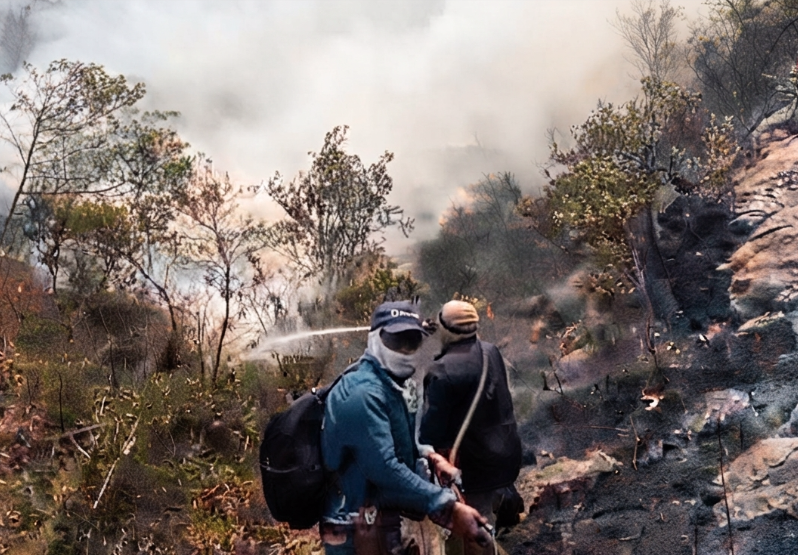
According to the latest UNGRD report, around 250 people are involved in the operation, including firefighters, soldiers, police, Civil Defence personnel, Red Cross teams and national emergency agencies.
Three helicopters have been deployed for aerial firefighting: an MI-17 contracted by the Boyacá government, together with UH-60 Black Hawks operated by the Colombian Aerospace Force and the Army.
During the latest operation, the aircraft carried out 75 water drops over the fire zones. Authorities are also preparing to insert specialised personnel by air into areas that cannot easily be reached from the ground.
More than 20 park rangers have been working in the area since the weekend. On Monday night, another 15 forest-fire specialists arrived from Chingaza and Tama national parks and the Guanentá Alto Río Fonce Flora and Fauna Sanctuary to reinforce the response.
The ongoing threat to Iguaque carries both environmental and cultural significance. According to Muisca traditions, Bachué, regarded as the mother of humanity, emerged from the sacred waters of the Iguaque lagoon with a child who would become the ancestor of the pre-Columbian peoples.
The lagoon lies at around 3,599 metres above sea level, surrounded by páramo vegetation and the high-Andean landscape protected by the sanctuary. Parques Nacionales describes Iguaque as a territory where natural ecosystems and Muisca cultural traditions remain closely connected.
The sanctuary was declared a protected area in 1977 and today forms part of Colombia’s national system of protected areas.
Its ecosystems are particularly important in a country where páramos provide critical water-regulation functions. The vegetation captures moisture, slows its movement through the landscape and helps maintain water supplies during drier periods.
Fire moves beyond colonial enclave
For several days, the international focus of the emergency centred on Villa de Leyva, one of Colombia’s most visited colonial destinations.
The fire threatened homes, hotels and tourism infrastructure around the town, while residents and volunteers joined firefighters in trying to stop the flames advancing through the surrounding hills.
By Monday, however, authorities reported that the fire around the urban area was largely contained. The principal concern had shifted to the upper mountain slopes leading towards Iguaque.
The UNGRD says the fire is 75% controlled, but the figure does not mean the emergency is over. Two active fronts remain, and difficult terrain is preventing easy access to the highest areas.
Boyacá Governor Carlos Amaya has called for additional aerial support and appealed for continued resources to confront the remaining fire fronts. “Literally, a tragedy is being experienced,” he wrote on X, describing the images from the affected area as among the most painful seen in his department in recent years.
The immediate objective is now to prevent the remaining fire fronts from advancing further into Iguaque and to extinguish the areas already burning inside the protected zone.
The operation is expected to continue as long as weather, visibility and safety conditions permit. For Villa de Leyva, the fire has moved away from the immediate threat to its historic centre and patrimonial homes.
For Iguaque, however, the emergency is entering a more consequential phase.
What began as a wildfire on a hillside above a colonial enclave has become a fight to protect one of Boyacá’s most important high-altitude ecosystems – and the water systems, wildlife and cultural heritage that make this territory so unique for Colombia.