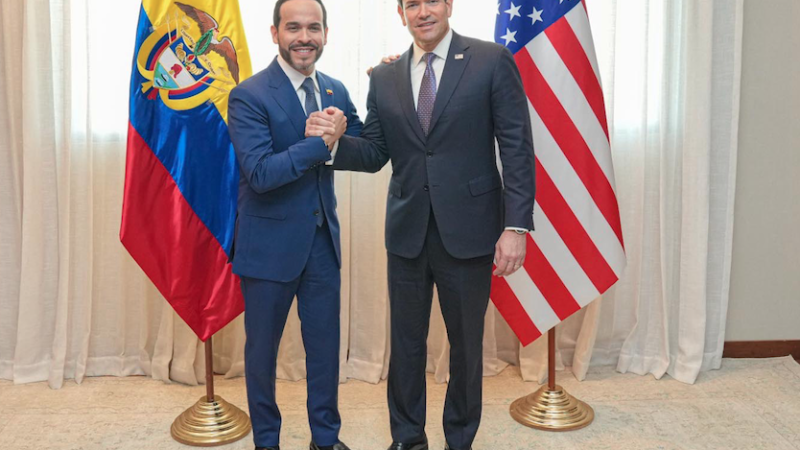


Colombian President Abelardo De La Espriella launched a forceful attack on corruption during an televised address to the nation Sunday, targeting both those convicted of crimes involving public funds and those who, he says, attempt to use their positions, influence or personal connections to secure special treatment.
In a speech focused on the victims of corruption, De La Espriella argued that the consequences of stealing public money extend far beyond a criminal investigation or court case, directly affecting ordinary Colombians.
“When they steal the budget for a road, a hospital or a school, they are not stealing from the government, they are stealing directly from the Colombian people,” the president said.
De La Espriella rejected the idea that corruption should be viewed simply as a crime against the state. He said Colombians have a right to know the true cost of government and the obligations the country must meet.
“Colombians have the right to know, really, how much the state costs and what obligations we have to pay,” he said.
The president accused the previous government of presenting a budget that failed to reflect the country’s full financial position, saying it left essential expenditures unfunded and understated the real burden of public debt.
“The budget presented by the previous government did not show the whole reality, it lied, it left essential expenses unfunded and did not correctly reflect the true weight of the debt we have today. We decided to put all the accounts on the table, with transparency,” he said.
De La Espriella also singled out what he described as unrealistic revenue projections during the four years of Gustavo Petro’s presidency. “But there is something even more serious: for four years (of Petro), budgets were built on false revenue figures, and spending continued as if that money were going to come in, but it never did,” he said. “In 2024 alone, tax revenues were 71 trillion pesos less than estimated.”
The president also criticised what he called the “chaotic and disorderly state” of Colombia’s public finances during the administration of ex-President Gustavo Petro, pointing to the existence of 60 special funds that, he said, disperse public resources and make it harder to determine where money is held, how it is spent and what results it produces.
For De La Espriella, public money cannot be treated as the property of those temporarily entrusted with running the state. “Public money is sacred because it is the money of Colombians,” he said.
No privileges for the powerful
The president directed particular criticism at what he called Colombia’s “white-collar criminals”, rejecting the notion that wealthy or influential offenders should receive different treatment from other people convicted of crimes.
“The so-called white-collar criminals are not criminals of a superior category,” De La Espriella said. “Their damage, he added, can be “devastating because their victims are counted in the thousands.”
The president said the consequences for families affected by corruption should be considered before anyone attempts to use influence to help a convicted offender.
He also challenged the perception that in Colombia a person’s surname, former position or political contacts can provide protection from the consequences of a criminal conviction.
The prison system, he said, should not depend on “the surname, the position one held or the contacts one has.” he also went on to declare: “There will be no privileges for those who used a suit and tie to commit crimes.”
“I am coming for all of you”
The president said his anti-corruption campaign would not end with an investigation or a court ruling, promising to pursue those he holds responsible for what he described as the country’s financial deterioration.
“We are going to pursue without quarter those responsible for this disaster, those who lied in the figures, those who compromised Colombia’s future,” he said. “I will not leave you alone. I am coming for all of you.”
His message was ultimately framed around the principle that public resources belong to the citizens and that anyone who diverts or appropriates them must answer to the justice system.
“Public money is sacred because it is the money of Colombians,” De La Espriella said, turning the phrase into the central theme of his corruption offensive. Under that principle, the president highlighted that neither wealth nor political influence nor social status should provide protection from prosecution or punishment.