
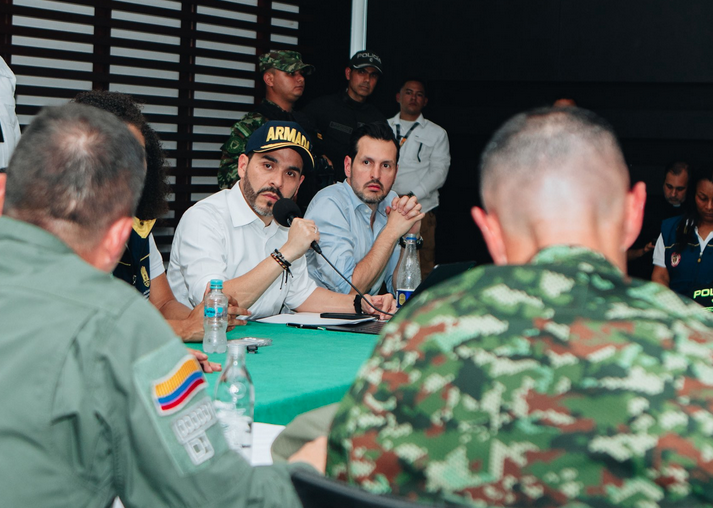
Colombia’s Abelardo De La Espriella has declared that every illegal armed and criminal organization operating in Colombia will be treated as a terrorist group, signaling a sharp hardening of his government’s security policy only weeks after taking office.
Speaking during a security council in Barranquilla on Sunday, President De La Espriella said his government would end distinctions between criminal organizations involved in drug trafficking, illegal mining, extortion, smuggling and other illicit activities.
“Here we have to stop treating these criminals differently,” the president said. “They must all be treated under a single designation, which is that of terrorist groups.”
He was even more emphatic moments later. “Here that division is over,” he said. “When it comes to combating crime, there are no differences either in the State’s action or in the State’s response.”
“And even less in a categorization invented by sectors seeking to protect these criminals so that the State cannot exercise legitimate force as it should,” he added.
“They are all terrorists and we are going to treat them as such, no matter what.”
The declaration establishes the central principle of the security strategy the president presented in Barranquilla: criminal organizations will no longer receive different treatment from the State according to their name, structure or particular criminal activity.
De La Espriella argued that Colombia’s criminal economies are interconnected, with narcotics trafficking providing the financial foundation for other illegal activities.
“Narcotrafficking is the principal source of financing for criminal structures,” he said, insisting that the State must respond to the entire criminal ecosystem rather than separating its components.
The president said his government would pursue a unified response from Colombia’s security and judicial institutions. “The Colombian Public Force must act as a monolithic and unified body, without rivalries between institutions, under a single flag,” he said.
The strategy includes the Army, National Police, Navy and Aerospace Force working with the Fiscalía General and the judiciary. Among the measures announced is the immediate creation of a National Search Bloc against Extortion, bringing together the country’s principal security forces and judicial authorities to target extortion networks.
De La Espriella also ordered the reactivation of the national rewards system, raids and networks of civilian informants, as well as urgent transfers of prisoners accused of continuing to coordinate criminal activities from inside Colombia’s prisons. “We cannot allow prisons to continue operating as centers of extortion,” he said.
The president also ordered a renewed assault on criminal finances, calling for greater cooperation between the financial system, the police and the Financial Information and Analysis Unit, or UIAF.
His government plans to establish specialized teams of prosecutors and judges in each city and to pursue the financial structures supporting organized crime.
De La Espriella has also singled out gota a gota (drop-by-drop) money lending networks, which provide informal high-interest loans and are frequently linked to criminal organizations. He described the practice as “a modern form of slavery” and said it affects approximately 12 million of Colombia’s most vulnerable, the majority without access to formal banking.
The president’s security agenda extends beyond Colombia’s traditional armed groups. He has also ordered Migration Colombia to conduct coordinated operations with police in Barranquilla against irregular migration and foreign criminality.
Barranquilla and its metropolitan area, meanwhile, are to become a “laboratory” for the new security strategy, with increased police presence, intelligence operations and closer coordination among institutions.
The president’s announcement comes as his government moves to strengthen security cooperation with the United States. De La Espriella has closely aligned his administration with Washington’s campaign against organized crime and narcotrafficking and has backed the Shield of the Americas, a regional security initiative promoted by U.S. President Donald Trump.
The Trump administration has said it is prepared to support Colombia in defeating what it describes as “narcoterrorist and criminal organizations,” including through expanded technology and coordinated operations with Colombian security forces.
But in Barranquilla, De La Espriella’s message was less about individual organizations than about the principle that will guide his government: that the State must combat all illegal armed groups with the same determination. He then delivered a declaration that is likely to become the defining phrase of his opening security offensive: “They are all terrorists, and we will treat them as such.”