
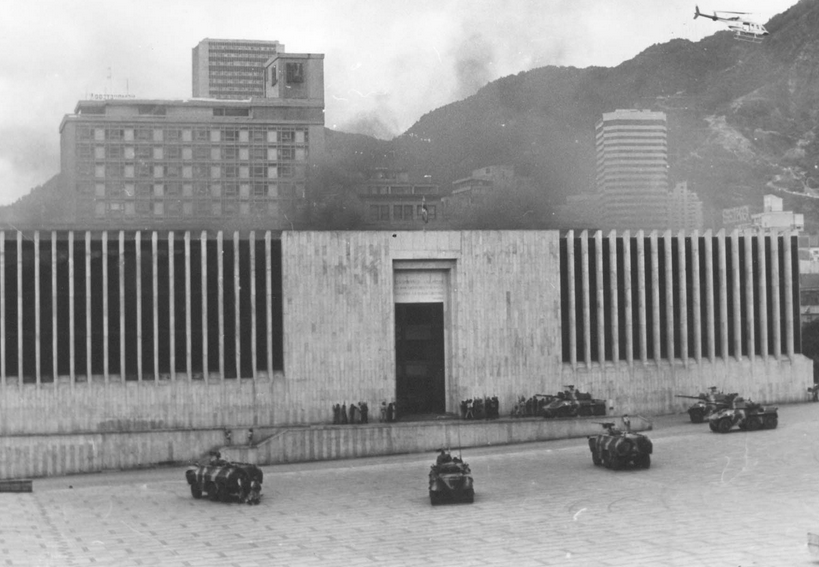
Forty years after one of the darkest chapters in Colombia’s modern history, the country is commemorating the 1985 Palace of Justice siege amid fierce controversy over President Gustavo Petro’s attempts to reinterpret and elevate the legacy of the M-19 — the guerrilla to which he once belonged and which unleashed one of the bloodiest attacks in the nation’s history.
For a majority of Colombians, the anniversary is a solemn time to remember the 98 people killed and 11 disappeared during the Nov. 6 to 7 assault, when M-19 insurgents stormed the judicial complex and held it under fire for 28 hours. Decades of exhaustive forensic investigations by Colombia’s Attorney General’s Office located the remains of 10 of the disappeared, while one victim, buried under a construction site, has also been identified, but whose remains cannot be exhumed for burial.
This year, the official ceremony has been overshadowed by a growing backlash against Petro, who has used his presidency to publicly rehabilitate symbols of the demobilized guerrilla: brandishing Simón Bolívar’s sword that the group once stole, elevating the hat of M-19 commander Carlos Pizarro to national patrimony, and repeatedly challenging long-established findings about the group’s violent actions.
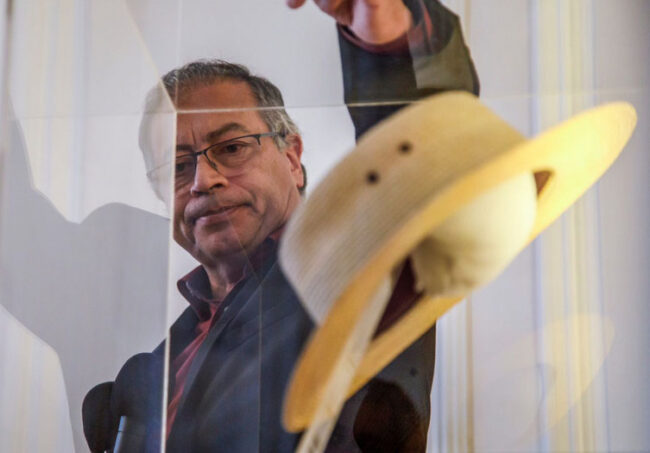
Most provocative has been the president’s insistence – sharply at odds with judicial records – that M-19 did not receive drug money from Pablo Escobar to finance the assault. He has also suggested that magistrate Manuel Gaona, known to have been executed at close range during the siege, may instead have died at the hands of state forces. “No magistrate has gunshot wounds from M-19 weapons,” Petro wrote on ‘X’, provoking a storm of condemnation from jurists, victims’ families, and political leaders across the spectrum.
Senior judicial figures responded swiftly, and in unusually direct terms. “The siege of the Palace of Justice was not a ‘brilliant action’ [as Petro once stated] but a deranged one. A terrorist act,” said Jorge Enrique Ibáñez, president of the Constitutional Court, in a stark repudiation of any attempt to validate the November “holocaust”.
José Roberto Herrera, former president of the Supreme Court and author of its Truth Commission report, also rejected Petro’s claims. The evidence, he stressed, had long been definitive: Magistrate Gaona was killed by an M-19 insurgent guarding hostages in the building’s mezzanine. “The findings were conclusive,” he said. “Gaona was shot at point-blank range by a guerrilla fighter.”
As the debate intensifies, Colombians are once again forced to revisit the harrowing details of the attack. On the morning of Nov. 6, 1985, seven M-19 militants entered the Palace through the main doors while others slipped in through the parking garage.
Within minutes, gunfire ripped through the building as the guerrilla executed security guards, took hostages, and seized control of several floors. On the fourth floor — where magistrates and guerrillas were trapped together — no one survived. When the military retook the building nearly a day later, investigators recovered charred bodies, mutilated remains, and unmistakable signs of excessive force.
Official inquiries have long documented the extrajudicial killings and forced disappearances by both the M-19 and state’s security forces. Eleven civilians seen alive during the retaking disappeared and have never been found. But across decades of investigations, responsibility for launching the massacre has always centered on the M-19.
It is this historical consensus that Petro now appears determined to challenge — a move many see not as nuance but as a direct affront to truth and the respect the victims of the M-19 massacre deserve.
Since taking office, the president has repeatedly invoked M-19 not as a group responsible for kidnappings, assassinations, and the deadliest attack against Colombia’s judiciary, but as a democratic insurgency whose fighters helped open political space. He frequently carries Bolívar’s sword — stolen by M-19 in 1974 — at state ceremonies, calling its theft an act of “restoration” for the people. He declared Pizarro’s hat a national cultural relic. And he often cites his former guerrilla movement as part of a personal narrative of “rebellion” against state abuses.
To critics, this is not historical reflection but the romanticization of a violent past.
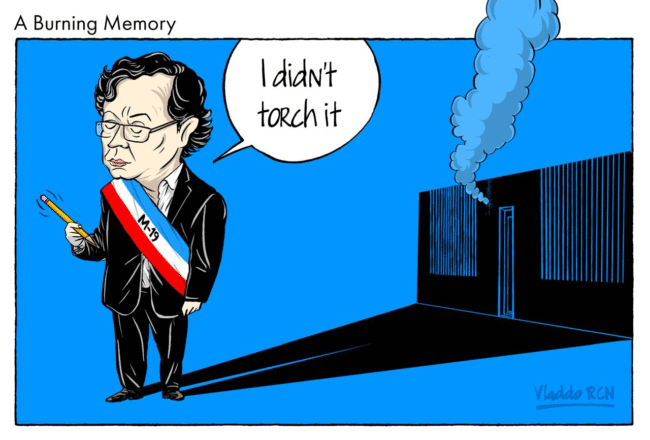
“Forty years later, the country is still waiting for Gustavo Petro to accept the political responsibility that corresponds to him as a former M-19 member,” noted the Colombian cartoonist VLADDO on social media, alongside one of his editorial illustrations.
Spanish-Colombian journalist Salud Hernández went further, arguing that Petro’s narrative reflects a country where “killers become the heroes, and their victims the villains.”
Conservative senator María Fernanda Cabal accused the government of trying to “rewrite history,” calling M-19 a terrorist group that attempted “a bloody coup against the democratic state.”
Families of victims say the president’s rhetoric deepens their wounds. Carlos Eduardo Medellín, whose father was killed in the siege, warned of a “dangerous imbalance” in how the country has pardoned ex-combatants while prosecuting the senior military officials involved in the retaking. “Truth, justice, and reparations — but for everyone,” he said.
The conflict over memory may prove as enduring as the event itself. In 2010, the Supreme Court’s Truth Commission wrote that Colombia had “abandoned words” and allowed brute force to replace democratic principles. Four decades later, words — their meaning and their ownership — have become a battlefield as the country’s first leftist president attempts to redefine truth and its consequences.
And in a striking reflection of these tensions, Colombia’s High Courts chose not to invite Petro to the official 40-year commemoration ceremony — a silent yet undeniable rebuke from the nation’s legal authorities.