

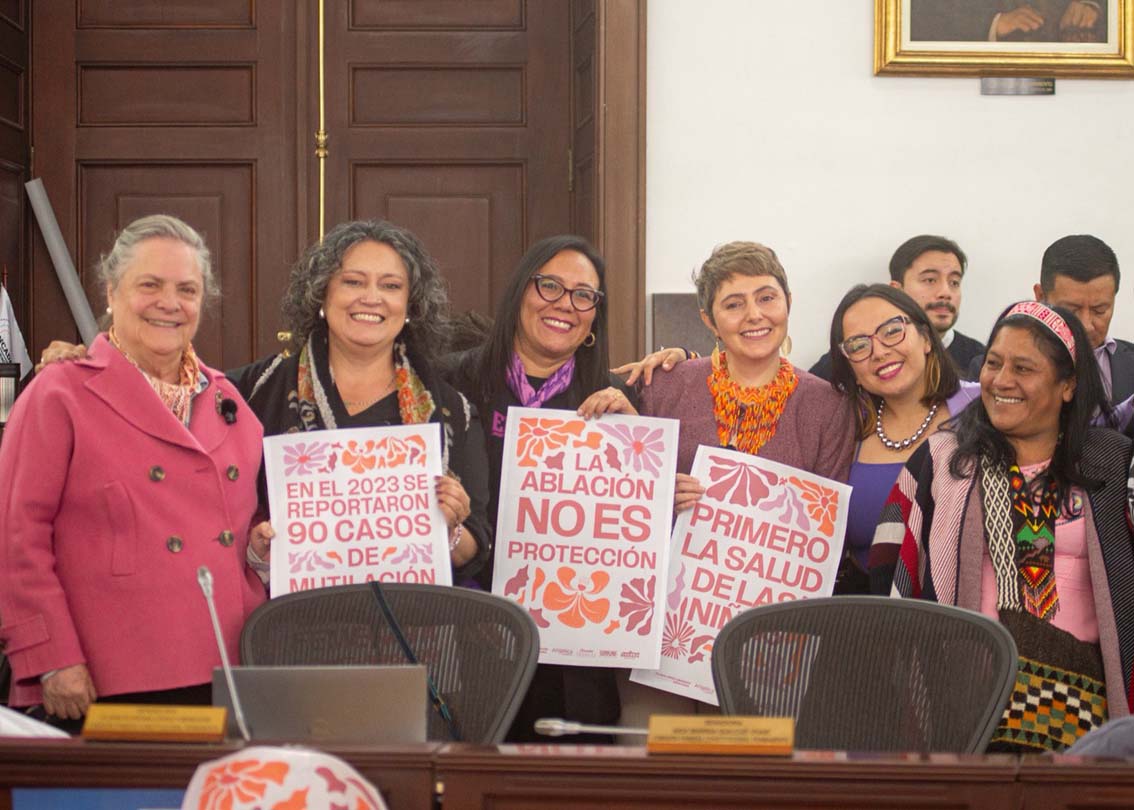
Colombia is on the verge of banning female genital mutilation (FGM), as lawmakers advance legislation that would outlaw a practice still reported in parts of the country, making it the only nation in Latin America where cases have been documented.
In a unanimous decision, the First Commission of the Senate approved the bill in its third debate, leaving just one final vote in the full chamber before it can become law — a significant step in addressing a practice widely condemned as a violation of human rights.
The initiative, known as Bill 440 of 2025 (accumulated with 239 of 2024), seeks not only to prohibit FGM but to eradicate the conditions that allow it to persist, particularly in indigenous communities.
“This is about settling a historic debt with Indigenous women and girls,” Representative Jennifer Pedraza said after the vote. “Eradicating this violent and limiting practice is essential to guaranteeing their health and dignity.”
Globally, more than 230 million girls and women alive today have undergone FGM, according to the World Health Organization. The practice, defined as the partial or total removal of external female genitalia for non-medical reasons, is most often carried out on minors and can lead to severe bleeding, infections, complications in childbirth and long-term psychological trauma.
While FGM is most prevalent in parts of Africa, the Middle East and Asia, Colombia’s case has drawn particular concern due to its singular status in the Americas. Lawmakers noted that the practice disproportionately affects very young girls, often under the age of one, with cases concentrated in the departments of La Guajira, Chocó and Risaralda.
Official data show a gradual decline in reported cases: 91 in 2023, 54 in 2024 and 39 so far in 2025. Authorities caution, however, that underreporting, is pervasive.
The bill marks a strategic shift away from punitive approaches toward prevention, education and intercultural dialogue. Senator Clara López, who led the initiative in the Senate, argued that criminalization alone has failed to eliminate the practice elsewhere.
“In countries where FGM has been banned for decades, prevalence remains high,” López said during the debate, pointing to cases such as Mali and Egypt, where rates have remained above 80% despite legal prohibitions.
The legislation was developed through consultations with Indigenous leaders, including representatives of the Emberá community, where cases have been recorded. Juliana Dominico, a spokesperson for the Emberá, backed the bill while stressing that FGM is not an essential cultural or spiritual practice.
Supporters argue that framing FGM solely as a criminal issue risks driving it underground and alienating communities. Instead, the proposed law emphasizes public health strategies, education campaigns and culturally sensitive engagement to encourage abandonment of the practice.
International bodies have long called for a coordinated response. In 2008, the World Health Assembly adopted Resolution WHA61.16, urging governments to act across sectors including health, education, justice and social services.
Beyond its immediate health risks, FGM is widely recognized as a violation of fundamental rights, including bodily integrity and freedom from cruel or degrading treatment. In some cases, the procedure can be fatal.
The economic burden is also significant. The WHO estimates that treating complications related to FGM costs health systems around $1.4 billion annually, a figure expected to rise without stronger efforts to end the practice.
If approved in its final debate, Colombia’s ban would mark a turning point for the hemisphere, aligning the country with global efforts to eliminate FGM while testing a prevention-focused model that lawmakers hope will succeed where criminalization alone has fallen short.