
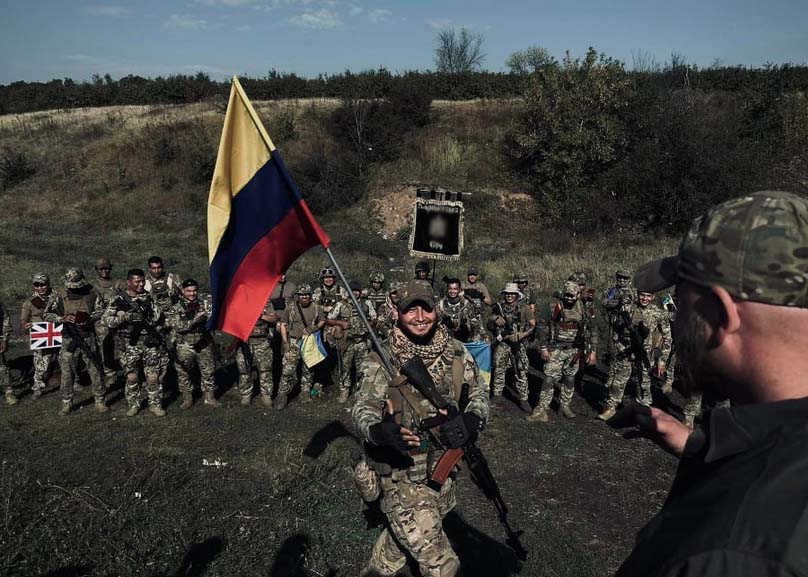
Thousands of miles from Bogotá, in the frozen trench lines of eastern Ukraine, Colombian accents have become a familiar sound of war.
Between 1,000 and 2,000 Colombian nationals are currently serving in the ranks of the Armed Forces of Ukraine, according to recent investigations, while as many as 7,000 have passed through the country’s defence forces since Russia’s full-scale invasion in 2022. Their presence has turned Colombia into the single largest source of foreign fighters in Ukraine’s war effort – and estimated 25% – and an unexpected human bridge between two distant conflicts.
What might once have been dismissed as a story of mercenaries and combat-tested veterans has evolved into something far more complex: a shadowy window into the globalization of military labor.
Many of those arriving in Ukraine have witnessed close-hand Colombia’s internal conflict, which for more than six decades has forged one of Latin America’s most experienced armed orces. Trained in counterinsurgency, reconnaissance and irregular warfare, Colombian fighters bring a skillset that has proven adaptable to the grinding, attritional combat of the Donbas.
Ukrainian commanders have taken notice. In some units, Colombians have made up a majority of infantry personnel, valued for their endurance and battlefield discipline. Their roles range from trench warfare to fortification building and increasingly to drone operations, a defining feature of the war.
Yet their journey to the frontlines is rarely driven by ideology.
A steady stream of Colombian soldiers leaves active service each year, often in their late 30s or early 40s. While formal reintegration programmes exist, many veterans struggle to transition into civilian life. Salaries drop sharply after retirement, and the domestic private security sector is saturated. For some, Ukraine offers an economic lifeline.
Combat pay of between US$3,000 and US$5,000 a month – several times the average Colombian wage – is supplemented by signing bonuses and compensation packages for families in the event of death. The contrast is stark enough to turn war into a viable, if perilous, form of employment.
“Colombians understand the risks … yet they still come,” one Ukrainian officer involved in recruitment told local media.
The legal and political framing of these fighters remains contested. In December 2025, the Colombian Congress ratified the United Nations convention against mercenaries, a move backed by the leftist government of President Gustavo Petro.
Under the Convention’s definition, however, most Colombians serving in Ukraine are not considered mercenaries. They are formally integrated into Ukraine’s military structures, receive equal pay to local troops and operate under state command rather than private contracts.
Even so, President Petro has cast the phenomenon as a form of exploitation, warning of the risks faced by citizens drawn into distant war, including the conflict in south Sudan.
Those causes are visible not only in Colombia’s labor market but also in Ukraine’s evolving military structure. As the war has dragged on, Kyiv has reorganized its foreign units, integrating international volunteers into larger brigades to improve coordination and access to heavy weaponry. The shift has further embedded foreign fighters – Colombians among them – into the core of Ukraine’s defensive operations.
The human cost of this integration has been steep. Estimates from the Atlantic Council claim that between 300 and 550 Colombians have been killed in Ukraine since 2022, making them the foreign nationality with the highest number of combat deaths. In Kyiv, Colombian flags now appear among the growing patchwork of memorials to fallen soldiers – a quiet testament to the war’s global reach.
Despite the losses, recruitment has continued. Military analysts say the phenomenon reflects deeper structural failures. Colombia’s decades-long conflict produced a large pool of highly trained personnel, but the transition to civilian life has lagged behind. Skills honed in war have limited application in the formal economy, leaving many veterans in a precarious position.
This dynamic has fed what some researchers describe as a transnational market for military labor, operating in the grey zones of international law. Fighters move between conflicts not necessarily out of allegiance, but out of necessity – carrying their expertise with them.
The implications extend beyond Ukraine. Security analysts warn that the eventual return of battle-hardened veterans, particularly those trained in emerging technologies such as drone warfare, could pose risks if criminal organizations seek to absorb their skills.
For now, however, the flow continues in one direction.
On a recent winter evening in Kyiv, a Colombian veteran reflected on the reality behind the headlines. “Tell Colombians not to come,” he said quietly. “More die than return.”
It is a warning that captures the paradox at the heart of this story: a war that is both distant and deeply connected, drawing in those for whom the frontlines are not just a cause, but a last resort.
In that sense, the presence of Colombians in Ukraine is not an anomaly. It is a signal – of how modern conflicts intersect, and of how the consequences of one war can echo, years later, in another.