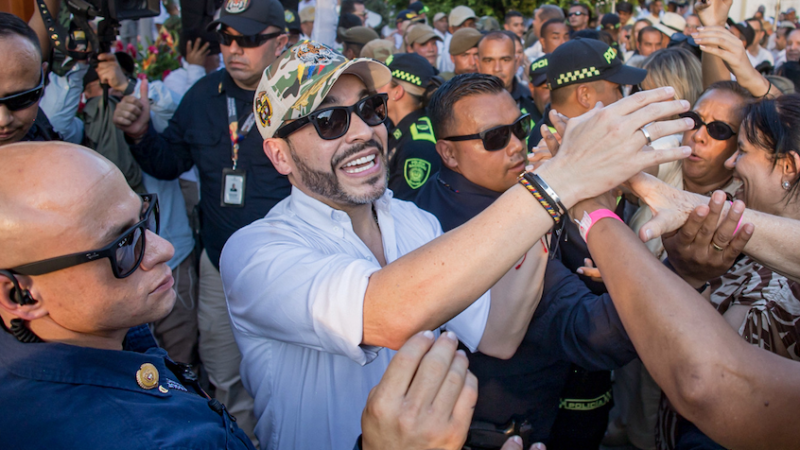

In a lengthy post on Truth Social, U.S. President Donald Trump threw his support behind Colombian presidential candidate Abelardo “El Tigre” de la Espriella, describing him as a “Smart, Strong, and Tough Leader” and offering what he called his “Complete and Total Endorsement” ahead of Colombia’s June 21 presidential runoff.
Trump praised De la Espriella’s first-round victory and portrayed him as a future champion of economic growth, law and order, and closer ties with the United States.
“The results of this Election are very important to the future of Colombia and its relationship to the United States,” Trump wrote.
The endorsement was notable not only for its enthusiasm but also for its language. Trump attacked De la Espriella’s opponent, left-wing senator Iván Cepeda, as a “Radical Left Marxist” and suggested the runoff could shape the future direction of one of Washington’s closest allies in Latin America.
Then came the response.
Addressing Trump directly, De la Espriella published a lengthy open letter that read less like a campaign statement and more like a declaration of intent.
“With my head held high and a heart full of patriotic gratitude, I receive your words and your steadfast support,” he wrote.
“Thank you, Mr. President.”
The candidate praised Trump as “a leader of true strength and conviction” who had refused to surrender to ideological trends or enemies of freedom.
More importantly, he suggested that Colombia was now following a path similar to that taken by Trump’s political movement in the United States.
“You have paved the way for the people to defeat the entrenched powers that have long held sway,” De la Espriella wrote. “In Colombia, we have now begun to follow that same path.”
It was one of the clearest attempts yet by the conservative candidate to place his campaign within a broader political realignment taking shape across the Americas.
The letter repeatedly returned to the idea of a common destiny shared by Colombia and the United States.
“The United States and Colombia are sister nations, bound by the blood of heroes and by our shared destiny to defend Western civilization across the Americas,” he wrote.
“Together, we are unbreakable.”
For De la Espriella, the relationship extends beyond diplomacy. It is rooted in what he described as shared values, mutual respect and a common struggle against forces that threaten both nations.
The candidate outlined a vision of closer cooperation on security, trade and economic development while emphasizing that both countries face similar challenges from organized crime and drug trafficking.
“Our security policies are fully aligned,” he wrote.
“Narcoterrorism is the cancer destroying our societies, and we will confront it relentlessly, with iron resolve and without apology.”
The statement echoed themes that have defined much of De la Espriella’s campaign: security, economic growth, private enterprise and a promise to reverse what he views as the failures of the Petro administration.
“We stand together in the sacred defense of private property, free enterprise, productive growth, and the well-being of our citizens as the highest purpose of government,” he wrote.
The candidate also pledged resistance to what he called the advance of communism in the hemisphere and announced support for an “Alliance of the Shield of the Americas,” a regional initiative intended to strengthen cooperation among governments committed to security, democracy and economic freedom.
The exchange unfolded as another senior figure in the Trump administration weighed in on Colombia’s election. U.S. Secretary of State Marco Rubio said Washington would closely monitor the electoral process. “We will be very firm in guaranteeing free and fair elections in Colombia and will do everything within our power to achieve that,” he said.
The comments were interpreted by many as a sign of growing U.S. interest in the outcome of the June 21 runoff.
President Gustavo Petro responded without mentioning Trump directly.
“When one country intervenes in the decisions of another country, freedom dies,” he wrote on social media, before posting videos of anti-riot police on the streets of Santiago, Chile, accompanied by the text: “They chose (President) Kazt and once again the violent war against youth in Chile.” Petro’s incoherence is palpable.
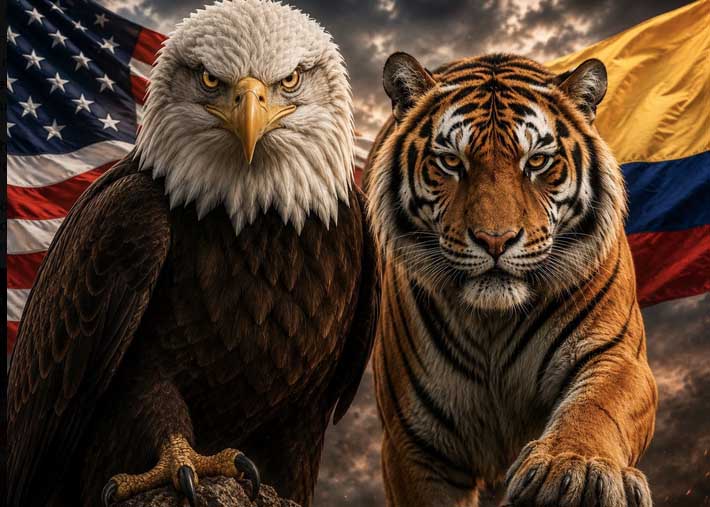
Yet it was the final image accompanying De la Espriella’s letter that perhaps captures the moment more effectively than any political statement.
Created using artificial intelligence, the illustration shows a bald eagle next to a fearless tiger. Behind them, the flags of the United States and Colombia under a turbulent sky.
The symbolism requires little explanation.
The eagle represents the United States. The tiger represents the firebrand “outsider”.
And together they illustrate the central message of De la Espriella’s response: that if voters elect him on June 21, relations between Bogotá and Washington will enter a new chapter.
“In this coming Era of the Tiger – which begins on June 21 – we look forward to the full normalization of relations between Colombia and the United States, built on mutual respect, sovereignty, and mutual benefit.”
Whether Colombians embrace that vision remains to be seen.
But for one extraordinary day in the campaign, the conversation was no longer only about Colombia’s future. It was about two flags, an eagle, a tiger and a political alliance that both supporters and critics believe could reshape relations across the hemisphere.