
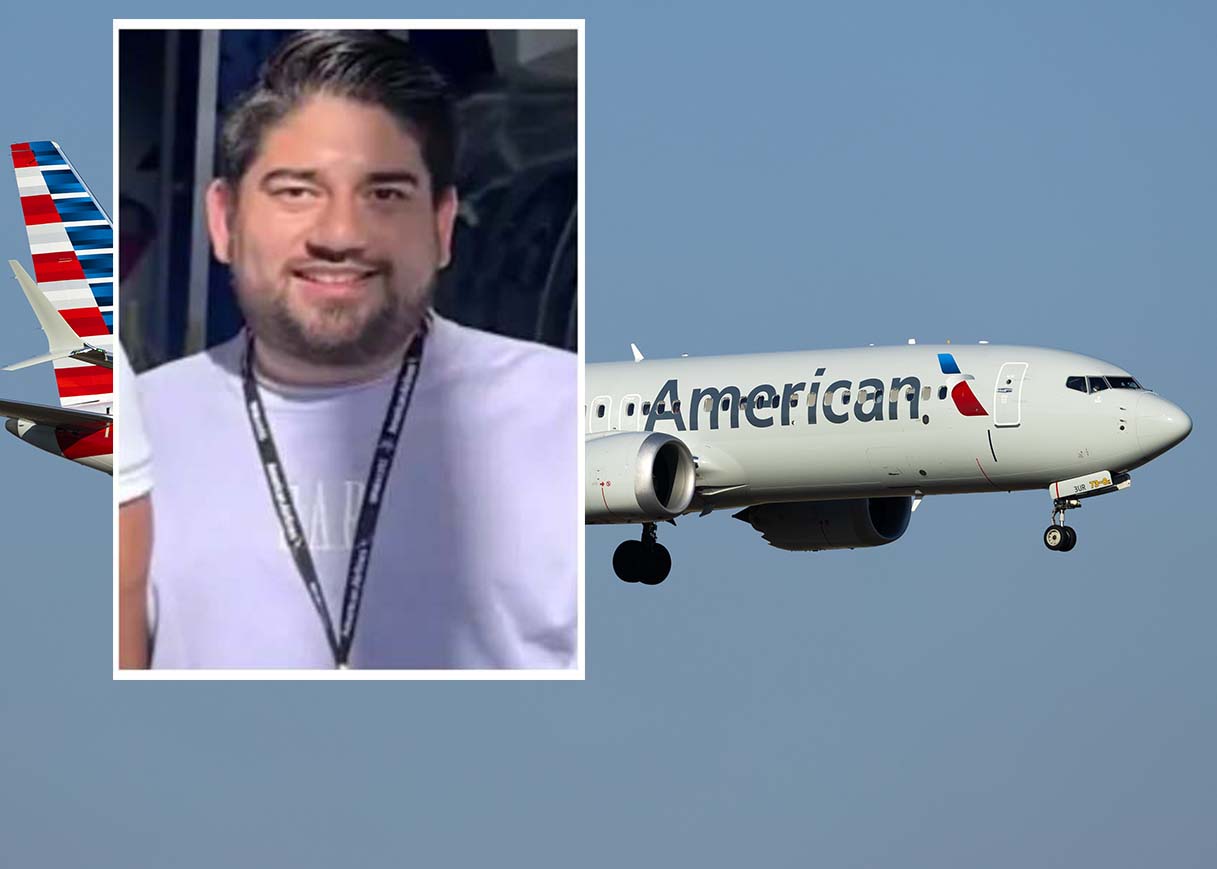
The disappearance of a U.S. flight attendant during a brief layover in Medellín has sparked an urgent search involving Colombian authorities, airline officials and U.S. representatives, as questions mount over his final hours in the city.
Eric Fernando Gutierrez Molina, 32, an American Airlines crew member based in Dallas-Fort Worth, arrived in Colombia’s second-largest city late on Saturday as part of a routine flight rotation. He and fellow crew members were scheduled to remain overnight before returning to the United States on a flight to Miami early Sunday.
But Molina never made it back to the airport.
According to local broadcaster Telemedellín, Molina left his hotel Saturday night with a colleague and went to a nightclub in the city. There, they reportedly met two men and later decided to continue the evening elsewhere after the venue closed.
Hours later, Molina’s colleague was found disoriented by authorities and taken to a medical center. The circumstances surrounding what happened next remain unclear.
The last confirmed sighting of Molina occurred in the early hours of Sunday in Medellín’s La América neighborhood, a largely residential area not typically frequented by foreign visitors. Investigators say the timeline of events following that sighting is fragmented and under review.
A final digital trace from Molina came in the form of a message sent around 5:00 a.m. on Sunday, sharing his location at an Airbnb property in El Poblado, a district known for its nightlife and popular among tourists. The location is roughly 20 kilometers from José María Córdova International Airport, where Molina had been expected to report for duty just hours later.
After that message, no further communication was recorded.
Friends and coworkers have since filed missing persons reports in both Medellín and Dallas, while Colombian authorities have activated an urgent search protocol. Officials have not ruled out any lines of investigation, including robbery, intoxication or other forms of assault.
Family members told local media that Molina had intended to use his layover to briefly explore Medellín’s nightlife, a common practice among airline crews on tight schedules. However, those who accompanied him that night have reportedly been unable to provide clear details about his last known movements.
One unconfirmed account suggests that while at the nightclub, Molina and his group were approached by a man who claimed to know the city well and offered to take them to other venues. Authorities have not substantiated this version of events and caution that it remains one of several hypotheses under consideration.
The case has drawn international attention, with American Airlines confirming it is working closely with Colombian law enforcement.
“We are actively engaged with local law enforcement officials in their investigation and doing all we can to support our team member’s family during this time,” the airline said in a statement to U.S. media.
The Association of Professional Flight Attendants also said it is supporting efforts to locate Molina, describing the situation as deeply concerning for colleagues across the airline industry.
U.S. diplomatic officials in Colombia have been notified of the disappearance, though details of their involvement have not been made public.
The incident also highlights ongoing safety concerns tied to nightlife in Medellín. Authorities have repeatedly warned of cases in which foreign visitors are targeted in bars or nightclubs, sometimes through the use of drugs such as scopolamine — locally known as “burundanga” — which can leave victims disoriented, unconscious or vulnerable to theft.
While officials have not linked Molina’s disappearance to such substances, the fact that his colleague was found disoriented has added to concerns among investigators and the public.
Local data shows that Medellín has reported 124 missing persons cases so far this year. Of those, 104 individuals were later found alive, two were found dead, and 18 remain unaccounted for.
Officials have not indicated whether Molina’s case is linked to any broader pattern.
As the search continues, investigators are working to reconstruct Molina’s final movements through surveillance footage, phone data and witness testimony. For now, significant gaps remain in the timeline, complicating efforts to determine what happened after he left the nightclub.
Nearly a week after his disappearance, Molina’s whereabouts remain unknown, leaving family, friends and colleagues awaiting answers in a case that has quickly evolved from a routine layover into an international missing persons investigation.
EDITOR’S UPDATE:
On Friday, March 27, authorities confirmed the discovery of the body of American Airlines flight attendant and U.S. citizen Éric Fernando Gutiérrez Molina in a rural area of Puente Iglesias, between the municipalities of Fredonia and Jericó.
Gutiérrez Molina had been reported missing since Saturday, March 21, after he was last seen leaving a nightclub in Itagüí, south of the Aburrá Valley. For days, family members and officials held out hope he would be found alive. However, after nearly a week of intensive search efforts, those hopes were dashed.
His body was located roughly 100 kilometers from the last place he was seen, raising serious questions about the circumstances surrounding his disappearance and death.
Authorities are pursuing multiple lines of investigation. One of the leading hypotheses is that Gutiérrez Molina may have been drugged with scopolamine – commonly used by criminal networks in Colombia to incapacitate victims – before being robbed. Investigators believe he may then have been transported to the remote area of Puente Iglesias, either while still alive but disoriented, or after his death, in an apparent attempt to mislead authorities and hinder search efforts.