

A border issue between Colombia and Peru has erupted into a full-blown diplomatic row after Colombian President Gustavo Petro accused Peru of violating the 1934 Rio de Janeiro Protocol by unilaterally occupying an island in the Amazon River within the tri-border region with Brazil.
In a post on social media, Petro claimed that the government of Peru had “unlawfully expanded its jurisdiction” to include the island of Santa Rosa, adjacent to Leticia, capital of Amazonas and the country’s southernmost city. Petro argues that the creation of a new administrative district – Santa Rosa de Loreto – on what he claims is Colombian territory violated international treaties and could threaten the commercial viability of Leticia as a key commercial port.
“The commemoration of the Battle of Boyacá (August 7) has been relocated to Leticia, not because of road blockades but because once again, the Peruvian government has occupied territory that belongs to Colombia,” Petro affirmed on his X account. “The Rio Protocol established that the border lies along the deepest part of the Amazon River. The government of Peru has appropriated islands that emerged north of this line and declared them part of its territory.”
Petro warned that such actions could “make Leticia disappear as an Amazonian port,” and said Colombia would “first and foremost, use diplomatic measures to defend its sovereignty.”
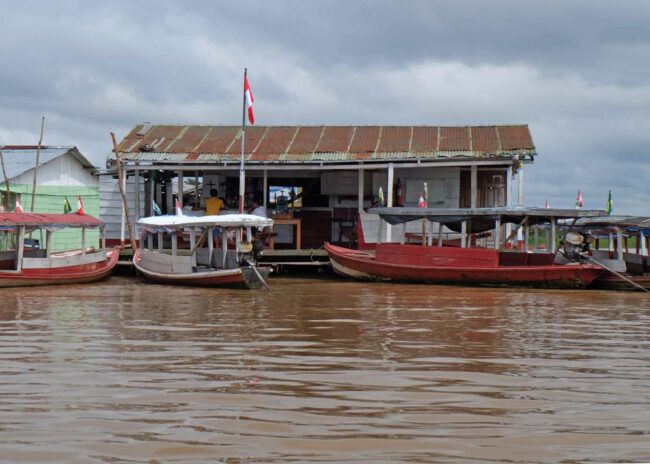
The island in question, referred to as ‘Chinería’ by Peru, lies in the middle of the Amazon River, between the Peruvian town of Santa Rosa and the Colombian city of Leticia. Both towns, along with Brazil’s Tabatinga, form a unique open border zone where Indigenous and riverine communities have traditionally moved and traded freely.
“The Ministry of Foreign Affairs of Peru expresses its most firm and energetic protest over the statements made by the President of Colombia,” read the communiqué. “The island of Chinería, where the district of Santa Rosa de Loreto is located, has been under the sovereignty and jurisdiction of Peru for more than a century, in full accordance with the 1922 Boundary and Fluvial Navigation Treaty between Peru and Colombia.”
Peru’s Foreign Ministry emphasized that the island was assigned to Peru in 1929 by a joint boundary demarcation commission and lies west of the officially recognized international border. The Peruvian government reaffirmed that the Colombian position had been acknowledged “on several occasions” and expressed concern that Petro’s declarations were based on a misunderstanding of the region’s legal and geographic reality.
Foreign Minister Elmer Schialer added that “not a single millimeter of Colombian territory has been touched” and criticized the leftist leader for raising the matter on social media rather than through diplomatic channels. “Santa Rosa is Peruvian and always has been. Peru has never sought to threaten Leticia,” said Schialer in an interview with Lima’s El Comercio newspaper.
According to local sources, Colombia’s Cancillería had issued two formal diplomatic protests in June and July, requesting the reactivation of the Comisión Mixta Permanente de Inspección de la Frontera Colombo-Peruana (COMPERIF), a binational body created to address disputes along the shared border. Colombia argues that any islands that formed in the river after 1929 must undergo a formal assignment process agreed upon by both nations. According to Colombia’s Foreign Ministry, the recent Peruvian law establishing the Santa Rosa de Loreto district, passed in 2025, violated this principle.
Peru rejected the letters of protest, reiterating its claim that the largely uninhabited island lies within its internationally recognized borders.
The dispute has ignited fierce debate in both countries. Peruvian former Foreign Minister Javier González-Olaechea criticized Petro’s remarks as a misinterpretation of treaty law and geography. “An island belongs to the state whose riverbank is closest. The riverbank is Peruvian. Even a geography student can measure that,” he said. He also added that Petro’s statements were politically motivated and potentially aimed at distracting from domestic controversies back home, including allegations of illegal campaign financing.
Other analysts warn that the use of social media to announce foreign policy stances could further escalate tensions in a region that depends on close cooperation for security, environmental management, and Indigenous rights.
“This is irresponsible,” said Peruvian international affairs expert Francisco Belaunde. “Relations with neighboring countries should not be handled through hysterical tweets. This needs to be resolved diplomatically.”
On Tuesday, Colombia’s Foreign Ministry clarified its position, stating that the island of Santa Rosa is a “formation that emerged after 1929 and therefore must undergo a process of assignment by mutual agreement,” reaffirming Colombia’s intent to resolve the matter through diplomatic channels.
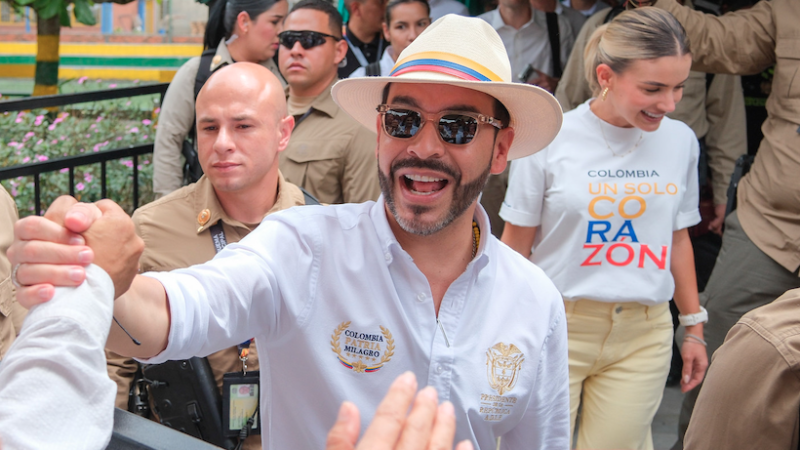
While the dispute has not resulted in any interruption of river traffic or the free movement of citizens from Colombia, Brazil, and Peru (within a 200 km radius), Petro’s visit to Leticia on Thursday could exacerbate tensions with his Peruvian counterpart, Dina Boluarte.
The region, often referred to as “Tres Fronteras,” is home to diverse populations and plays a critical role in Amazonian integration and conservation. While criticism of Petro’s comments from Peruvian officials has been largely unanimous, representatives from Colombian opposition parties have also denounced the belligerent narrative emanating from Casa de Nariño.
Former ex-Justice Minister, Wilson Ruíz Orejuela, posted his version of the meltdown: “Colombia already had a diplomatic conflict with Peru due to Petro’s obsession with defending Pedro Castillo. Now, Interior Minister Armando Benedetti is once again straining the relationship by mentioning Santa Rosa Island as if we were ready for war. While they provoke brotherly countries, they hand over the Catatumbo to Maduro’s communist regime. Talk about sovereignty, they are the first to trample on it.”
For former Vice-President Francisco Santos, the border conflict “aims to divert attention and create new points of tension. Petro needs chaos to stay in power.”
While Benedetti has warned that “things could get ugly” with Peru, how both countries navigate this dispute after August 7, will determine if cooperation or unhinged populism will define the next chapter of an endangered and geopolitically sensitive territory.